

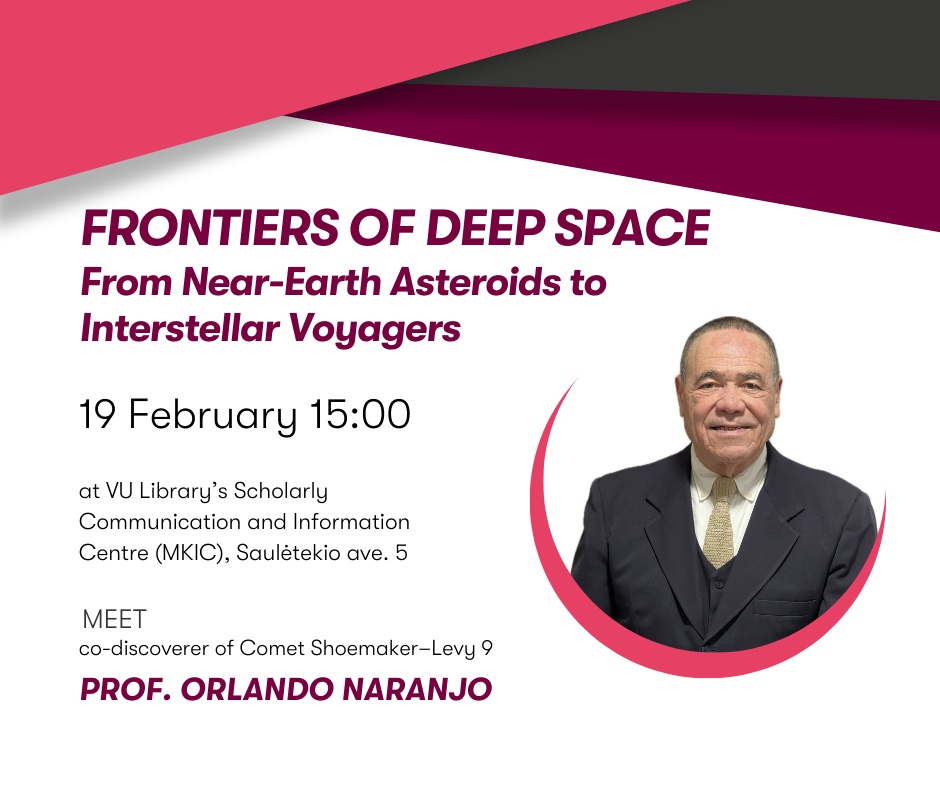
On February 19 at 15:00 at VU Library’s Scholarly Communication and Information Centre (MKIC), Saulėtekio ave. 5, Orlando Naranjo, a distinguished astronomer, will give a public lecture "Frontiers of Deep Space: From Near-Earth Asteroids to Interstellar Voyagers".
Abstract
We live in a cosmic shooting gallery, surrounded by ancient travelers that hold the secrets of our origins. In this talk, we journey from our planetary neighborhood to the reaches of interstellar space, tracking the asteroids and comets that cross our path. From the potential impact risks of Apophis and 2024 YR4 to the record-breaking scale of the giant comet Bernardinelli-Bernstein, we will explore how these "minor planets" redefine our understanding of the Solar System.
Drawing from his personal experience as a co-discoverer of Comet Shoemaker-Levy 9 and a pioneer of stellar occultations at the Llano del Hato Observatory, the speaker will share how we detect these elusive "dark comets" and interstellar visitors like Oumuamua. Join us for an exploration of the frontiers where science meets mystery, and discover how every new signal from the deep space helps us map our place in the vast cosmos.
About the speaker
Orlando Naranjo is a distinguished astronomer and a pioneer in the study of small bodies within our Solar System. He is best known for his independent discovery of Comet Shoemaker-Levy 9, a feat for which he is officially recognized as a co-discoverer by the International Astronomical Union (IAU). His work was instrumental in documenting one of the most significant astronomical events in modern history—the 1994 collision of the comet with Jupiter.
His research spans from tracking Near-Earth Asteroids (NEAs) to analyzing the physical properties of rare interstellar visitors and dark comets. Beyond his technical contributions, Orlando is a passionate science communicator dedicated to inspiring the next generation of students and space enthusiasts to look up and explore the mysteries of the cosmos.
The visit is promoted by ACEBaltic with the support of the Ramón Areces Foundation. Partners of the event: Embassy of Spain in Lithuania, International Astronomical Union (IAU), European Association for Astronomy Education (EAAE).