

Femtosecond laser systems with high average power and high pulse repetition rate are increasingly used in various fields of science and industry: material micromachining, biomedical imaging, spectroscopy and studies of ultrafast phenomena where high measurement speed and good signal-to-noise ratio are required. Such laser systems, with very high average power (over 100 watts), may also have potential applications in the defence sector.
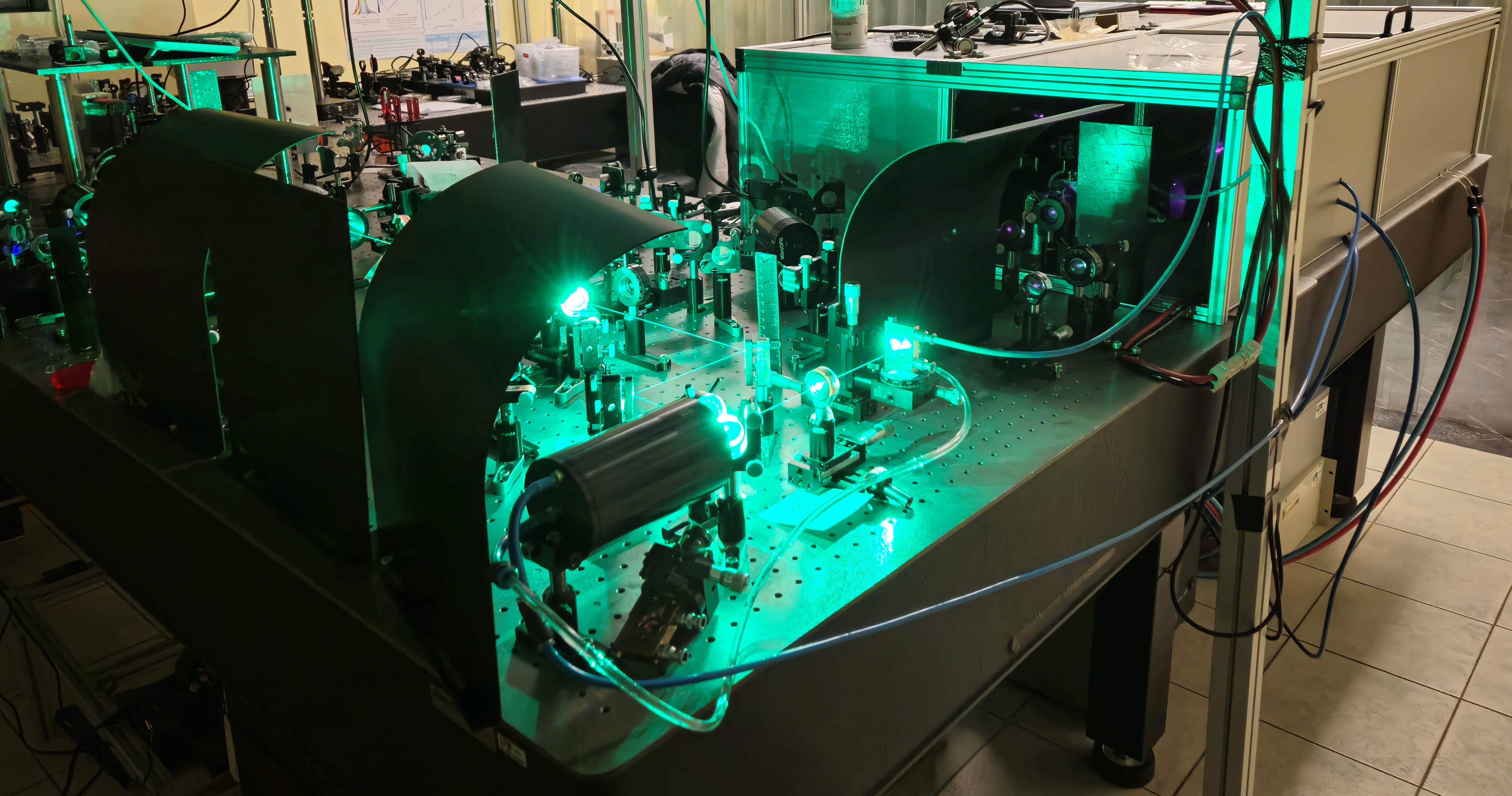
Scientists from the Laser Research Center at Vilnius University Faculty of Physics, begin a three-year (2025–2028) research project, funded by the U.S. Air Force Office of Scientific Research European Office of Aerospace Research and Development (AFOSR EOARD). The aim of the project “Towards very high average power and high repetition rate tunable femtosecond laser systems” is to develop a novel, very high power laser system capable of generating femtosecond pulses with an average power of more than 200 W at a repetition rate of 76 MHz.
Another important task of this project is the development of wavelength-tunable over a broad spectral range optical parametric amplifier by employing the developed high repetition rate and high average power femtosecond laser system. “By successfully implementing this goal, we will have a femtosecond laser source whose output wavelength can be tuned over a broad spectral range, from the visible to the mid-infrared, while maintaining high pulse repetition rate and achieving a significantly higher average power than that of currently existing femtosecond laser sources. This will further expand the application possibilities of such a laser system,” says the project principal investigator, assoc. prof. dr. Julius Vengelis.
The project will be carried out by the researcher team at the Laser Research Center: together with the principal investigator, junior researcher dr. Vaida Marčiulionytė and PhD students Jonas Banys and Simona Armalytė will work on the project. The research results are expected to contribute to the development of laser technologies that in the future may become important for defence needs.
This material is based upon work supported by the Air Force Office of Scientific Research under award number FA8655-25-1-7020. Any opinions, findings, and conclusions or recommendations expressed in this material are those of the author(s) and do not necessarily reflect the views of the United States Air Force.