

An event dedicated to the European Space Agency’s Gaia space telescope mission will take place at 11:00 on 28 November in the Research Council of Lithuania, Great Hall, Gedimino Avenue 3, Vilnius.
From 27 July 2014 to 15 January 2025, Gaia has made more than three trillion observations of two billion stars and other objects throughout our Milky Way galaxy and beyond, mapping their motions, luminosity, temperature and composition. Gaia's extraordinarily precise three-dimensional map will provide the data needed to tackle an enormous range of important questions related to the origin, structure and evolutionary history of our galaxy.
Ana Ulla, Professor at the University of Vigo and Member of the Gaia Data Processing and Analysis Consortium (DPAC) Consortium Team, will give a public lecture "GAIA: A Wealth of Galactic Achievements". She will speak about the European Space Agency’s Gaia mission – the most precise and comprehensive astrometric study of space ever undertaken.

Professor Ana Ulla
Prof. Dr Ana Ulla holds a degree in Physical Sciences, specializing in Astrophysics. Her research lines include late stages of stellar evolution, exoplanets, astrobiology, and cultural astronomy, among others. She is a researcher in the GEOMA group at the Marine Research Center (CIM), and also collaborates with the Galician Group for the Gaia satellite (GGG) of ESA, preparing satellite data archives and supporting their scientific exploitation.
Abstract
The ESA Gaia mission, launched in 2013 and operated until its passivation in 2025, has produced the most precise and extensive astrometric survey to date, delivering positions, parallaxes, proper motions, multi-band photometry and spectroscopy for almost two thousand million Galactic and extragalactic sources. With parallax precisions reaching a few tens of microarcseconds for bright stars and homogeneous BP/RP and RVS spectroscopic data, Gaia has transformed studies of stellar evolution, Galactic structure, star clusters, binary populations and the cosmic distance scale. Previous public data releases culminated in DR3 (2022), which provided enhanced astrophysical parameters, variability characterisation and large spectroscopic samples. The forthcoming DR4 (expected for 2026) and final all-mission DR5 (~2030) will refine astrometric accuracy, extend epoch photometry and spectroscopy, and deliver the definitive Gaia catalogue. Together, these releases ensure Gaia’s long-term legacy as a cornerstone dataset for modern astrophysics, Galactic archaeology and cosmology.
Event programme
11:00-11:20
Gintaras Valinčius, Chairman of the Research Council of Lithuania,
Fernando Fernández-Aguayo Muñoz, Ambassador of Spain to Lithuania,
Gražina Tautvaišienė, Vice-President of the International Astronomical Union,
Minia Manteiga, President of the Spanish Astronomical Society (SEA) and member of the Gaia DPAC consortium.
11:20-12:00
Ana Ulla Miguel, Professor of Astrophysics at the University of Vigo and member of the Gaia DPAC consortium team.
12:00-13:00
Opening of the exhibition "A Billion Eyes for a Billion Stars", dedicated to the European Space Agency’s Gaia space observatory.
The exhibition will be open to visitors until 19 December.
Event partners: Faculty of Physics, Vilnius University; Embassy of Spain in Lithuania; International Astronomical Union (IAU); European Association for Astronomy Education (EAAE); Research Council of Lithuania.
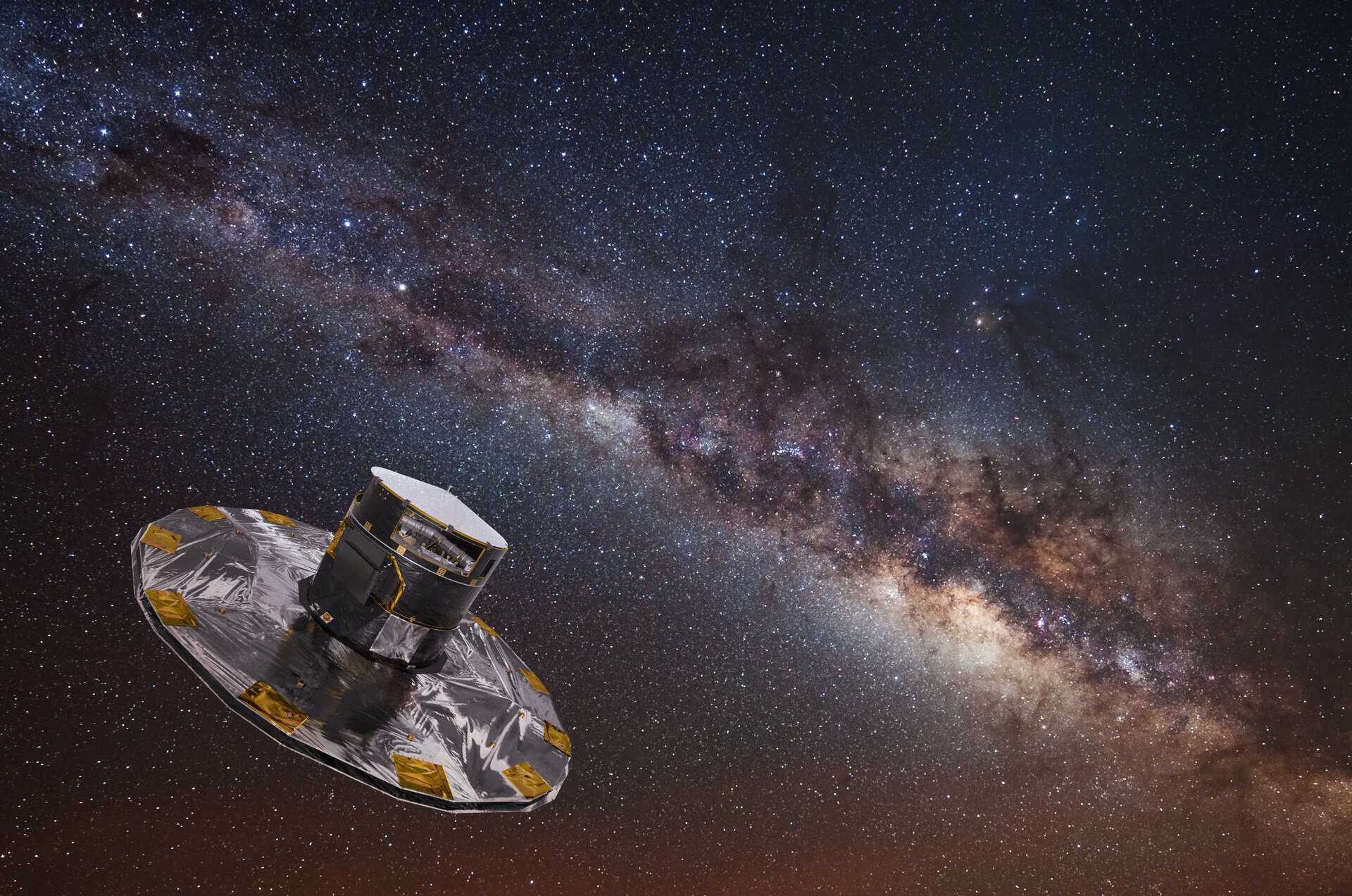
GAIA: ESA/ATG medialab; ESO/S. Brunier.