

Scientists from the Laser Research Center at Vilnius University (VU) Faculty of Physics, together with colleagues from the University of Geneva, have conducted a study that may pave the way for the development of new materials. The results, published in the journal “Physical Chemistry Chemical Physics”, reveal how the light affects special compounds called photoinitiators, that trigger formation of polymers and usually governs the final quality of 3D structure.
The scientists have investigated materials known as photoinitiators, which are usually mixed with prepolymers. When this liquid is exposed to ultraviolet light, a chemical reaction rapidly transforms the mixture into a solid. Such materials are widely used, for example, in 3D printing. A closely related area is 3D nanolithography, which utilises tightly focused laser beams to achieve extremely high light intensities. “Under these conditions, multiphoton absorption occurs, initiating photopolymerisation confined in the vicinity of the laser focus. This nonlinear process enables the creation of remarkably small, intricate, and highly precise 3D nanostructures with dimensions reaching several hundred micrometres,” explained Marius Navickas, PhD student at the Faculty of Physics.
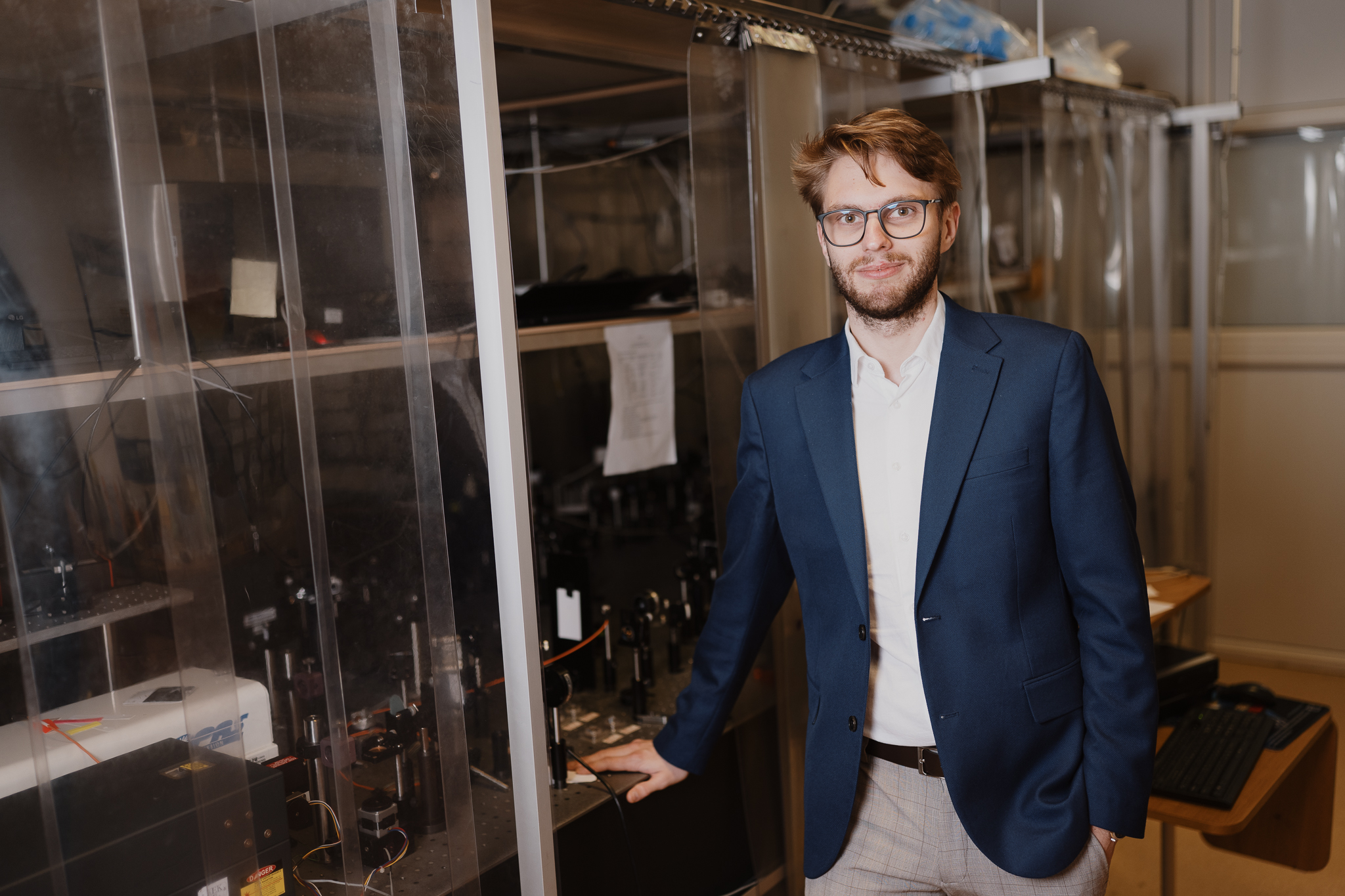
Marius Navickas
Using laser spectroscopy and femtosecond lasers, the researchers have observed fast and slow processes. “We monitored the evolution of the excited state and the changes occurring during it over a very broad time window—from hundreds of femtoseconds to hundreds of microseconds— which allowed us to gain a complete picture of the photophysics taking place in these materials and even consider what could be improved in this type of compounds in the future,” said M. Navickas.
New findings on the photophysics of phosphine oxide photoinitiators, used to initiate and control radical polymerisation, explain details of processes that were previously barely understood. This opens avenues to synthesise new, more efficient photoinitiators that could improve the effectiveness of photopolymerisation in the future. Such advances would enable an extreme downscaling of nanostructure dimensions.
The authors of the study are researchers: M. Navickas, E. Skliutas, Prof. M. Malinauskas, Prof. M. Vengris (Laser Research Center at VU Faculty of Physics) and J. Kölbel, Dr. R. J. Fernández-Terán (University of Geneva, Switzerland).