

On 5 December, Jonas Banys successfully defended his PhD thesis titled "Investigation of Optical Parametric Light Sources Pumped by the Subnanosecond Microlaser Pulses". Supervisor - Assoc. Prof. Dr Vygandas Jarutis.
These advances bring microlaser‑based parametric sources closer to commercial use, broaden their applications, and provide powerful tools for researchers across various disciplines. It also highlights Lithuania’s growing role as a regional leader in cutting‑edge laser technologies.
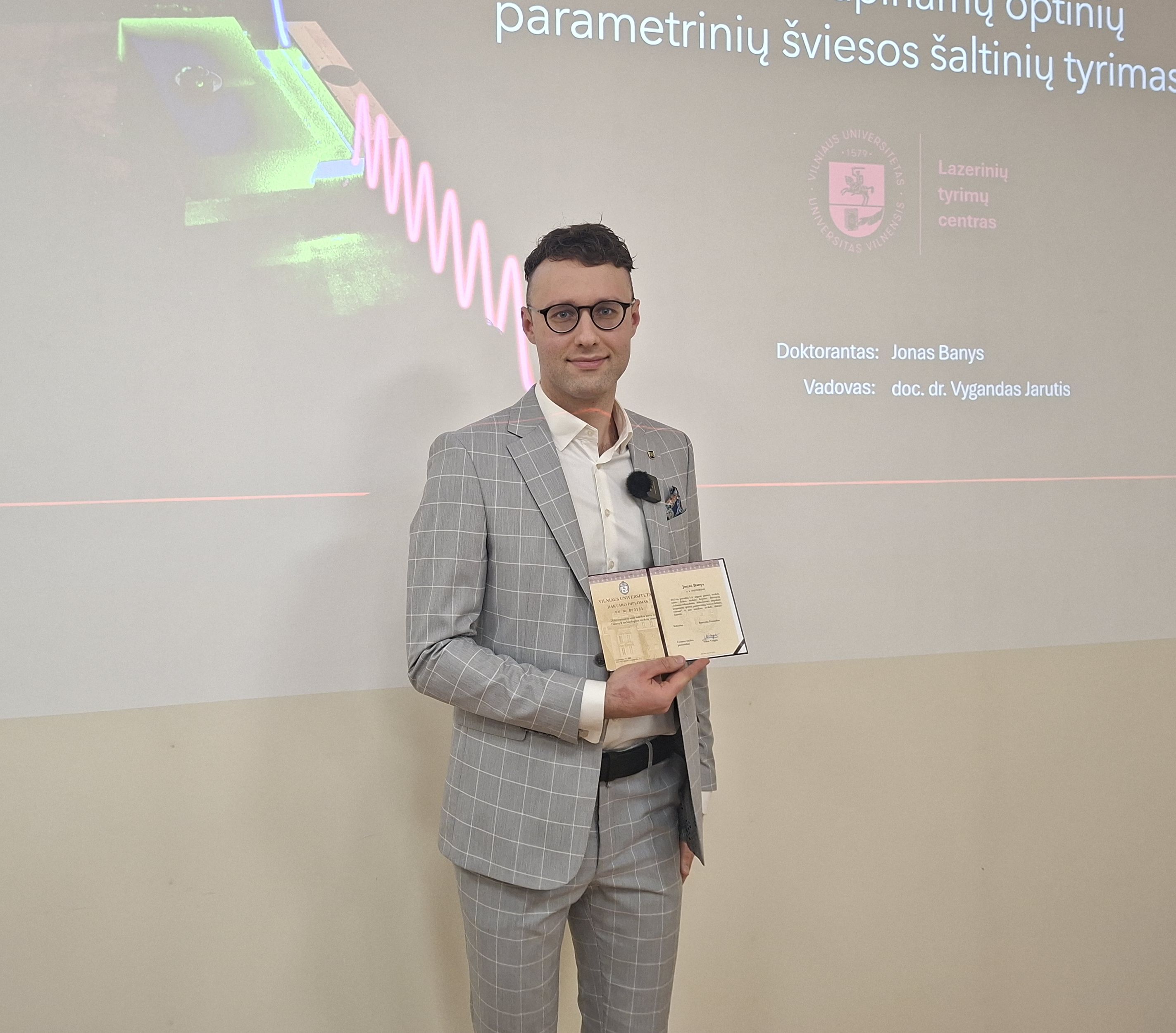 Wishing Dr Jonas a future rich with discoveries, meaningful partnerships, and continued excellence.
Optical parametric generation converts laser light into new wavelengths through the nonlinear interaction of intense laser pulses in specially engineered crystals. This thesis explores such phenomena in the sub-nanosecond pulse regime, developing and studying compact, wavelength-tunable parametric light sources pumped by modern Q-switched Nd:YAG microlasers. The research focuses on co- and counter-propagating three-wave interactions in periodically poled crystals. Developed optical parametric generators (OPGs) based on multigrating and fan-out MgO:PPLN crystals achieved wavelength tuning from 1.4 to 4.4 µm with up to 45% conversion efficiency, while also revealing device limitations imposed by optical damage and non-collinear interactions. Seeding these parametric systems with a narrowband diode laser and a fiber-generated supercontinuum significantly enhanced the output's energy, spectral, and stability characteristics. A green-pumped MgO:PPLN OPG revealed the complex interplay between parametric gain and nonlinear absorption, while off-axis pumping exploited the grating edge effect to tailor the OPG output properties. This OPG was used to seed a parametric amplifier, generating visible-tunable pulses. The first microlaser-pumped backward-wave optical parametric oscillators (BWOPOs) were demonstrated, generating counter-propagating signal and idler waves that delivered tunable sub-nanosecond pulses with pm-level bandwidth, high beam quality, and 50% conversion efficiency. Finally, parametric light generation was employed as a diagnostic tool to assess the homogeneity and thermal stability of the QPM crystals, offering valuable feedback for optimizing ferroelectric domain-engineered nonlinear media.