

An asteroid has been named after Prof. García Alabiano, the second Rector of Vilnius University (VU). The asteroid was discovered by Dr Kazimieras Černis, a researcher at the Institute of Theoretical Physics and Astronomy of the VU Faculty of Physics, and Rev. Dr Richard P. Boyle, S.J., from the Vatican Observatory in Arizona.
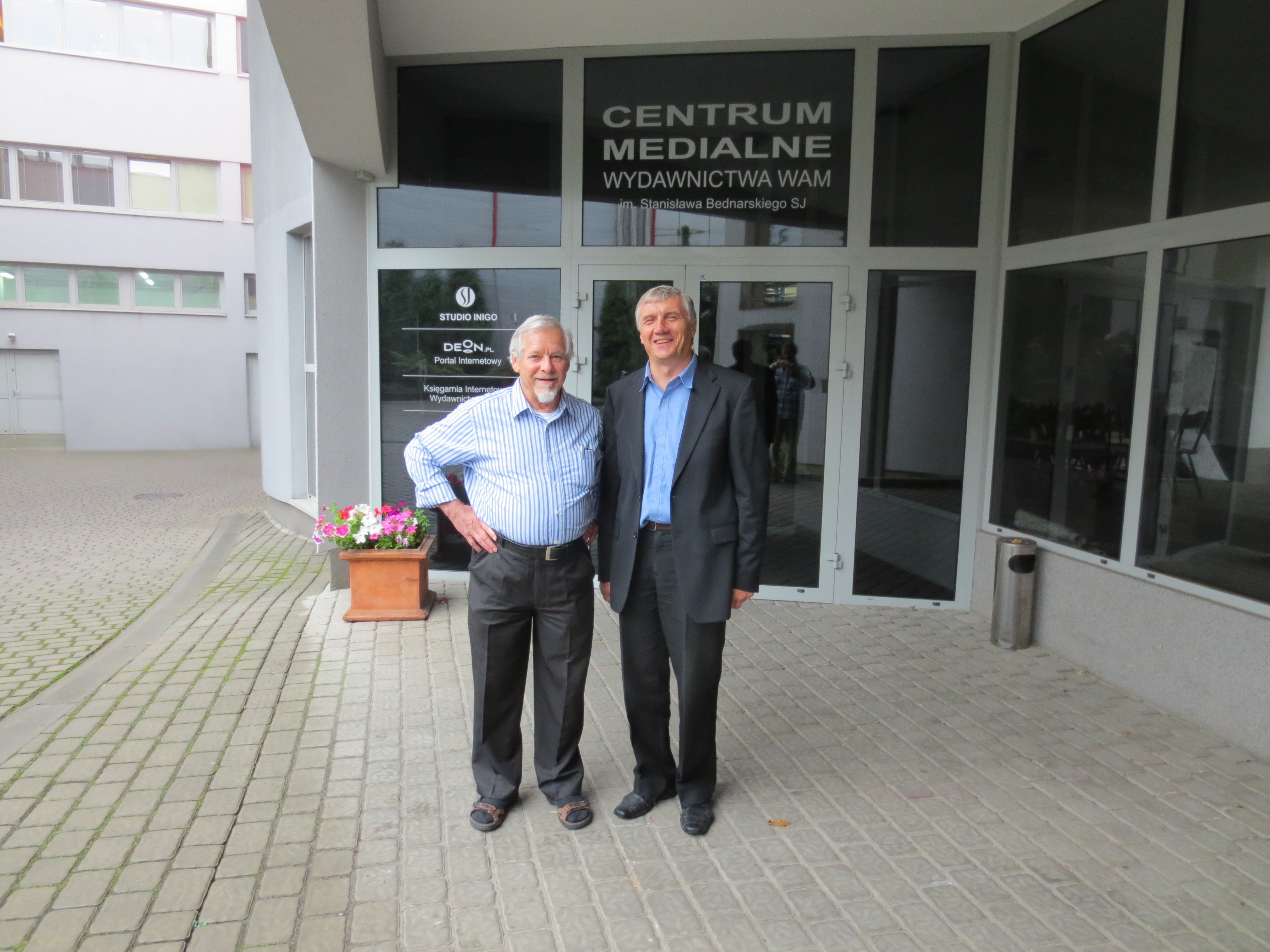
Dr Kazimieras Černis and Rev. Dr Richard P. Boyle, S.J. Photo from the personal archive of Dr K. Černis.
“I want as many asteroids as possible to be named after famous people. I would like to name as many asteroids as possible after university rectors, but of course it’s a slow process, with only a few asteroids named each year,” said Dr K. Černis, recounting the history of asteroid naming.
According to the database of the Minor Planet Center of the International Astronomical Union (IAU), the asteroid is on average 2.23 times farther from the Sun than Earth and orbits the Sun in 3.33 years (≈ 1215.804 days).
This year, we will have the opportunity to see the asteroid Alabiano in mid-August, when it will be in opposition, approximately 1.2 av from Earth. At that time, it will be flying through the constellation Capricornus and will have a magnitude of about 21. Asteroid orbital elements: a = 2.229 av, e = 0.14, i = 2.83°, P = 3.33 m.
Rector from Spain
Dr Liudas Jovaiša, associate professor at the VU Faculty of History, talks about a Jesuit professor who lived at the turn of the 16th and 17th centuries and was one of the first doctors of theology at VU.
"G. Alabiano was a Spanish Jesuit. He was born in Tarazona, in the region of Aragon, in what is now the province of Zaragoza. After studying in his hometown and at the University of Alcalá, he joined the Society of Jesus. Later, as a Jesuit, he studied in Zaragoza, Valencia, Barcelona, and Rome. Sent to Vilnius, he taught dogmatic theology there for six years, from 1578 to 1584. In 1583, together with another Spaniard, Antanas Arias, he was solemnly awarded the first doctorates in theology at VU in the presence of two cardinals and the court of King Stephen Báthory.
Appointed Rector of Vilnius University, G. Alabiano held this position for eight years – the longest in the history of the Jesuit University of Vilnius. After 14 years in Vilnius, in 1592, he moved to Krakow as confessor to Cardinal Jurgis Radvila, and when the cardinal died in Rome, he returned to Spain. He lived and worked mainly at the College of Zaragoza, where he also died,” says the historian.
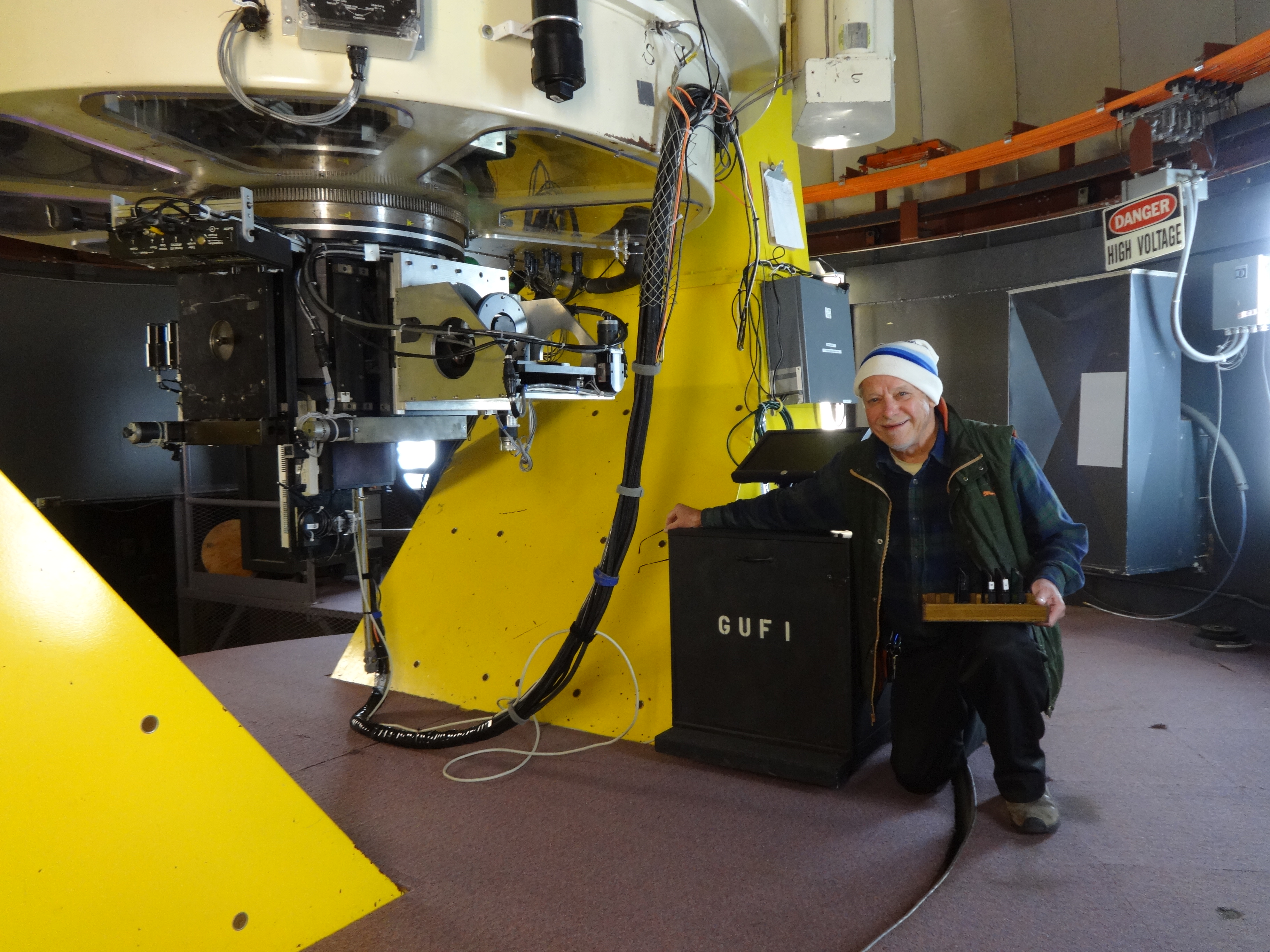
Rev. Dr Richard P. Boyle next to a telescope at the Vatican Observatory in Arizona. Photo by Dr Justas Zdanavičius.
The Unique Vatican Observatory
On January 9, the International Astronomical Union announced that the asteroid with catalogue number 2012 EN6 (763533) would be named Alabiano. The asteroid was discovered in 2012 at the Vatican Observatory (Specola Vaticana). Dr Šarūnas Mikolaitis, an astrophysicist at the VU Faculty of Physics, emphasises that this is a special, academically strong institution, founded and run by the Jesuit Order.
The Vatican Observatory is located in two places: the historic Castel Gandolfo Observatory in Italy and a modern research base in southeastern Arizona, on Mount Graham. Due to the excellent conditions for observation, the Jesuits, in collaboration with the University of Arizona, have installed a modern 1.8-meter diameter telescope (Vatican Advanced Technology Telescope – VATT) there,” says the astrophysicist.
Long-standing Cooperation Between Lithuanian and Jesuit Researchers
According to Dr K. Černis, Jesuit scientists work in many key areas of astrophysics, ranging from cosmology and stellar physics to research on bodies in the solar system, and publish their findings in prestigious scientific journals. Lithuanian astrophysicists have been collaborating with them for many years.
“We work in the same group together with the Jesuits, communicate directly, visit each other, and have prepared numerous joint publications. Thanks to this connection, we can use their infrastructure. One of the many results of this cooperation is the discovery and naming of the asteroid Alabiano.
The Vatican Observatory greatly appreciates the work of VU astronomers, especially Professor Vytautas Straižys, who served as president of the 25th Committee at the International Astronomical Union during the Soviet era and established such close ties. At that time, such contact was extremely important, as it was not possible to travel to Rome or the Vatican, or to invite them to Lithuania, so we communicated only by letter. I have now made observations in Arizona twice,” says the astronomer.