

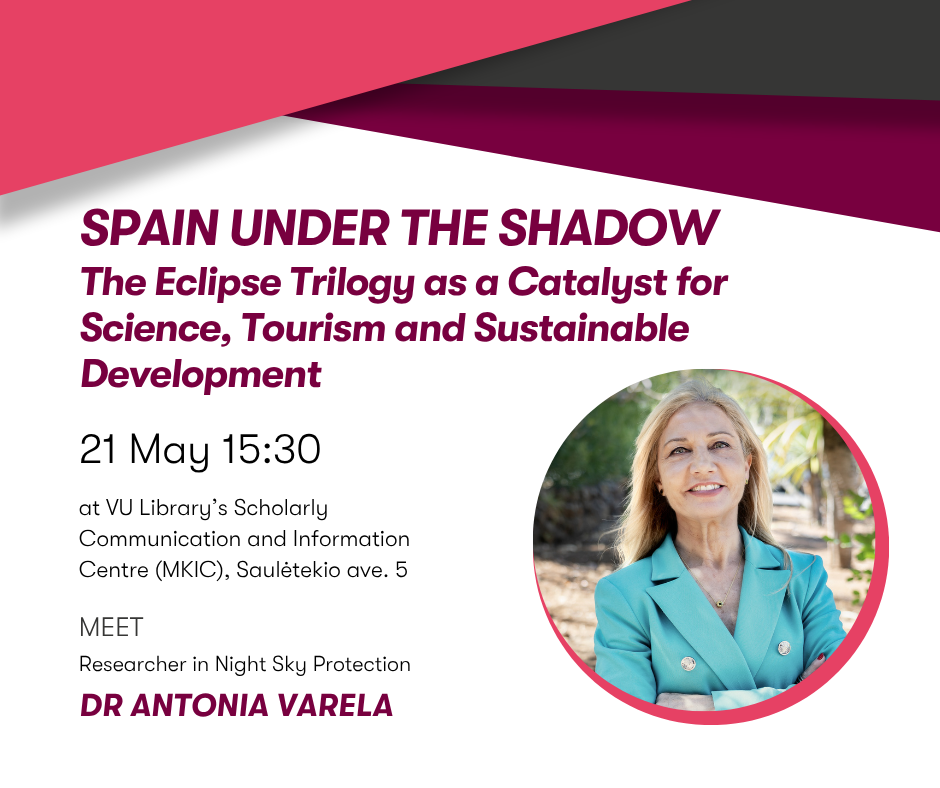
On May 21 at 15:30 at VU Library’s Scholarly Communication and Information Centre (MKIC), Saulėtekio ave. 5, Dr Antonia Varela, a researcher in Night Sky Protection and President of the Starlight Foundation, will give a public lecture.
Abstract
The upcoming “Spanish Eclipse Trilogy” represents an extraordinary astronomical event: a sequence of solar eclipses visible from the Iberian Peninsula within a short period of time, a phenomenon that has not occurred in over a century and is estimated to take place only once every several centuries.
This rare alignment offers a unique opportunity to position Spain as a global reference for astronomical observation and astrotourism. With its advanced tourism infrastructure, accessibility and services, Spain is exceptionally well placed to host large-scale international audiences. At the same time, this phenomenon presents significant challenges in terms of logistics, territorial planning, safety, environmental protection and visitor management.
Beyond its operational dimension, the eclipse trilogy constitutes a powerful tool for science communication and public engagement. It provides an exceptional context to promote scientific knowledge, inspire new audiences and reinforce the value of the night sky as a shared heritage.
This presentation will explore both the opportunities and challenges associated with this event, highlighting its potential as a catalyst for astrotourism development and as a strategic moment to reconnect society with the sky.
About the speaker
Antonia Varela holds a PhD in Astrophysics and has a strong track record in scientific leadership and institutional management. She is the President of the Starlight Foundation, the Director of the Museum of the Cosmos in Tenerife and a Researcher in Night Sky Protection at Instituto de Astrofísica de Canarias. The researcher promotes female leadership in STEM. Her career has been recognised, amongst other honours, with the Canary Islands Gold Medal.
Organizers: ACEBaltic, Vilnius University Faculty of Physics, University of Tartu Observatory, Instituto de Astrofísica de Canarias. Collaborators: Ramón Areces Foundation, Embassy of Spain in Lithuania, International Astronomical Union (IAU), Spanish Astronomical Society (SEA).