

From 21 to 24 April, Vilnius University (VU) hosted distinguished guests – members of the Executive Committee and Division Presidents of the International Astronomical Union (IAU). The organisation brings together astronomers from 102 countries worldwide; it serves as the principal global association of professional astronomers, coordinating scientific research, the naming of celestial bodies, and public education in astronomy. This was the first visit of its kind to Lithuania in the more than 100-year history of the IAU.
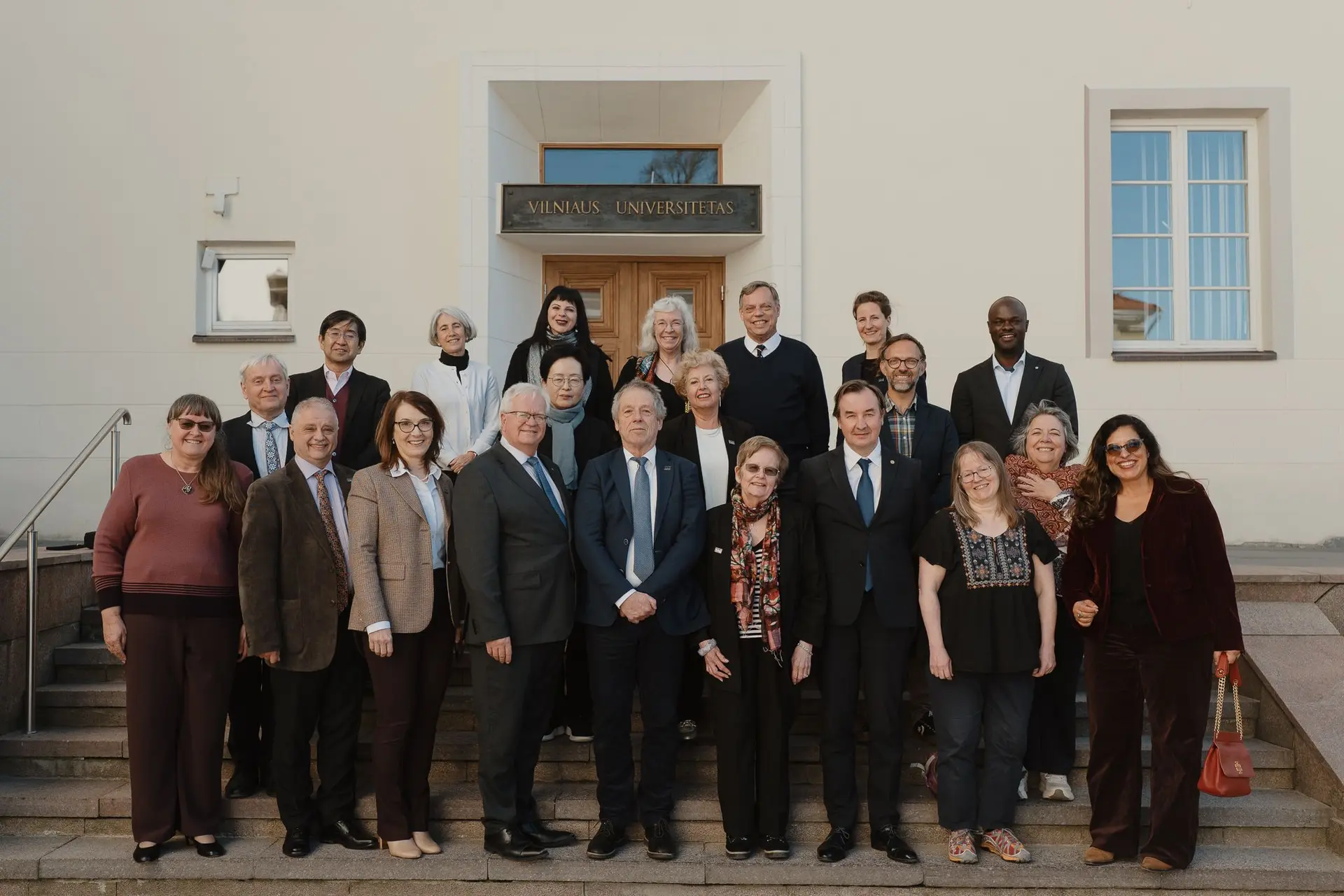
Global Astronomy Leaders Meet at Vilnius University.
Photo credit: Ugnius Bagdonavičius / VU
The 19-member delegation that arrived in Vilnius included some of the world’s most prominent astronomers. Among them were Nobel Prize laureate Prof. Brian Schmidt from Australia, who will assume the presidency of the IAU in 2027, and the current IAU President, Prof. Willy Benz from Switzerland, head of the CHEOPS space mission studying exoplanets.
During the visit, VU hosted the meetings of the IAU Executive Committee, where strategic issues related to the organisation’s activities were discussed and next year’s programme of events was shaped, including selected symposia and thematic conferences. Significant attention was also devoted to the achievements of early-career researchers: IAU divisions recognised the best doctoral dissertations in their respective fields, while three promising young scientists received the IAU Gruber Foundation awards worth €25,000. Among the recipients was Ignas Juodžbalis, a Lithuanian-born doctoral student at the University of Cambridge.
A major topic on the agenda was protecting the night sky from artificial light and atmospheric pollution. Preparations also began for an exceptional astronomical event – the close approach of the potentially hazardous asteroid Apophis to Earth. Asteroids of this size, nearly half a kilometre in diameter, come this close to our planet extremely rarely – on average, once every 5,000 to 10,000 years.
Communication and digital infrastructure were another important focus of the meetings. Discussions covered information channels, public access to data, and the further development of the IAU’s digital platforms. Scientific divisions, commissions, and working groups also presented reports on their activities. Membership expansion, financial sustainability, and international cooperation with other scientific organisations were also considered.

IAU President Willy Benz. Photo credit: Ugnius Bagdonavičius / VU
The guests attended a reception at VU, where they met with VU Rector Prof. Rimvydas Petrauskas, Vice-Rector Prof. Gintaras Valušis, President of the Lithuanian Academy of Sciences Vytautas Nekrošius, ambassadors from various countries, Lithuanian astronomers, and other invited attendees. In his address, IAU President Willy Benz emphasised the close ties between the International Astronomical Union and astronomers at Vilnius University. ‘From the pioneering efforts in monitoring sunspots, the development of the Vilnius seven colour photometric system to the ongoing contributions of your astronomers heavily using Moletai Observatory, in stellar physics, galactic studies, stellar atmospheres and exoplanet research, Lithuania has helped shape the IAU mission to promote the peaceful and cooperative advancement of astronomy worldwide,’ said Prof. W. Benz.
On the final day of the visit, the delegation toured the historic VU Observatory and Library, where they had the opportunity to see the first edition of a book by Nicolaus Copernicus. The visit concluded at the VU Molėtai Astronomical Observatory – Lithuania’s leading centre for fundamental astronomical research, known for its unique infrastructure and internationally significant research projects.
The aim of the IAU delegation’s visit to Lithuania was to strengthen international cooperation, assess the potential of Lithuanian astronomical research, and encourage the country’s active participation in global astronomy initiatives. The meetings also explored opportunities for Lithuania’s integration into international research infrastructures, the regional development of astronomy and space science, and the training of young researchers.
The visit of representatives of the IAU, which unites thousands of members worldwide, was initiated and organised by Prof. Gražina Tautvaišienė, an astrophysicist at the Faculty of Physics of VU and an internationally recognised expert in stellar spectroscopy. In 2024, she was elected Vice-President of the IAU, becoming the first scientist from the Baltic states to hold such a high position within the organisation.