

Researchers from the Faculty of Physics at Vilnius University (VU) have won a funding competition within the Lithuania–Japan bilateral project programme. The project will combine the expertise in pentaquark modelling of VU physicists, members of the European Organisation for Nuclear Research (CERN) LHCb Vilnius group, and Nagoya University in Japan. Dr Mindaugas Šarpis lead the project in Lithuania.
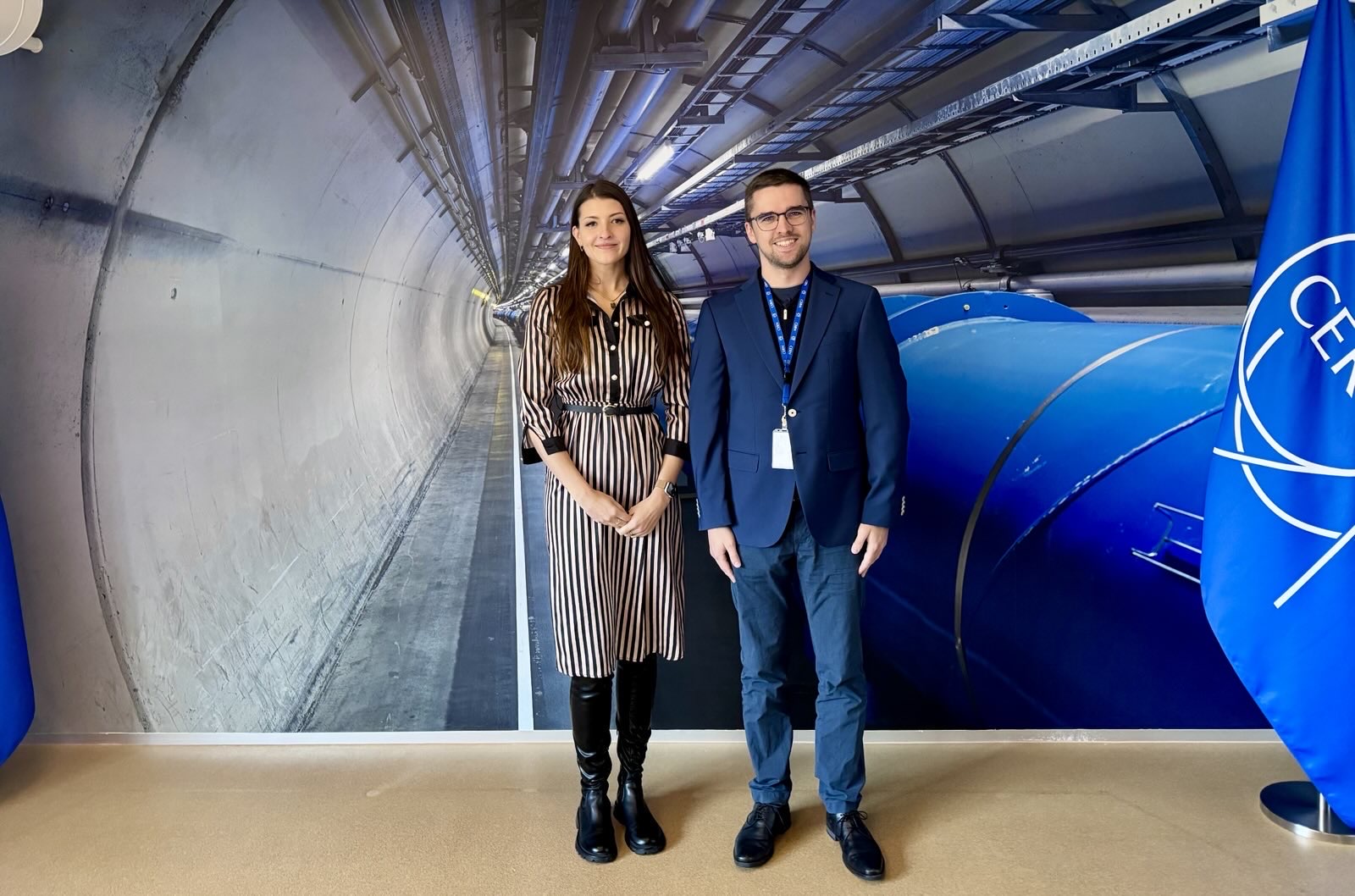
Rūta Racz and Dr Mindaugas Šarpis. Photo from personal archive.
“The Japanese researchers, led by Prof. Yasuhiro Yamaguchi, are among the world’s most prominent theorists investigating exotic states of matter – tetraquarks and pentaquarks. We aim to unite their expertise with that of CERN experimentalists. Close collaboration will enable much faster preparation and verification of theoretical models in the context of experimentally measurable parameters. There are a few projects, even on a global level, where researchers from different fields work so closely together. This project may yield breakthrough results that are highly significant for research in quantum chromodynamics – our understanding of the matter that constitutes everything. Furthermore, it will serve as an important step for future projects and continuous collaboration,” stated Dr M. Šarpis, head of the LHCb Vilnius group.
The VU physicist has been conducting pentaquark research at CERN for several years. “Pentaquarks are a particularly exotic form of matter. Unlike the familiar protons and neutrons, which consist of three quarks, these baryons are composed of five. Their lifetime is trillions of trillions of times shorter than a second, yet we can detect them using the LHCb detector. One could say that pentaquarks represent an extreme state of matter. They can reveal something to us about the mechanisms responsible for the formation and interactions of matter,” he explained.
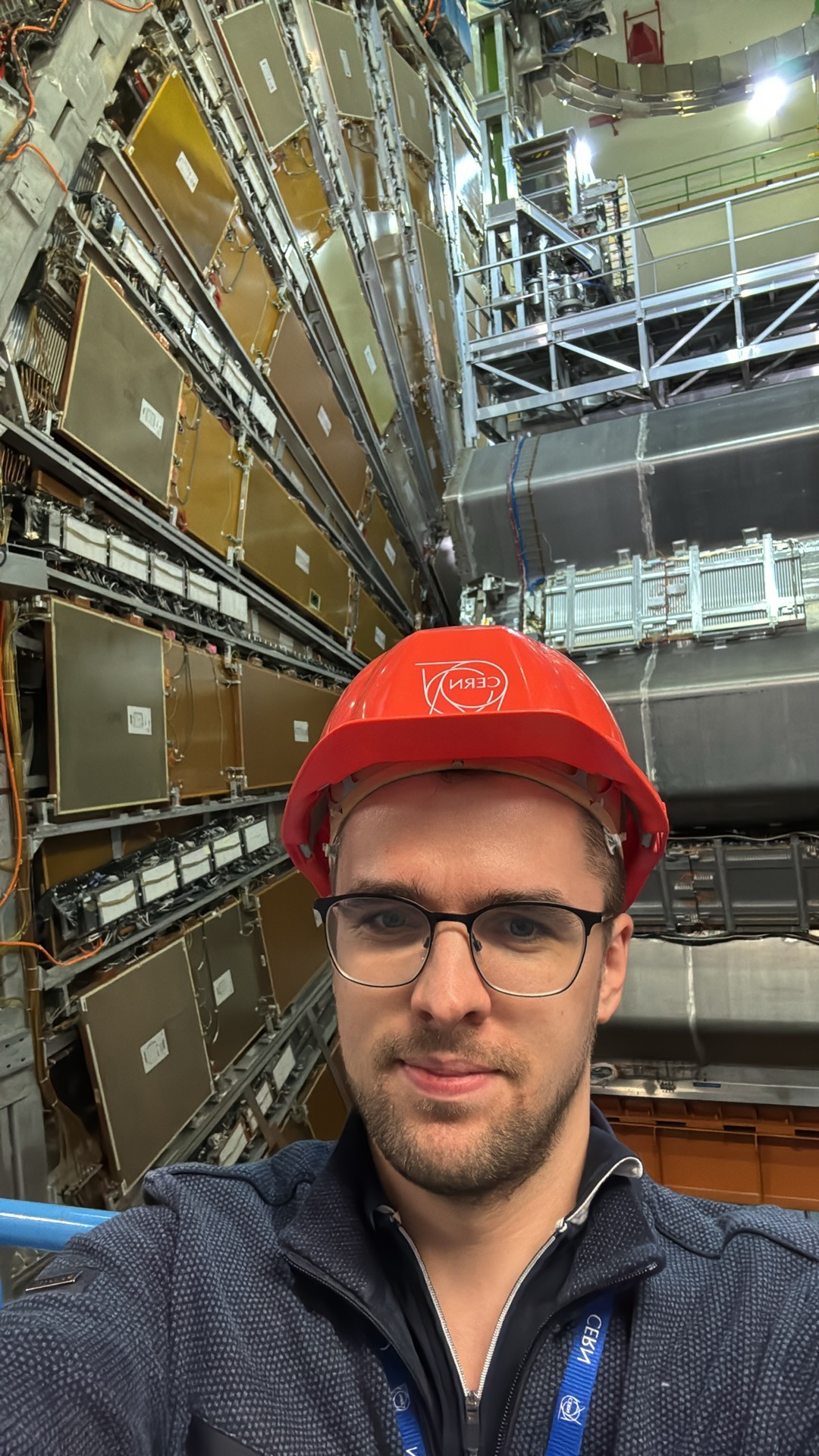
Dr Mindaugas Šarpis. Photo from personal archive.
Dr M. Šarpis recounted meeting Dr Yamaguchi at the HADRON 2023 conference in Italy. “He was particularly intrigued by the complex channel in which we are searching for pentaquarks. In 2024, I brought this expertise back to Lithuania. Currently, the LHCb Vilnius group is the only one searching for pentaquarks in this unique channel,” said the head of the group.
According to him, the involvement of bachelor’s, master’s, and doctoral students in the research of exotic particles – pentaquarks – is also anticipated during the implementation of the project. “We aim not only to educate but also to empower the competencies of young researchers. Six members of the VU LHCb Vilnius group will take part in the project, including two doctoral students, one master’s student, and two experienced researchers,” added Dr M. Šarpis.
The VU physicist notes that the visits have already been scheduled. “This year, we will travel to Japan, and we will also meet remotely to implement the project strategy. A visit from our Japanese colleagues to VU is planned for next year,” he said.
In 2025, Dr M. Šarpis received another prestigious grant dedicated to the search for pentaquark particles using a novel method.
The project “Unraveling the Structure of Pc Pentaquarks through Joint Experimental and Theoretical Effort Between Lithuanian and Japanese Scientists” complements ongoing research by expanding the network of involved researchers and strengthening collaboration. It is funded by the Research Council of Lithuania.