

An international team of scientists, including physicists from Vilnius University (VU), has been selected to develop next-generation quantum simulators. Using multicomponent ultracold atoms, the team will build highly controllable quantum simulators – systems designed to create and study complex quantum materials that are difficult to model with conventional computers.
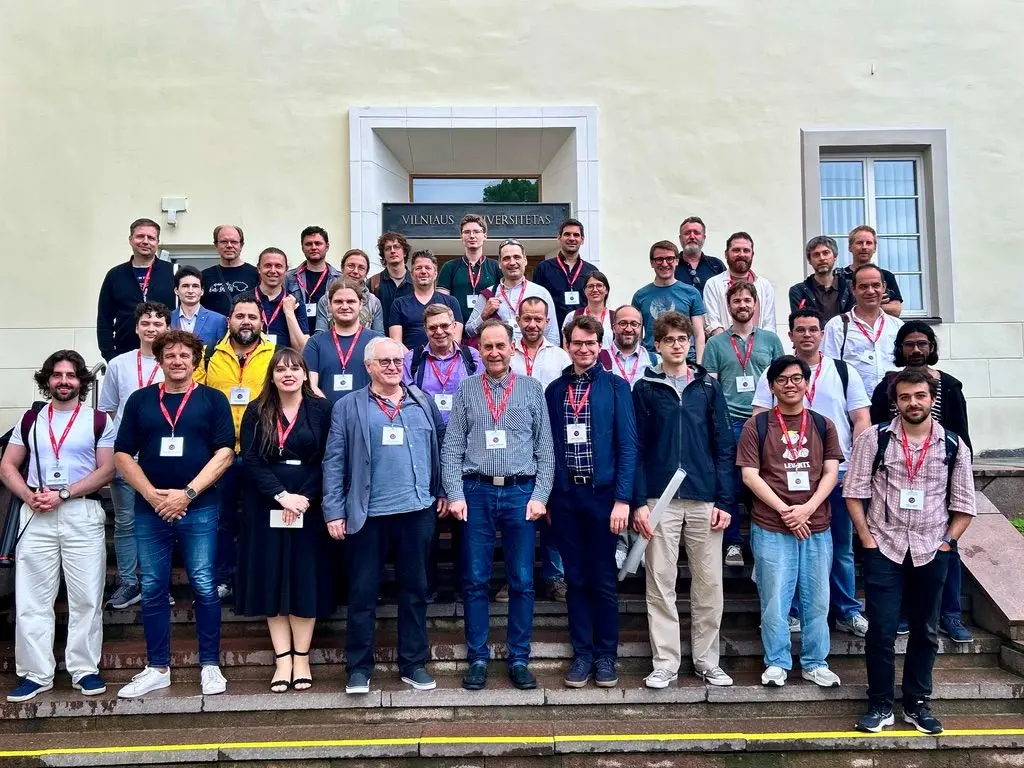
The international workshop “Quantum Simulations with Multicomponent Ultracold Atoms” at VU. Photo from personal archive.
Turning theoretical ideas into measurable results
“Quantum simulations with multicomponent ultracold atoms make it possible to recreate physical phenomena that would otherwise be hard to access, and in this project, we will combine this with state-of-the-art experiments. Bringing together leading European scientists – both experimentalists and theorists – not only enables progress in this field, but is also important for Lithuania, as it works to secure the country’s place in the broader landscape of quantum-technology research. Together with our project partners, we will develop theoretical ideas and turn them into real, measurable results,” says VU Distinguished Professor Gediminas Juzeliūnas.
The quantum simulators being developed with ultracold atoms will be able to emulate and study quantum materials that conventional computers cannot model. The aim is to harness these systems to create better, noise-resilient quantum technologies and highly precise sensors.
According to the VU scientists, the goal of the QUASIMODO project (QUAntum SImulations with MulticOmponent ultracolD atOms) is to create and control strongly correlated and topological quantum phases using multicomponent ultracold atoms such as dysprosium, potassium and ytterbium.
The challenges the project addresses
Today’s quantum simulators are subject to decoherence, which destroys the entangled quantum states essential to quantum information and computation. Solving these problems is crucial to paving the way for next-generation, reliable quantum technologies, including topological quantum computers and novel quantum metrology.
The research team is taking a new path, combining synthetic dimensions, dark-state engineering and dynamical gauge fields. The QUASIMODO project’s research directions differ in several respects from competing projects around the world. It uses synthetic dimensions encoded in the atoms’ spins, allowing for significantly larger topological band gaps and dark-state optical lattices with considerably lower laser-induced losses. The team also introduces entanglement-based observables as an entirely new diagnostic tool for directly measuring many-body correlations in the laboratory.
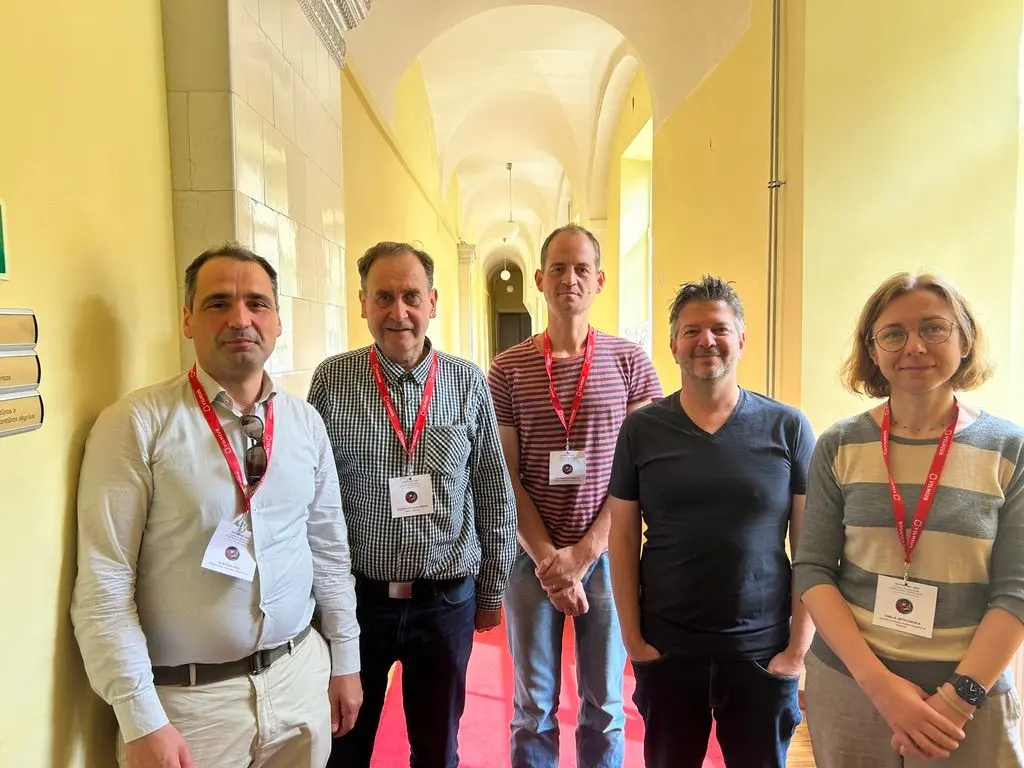
From left: Alessio Celi (Universitat Autònoma de Barcelona), Gediminas Juzeliūnas (Vilnius University), Sylvain Nascimbène (Collège de France / ENS, Paris), Oded Zilberberg (University of Konstanz), Emilia Witkowska (Institute of Physics, Polish Academy of Sciences). Photo from personal archive.
VU’s contribution – theory and high-performance computing
Scientists from VU’s Institute of Theoretical Physics and Astronomy are responsible for the theory and high-performance computing related to the synthetic gauge fields acting on ultracold atoms and to spin squeezing. Each theoretical concept will be tested on three different experimental platforms run by the project partners. This ensures robust cross-validation and reduces scientific risk.
The VU team is led by Prof. Juzeliūnas – head of the Cold Atoms and Quantum Optics group, one of the first to propose realistic schemes for creating artificial spin-orbit coupling in ultracold atoms, and also known for fundamentally important work on artificial magnetic fields for cold atoms and on slow light.
A consortium united by a long-standing partnership
The QUASIMODO consortium brings together six research teams from five countries. The project coordinator is Prof. Oded Zilberberg of the University of Konstanz (Germany). The partners are the Max Planck Institute of Quantum Optics (Germany), ICFO – The Institute of Photonic Sciences (Spain), the Institute of Physics of the Polish Academy of Sciences (Poland) and the Kastler Brossel Laboratory (France).
The partnership builds on earlier successful collaborations, including the QuantERA project DYNAMITE, the DFG FOR5688 consortium, and the bilateral Lithuanian-Polish Daina project. The consortium’s kick-off meeting – the international workshop “Quantum Simulations with Multicomponent Ultracold Atoms” – took place on 4–6 June 2026 in Vilnius and was organised by VU scientists.
“What excites me most is the close integration of our theoretical models with cutting-edge experiments, which will finally allow us to directly measure complex quantum entanglement in these systems. I am inspired by the opportunity to push the boundaries of quantum simulation and venture into regimes that are already beyond the reach of classical computing,” says Prof. Zilberberg.
About the project and the QuantERA call
By the end of the project, success would mean a demonstrated proof of robust topological phases, emergent fractionalisation (where excitations acquire fractional quantum numbers) and strongly squeezed spin states approaching the fundamental Heisenberg limit for quantum sensors – thereby establishing multicomponent ultracold atoms as an important platform for building reliable quantum technologies.
The project runs for 36 months and has a total budget of EUR 1,377,011.
The call from QuantERA, the European network funding quantum-technology research, was announced in September 2025 and organised by 34 research-funding organisations from 29 countries. It attracted a record number of applications (287), of which 39 projects were selected as winners – a clear illustration of the wealth of new ideas the quantum-research community is seeking to explore through international collaboration.