

The Experimental Nuclear and Particle Physics Center at the Faculty of Physics of Vilnius University (VU) is participating in the development of the Compact Muon Solenoid (CMS) detector technology at the European Organization for Nuclear Research (CERN). VU physicists contributing to the upgrade of the inner tracker are the only ones in Lithuania refining the assembly of the electronic components of the TEPX (Tracker Endcap Pixel) modules, verifying and testing their durability and performance.
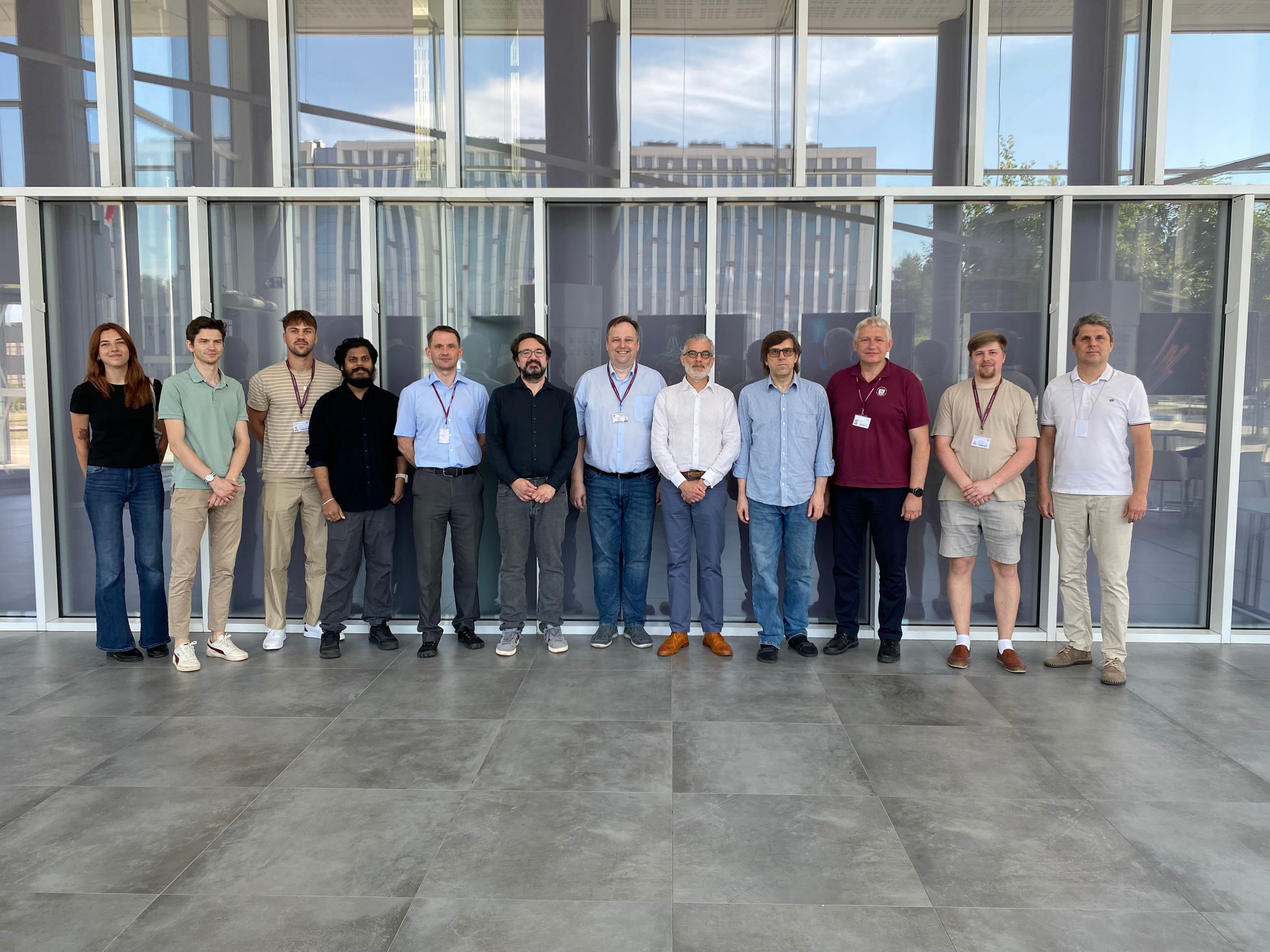 Photo credit: Aurita Petrulytė
VU will participate in the assembly and testing of modules for the CERN CMS detector. This was approved by CMS inner tracker representatives, Marko Dragicevic and Giacomo Sguazzoni, who highly praised the work being done by VU scientists and the equipment available there. The evaluators familiarised themselves with the work carried out by VU physicists on July 1, 2026.
'We are involved in the assembly and testing of semiconductor electronics. The modules of a specific class that we have tested will be installed as part of the CMS detector upgrade,' says Dr Andrius Juodagalvis, Head of the Experimental Nuclear and Particle Physics Center at Vilnius University.
According to him, VU researchers receive mechanically connected modules and use ultrasonic wire-bonding in the laboratory to connect the silicon sensor to the readout chip. They do this with extreme precision, as the parts of electronic components are wire-bonded using a wire as thin as 25 micrometres (µm). Such a size – smaller than the thickness of a human hair – can only be seen under a microscope. In the testing room, they verify that everything is functioning properly and the module is ready for the next stage – application of a protective coating. Having received modules with the protective coating, physicists use a specialized equipment and computer software to test their performance to ensure the device correctly reads electric signals and can be used for particle detection.
'These electronic components will be integrated into the upgraded CMS detector. The upgrade is necessary to prepare for the operation of the next-generation Large Hadron Collider (LHC) at much higher luminosity (High-Luminosity Large Hadron Collider). Luminosity describes how often protons collide during one bunch crossing. For example, the current rate is around 60 collisions. Still, after the upgrade, the proton collisions will be much more intense, reaching up to 200 separate proton collisions at the same time,' explains the researcher. This means that 200 separate mini-explosions will occur simultaneously every 25 nanoseconds (ns) or, in other words, 40 million times per second, each creating new particles.
According to him, protons travel in the accelerator in bunches. Each collision of bunches is called a 'bunch crossing'. The CERN CMS detector counts the collisions and follows their outcome by studying individual tracks recorded by the detector. At the end of June, CERN announced the termination of the Large Hadron Collider programme and the start of intense upgrade activities.
'We know that more particles exist, but we haven’t been able to detect them so far. As the number of proton collisions increases, so will the number of random, extremely rare events. We’ll be able to extract much more valuable data from this and observe rare processes,' says Dr A. Juodagalvis.
He explains that extremely rare events in particle physics are processes with a very low probability (for example, one in a billion or even a trillion). The more proton collisions occur at the LHC, and the more targeted data is collected, the more precisely and accurately scientists can measure quantities, detect anomalies, and search for new physics – to explain phenomena beyond the Standard Model, such as new particles, new laws, or dark matter, as well as other questions that remain unresolved to this day.