

It would be difficult to name a prize that rivals the Nobel Prize in prestige. When the laureates are announced every December, journalists and audiences around the world suddenly turn their attention to that small group of people whose discoveries and achievements have earned them a place in history. Yet Nobel laureates often seem distant and out of reach to the rest of society. The Lindau Meetings, now in their 75th year, have done much to close that gap. Each year, the project brings together Nobel laureates and promising young scientists from around the world. This year, one of those young scientists was Justas Lekavičius, an alumnus of Vilnius University’s (VU) Faculty of Physics.
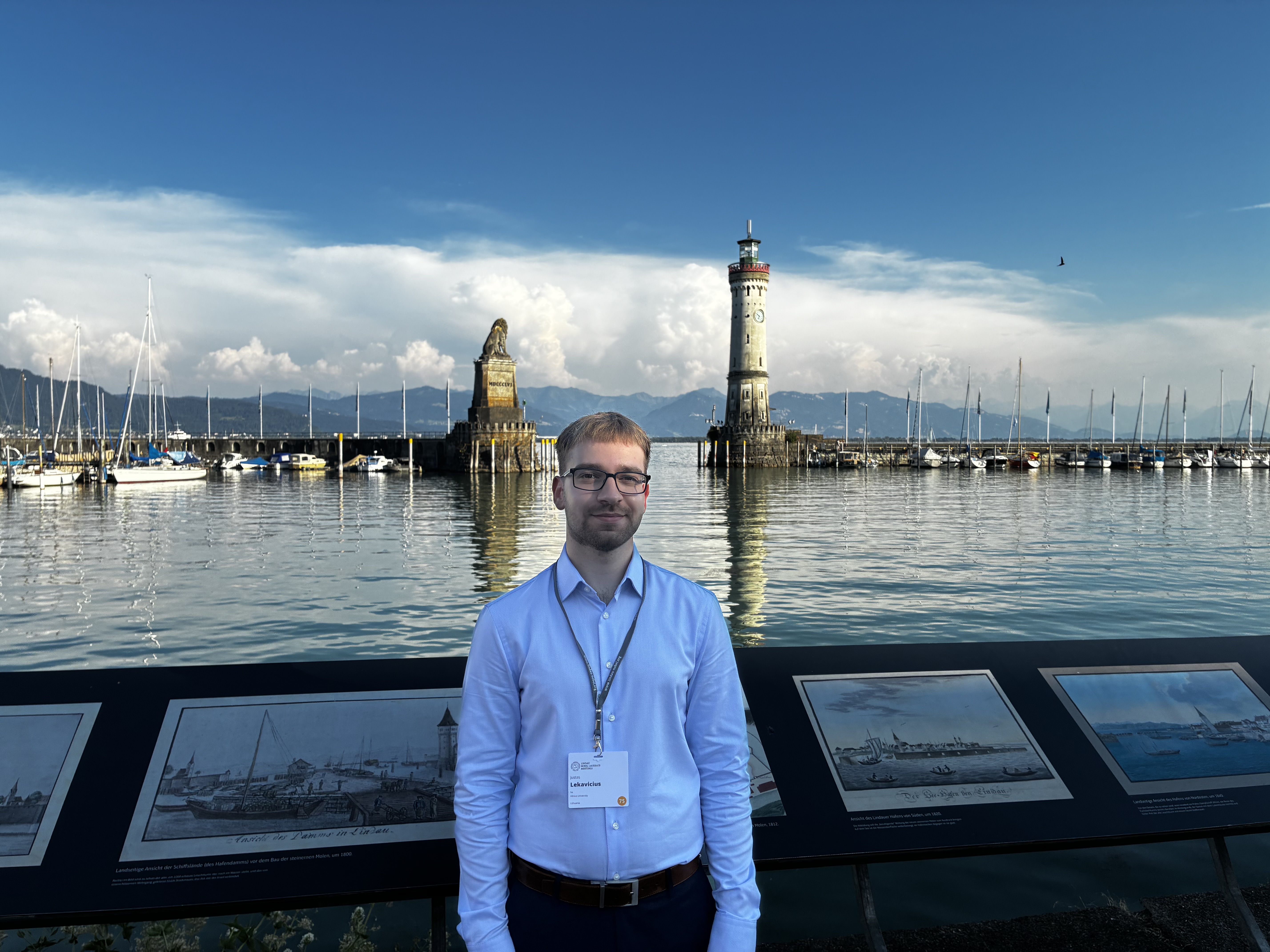
Justas Lekavičius. Photo from personal archive.
A spirit of Lindau
The Lindau Meetings take place annually and are usually devoted to a specific discipline such as chemistry, physics, and so on. This year’s meeting, however, was interdisciplinary, bringing together researchers from all fields. The Lithuanian Academy of Sciences sends three people to Lindau each year. When Lekavičius learned that he could be one of them, he didn’t hesitate to apply.
“I went there with an open heart. What mattered most to me was the chance to talk with Nobel laureates in an informal setting. Part of the program is designed exactly for that. You can chat with them in a very informal setting. It’s fascinating to see how they interact with you. This kind of experience is incredibly inspiring,” he says.
From the very first day, he understood what people mean by the phrase “Lindau spirit,” which is used by organizers and past and present participants alike.
“Being there, it’s hard to grasp that dozens of Nobel laureates have gathered in one place, sharing their experience and insights not just during official discussions, but also by mingling with groups of young scientists during breaks,” Lekavičius says.
Why one should be curious about mistakes
The scientist says that one of the moments that left the deepest impression on him was a walk he took with William E. Moerner, a Nobel Prize laureate in Chemistry in 2014. Moerner was the first to spectroscopically detect single organic molecules and, in doing so, became a pioneer of super-resolution microscopy. The very same field that Lekavičius started his career in.
“I personally studied the optical properties of organic compounds during my bachelor’s and master’s studies, in the organic optoelectronics group at VU’s Faculty of Physics, Institute of Photonics and Nanotechnology. During my upcoming doctoral studies in Germany, I’ll be developing new super-resolution microscopy methods. During our walk, the laureate shared his views on the current state of this research field and talked about his own failures and discoveries,” he says.
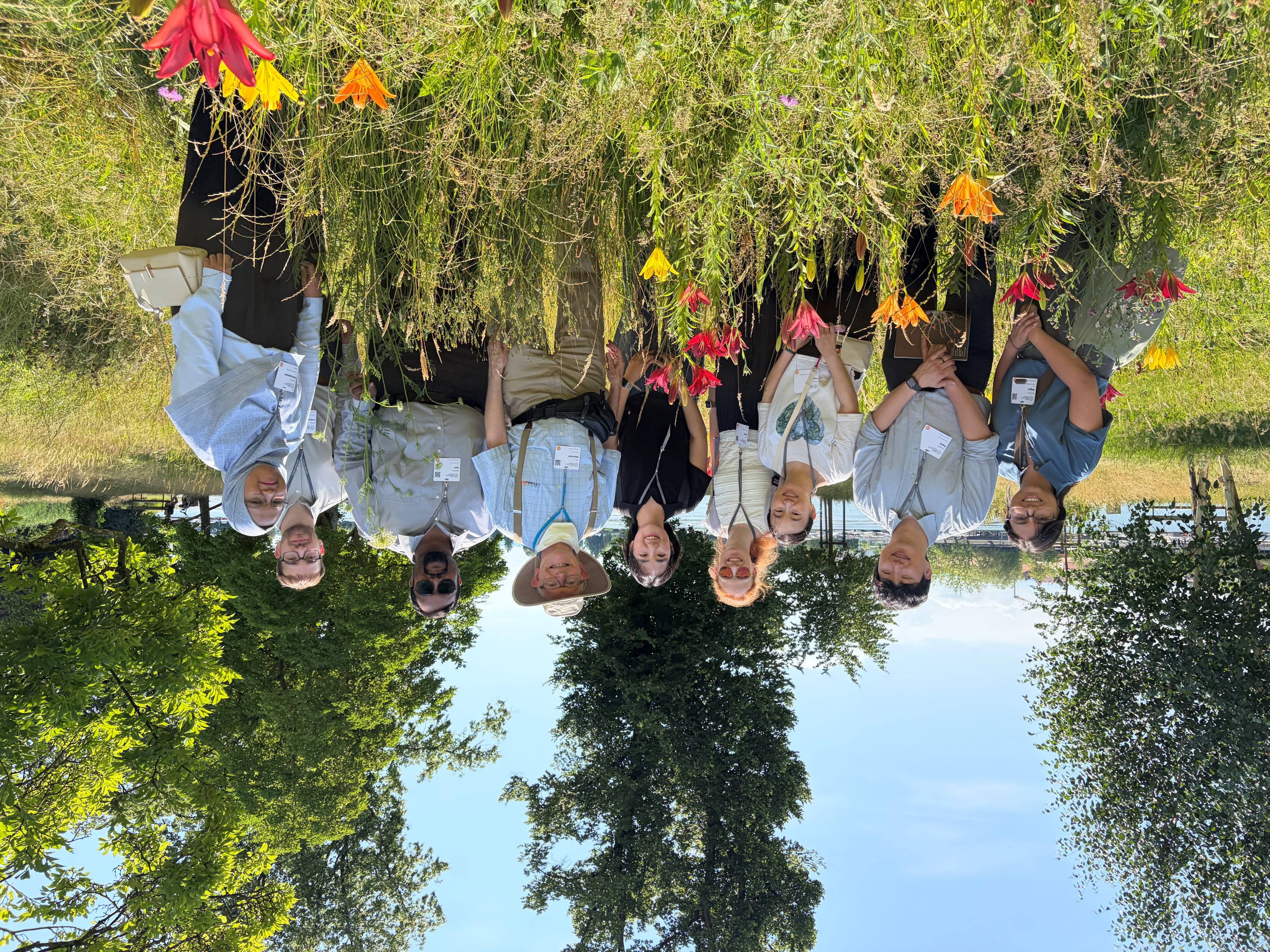
Meeting with William E. Moerner. Photo from the personal archive.
Lekavičius was especially interested in learning about the ideas that scientists failed to bring to fruition. After all, the public usually only sees success stories, even though in reality, far more attempts simply don’t work out. Many mistakes are needed to achieve something meaningful.
“At this stage in my own career, I’m getting very good at making mistakes! I think it’s worth constantly reminding ourselves how important it is to fail. It’s a shame that in modern science, we so rarely talk about our mistakes. They tend to be swept under the rug, and yet they’re responsible for so many achievements. Mistakes are incredibly valuable information,” Lekavičius says.
Interdisciplinarity and the challenges of science
The VU alumnus says that when it comes to the Nobel Prize, he’s most curious about nominations in physics and chemistry. There’s always something to learn from the winners, not just in your own field, but from those working in entirely different disciplines.
“It’s always fascinating to learn from biologists what they don’t yet know. For physicists, that’s crucial, because it shapes the tools we choose to build. Sensing the boundary between what’s known and unknown, and finding a way to answer certain questions, is a challenge I find deeply compelling. Talking with chemists is also great. My own work is increasingly moving toward chemistry, so I want to dive deeper into it,” Lekavičius explains.
At the Lindau Meetings, one topic seemed to interest scientists across nearly every field: artificial intelligence (AI). All the Nobel laureates see great value in AI, and some even describe dramatic improvements in their own work efficiency. But just as often, discussions highlighted the dangers AI poses to our society.
“During the event, a parallel was drawn between the dangers of AI and nuclear weapons. Both are topics that scientists were the first to raise publicly. In the past, young researchers were encouraged to take action to help reduce the number of nuclear weapons in the world, and now they’re called to prevent AI from being used for harmful purposes,” Lekavičius says.
This year, he completed his master’s degree in photonics and nanotechnology at VU, graduating with a Magna Cum Laude diploma.
The Lindau Nobel Laureate Meetings, held in Germany this summer, brought together more than 70 Nobel laureates and over 600 young scientists from around the world.