

Asteroids have been named after two geographical features in Lithuania – Nida and the Šventoji River. They were discovered and named by Dr Kazimieras Černis, an astronomer at the Institute of Theoretical Physics and Astronomy, Faculty of Physics, Vilnius University (VU), together with Edvardas Černis and a colleague from Latvia, Dr Ilgmārs Eglītis.
The asteroid, now named “Nida”, was discovered by scientists on 5 May 2010 at the Baldone Astronomical Observatory in Latvia, using an 80/120 cm Schmidt telescope. At the time, the new object had a magnitude of around 21 and was moving through the constellation Virgo.
“We discovered the asteroid together with Dr Eglītis whilst observing the sky low above the southern horizon. Due to unfavourable weather conditions, we were unable to observe the asteroid the following night. It was not until 10 May that we managed to photograph it again. We thought the object had been lost, as no one else had observed it in the meantime. However, approximately two months later, on 9 July, the object was detected and confirmed by the WISE (Wide-field Infrared Survey Explorer) space observatory – NASA’s infrared space telescope, which has a primary mirror 0.4 m in diameter. These observations made it possible to correlate the new data with earlier observations from the Baldone Observatory and to calculate the asteroid’s orbit more accurately,” explains Dr Černis.
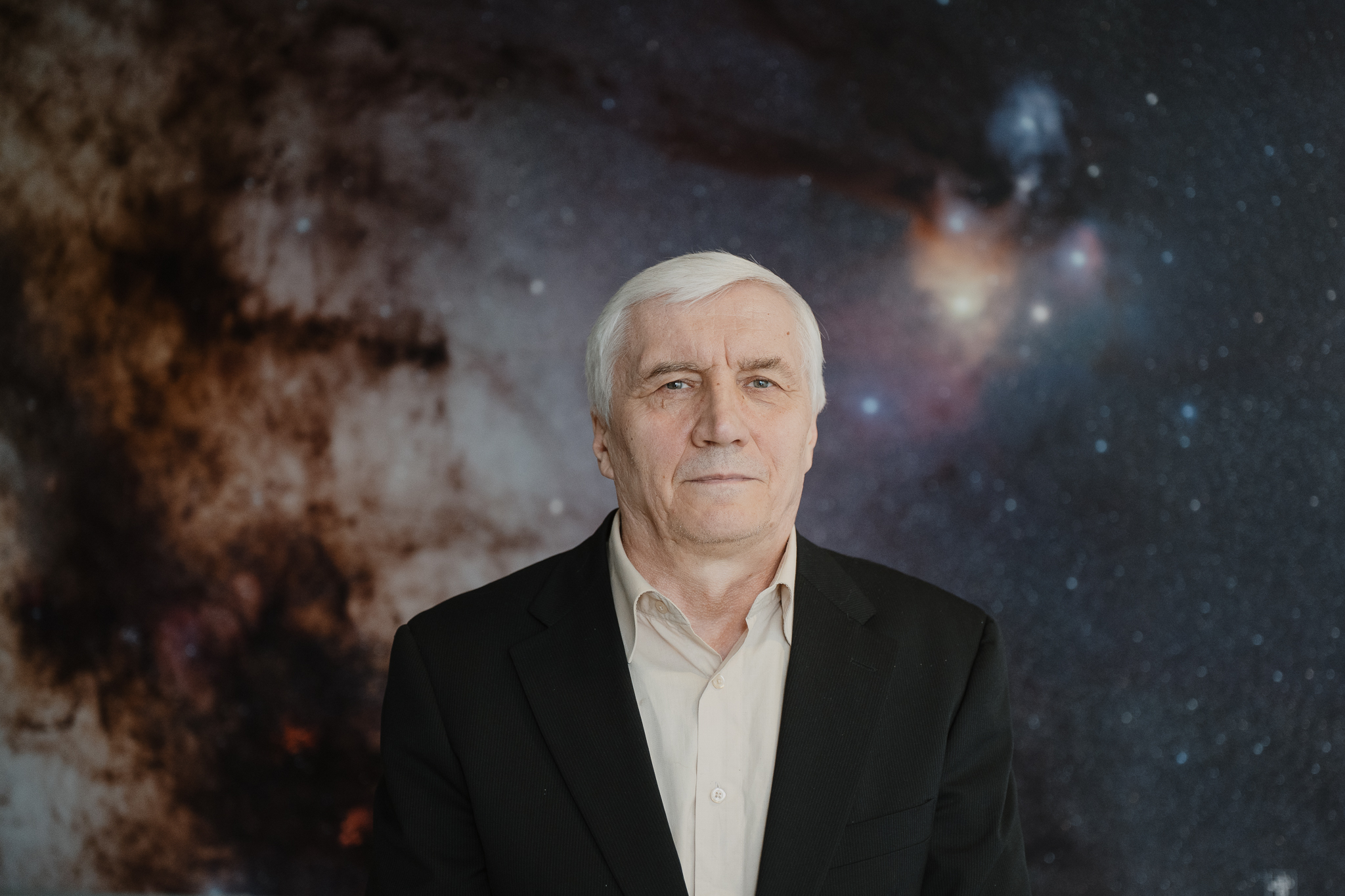
Dr Kazimieras Černis. Photo by Ugnius Bagdonavičius.
“Šventoji” was first photographed by astronomers on 31 August 2008 at the VU Molėtai Astronomical Observatory, using a 0.5-metre Maksutov-type telescope. At that time, the asteroid was of magnitude about 20 and moving through the western part of the constellation Pisces. On 5 September, the asteroid was independently confirmed by the Kitt Peak Observatory (Arizona, USA) using a 1.8-metre telescope.
Since 2004, Dr K. Černis and his colleagues have named more than 150 asteroids, 100 of which have Lithuanian names or names linked to Lithuanian history. Crossing the sky are: “Kaunas”, “Klaipėda”, “Molėtai”, “Plungė”, “Kretinga” and others.
“I have also named another one after another seaside resort – “Palanga”. It is one of the most beautiful places in Lithuania, and I am delighted to name asteroids in its honour – we often go there with the family, return feeling refreshed, and bring back many lovely memories. I believe these are not only beautiful places, but also very significant to the people of Lithuania. I have also named several other asteroids after other Lithuanian resorts, such as Birštonas and Druskininkai.
As for rivers, I chose to honour the Šventoji River because it is the longest river flowing entirely within Lithuanian territory. This is already the third asteroid to be named after a Lithuanian river. The first two were “Nemunas” and “Neris”, explains the astronomer.
According to the Minor Planet Center database of the International Astronomical Union, asteroid (833362) “Nida” is on average 3 times farther from the Sun than Earth and orbits the Sun in 5 years and 65 days (1889,56 days). Asteroid orbital elements: a = 2,99 AV, e = 0,035, i = 10,1°, P = 1889,56 days (5,17 years). ‘Nida’ will approach Earth again in late August 2027 – the closest distance will be around 298 million km. At that time, it will be around magnitude 20, making it visible to medium-sized astronomical telescopes. The asteroid will be visible in the constellation Aquarius, near opposition, when observing conditions from Lithuania will be among the most favourable.
According to the Minor Planet Center database of the International Astronomical Union, asteroid (431803) “Šventoji” is on average 2,6 times farther from the Sun than Earth and orbits the Sun in 4 years and 102 days (1563,19 days). Asteroid orbital elements: a = 2,64 AV, e = 0,137, i = 3,4°, P = 1563,19 days (4,28 years). At the end of January 2027, the asteroid “Šventoji” will once again approach Earth – the closest distance will be around 247 million km. At that time, it will have a magnitude of approximately 20 and, at opposition, will be visible in the Lithuanian sky in the constellation Cancer.