

Every summer, hundreds of talented students from around the world participate in student programmes at the European Organization for Nuclear Research (CERN). Between June and August, 13 students from Vilnius University (VU) spent time at the world's largest particle physics laboratory, marking the highest number of Lithuanian participants in the organisation’s history. The undergraduate and postgraduate students joined a range of programmes lasting from a few weeks to three months.
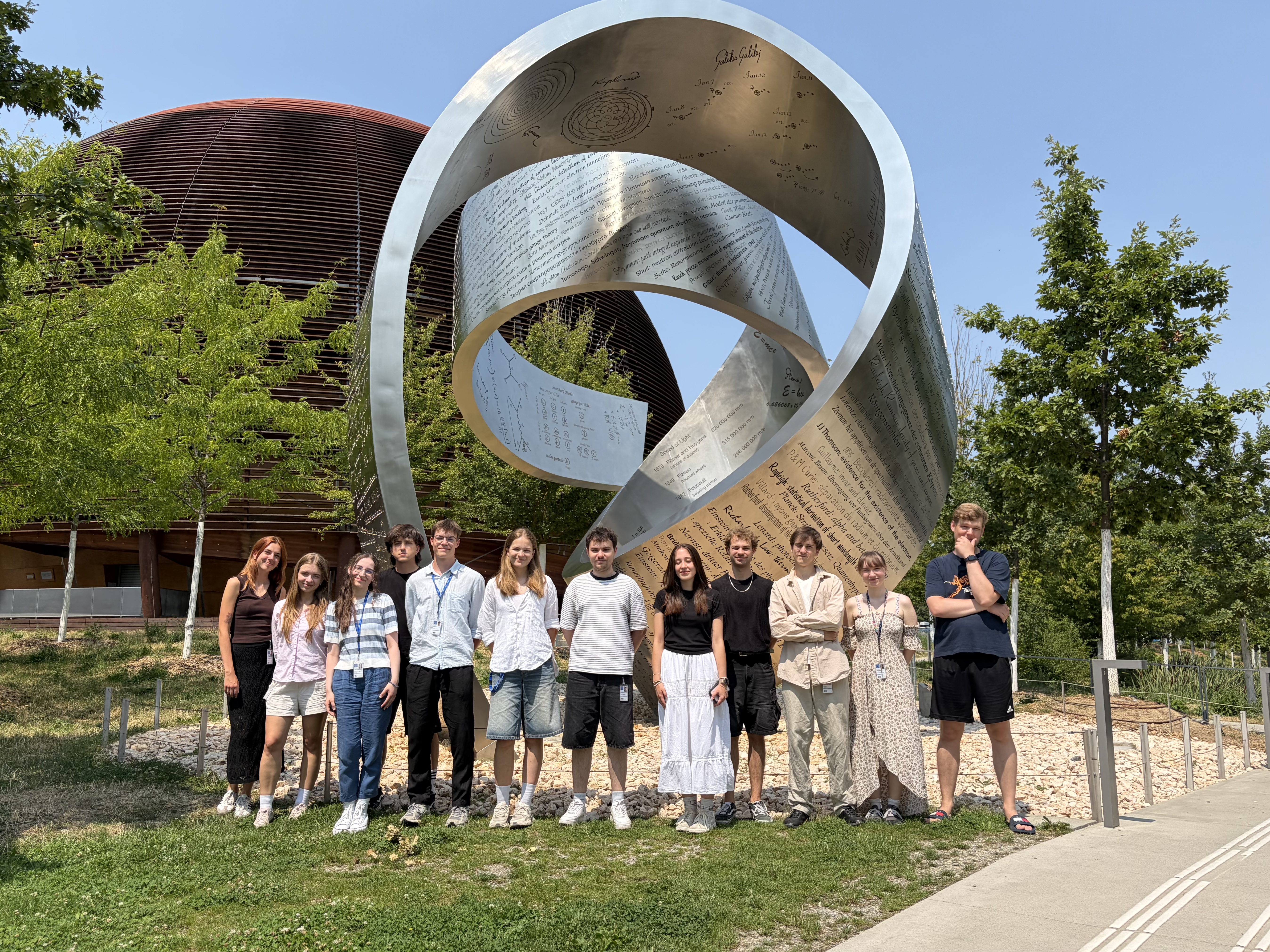
VU students at CERN. Photo from the students' personal archive
An inspiring experience
“I was constantly surrounded by exceptional scientists. While I could have carried out my project anywhere in the world, CERN offered a unique environment that continually inspired me to learn, collaborate and develop new ideas alongside my colleagues,” said Ernesta Idzelytė, an undergraduate Physics student.
Although much of their time was dedicated to research and project work, students also had numerous opportunities to learn from some of the world's leading experts. Participating in programmes with students from around the world, they met regularly at lectures, workshops, and social events, sharing experiences, discussing challenges, and broadening their perspectives.
“Working in an international environment allowed me to engage with scientists and engineers from around the world, learn from their experience, discuss challenges and collaboratively develop solutions. Such an environment fosters curiosity, independence, teamwork and a commitment to continuous learning,” said Margarita Biveinytė, a master's student in Photonics and Nanotechnology, who spent her third summer at CERN.
Students descended 56 metres underground to visit the ALICE detector, one of the four major experiments at the Large Hadron Collider (LHC). “Seeing the detector and grasping its immense scale made me reflect on how only the combined efforts of experts from a wide range of disciplines can help us unlock the secrets of the Universe,” said Deimantė Juknevičiūtė, an undergraduate Physics student.
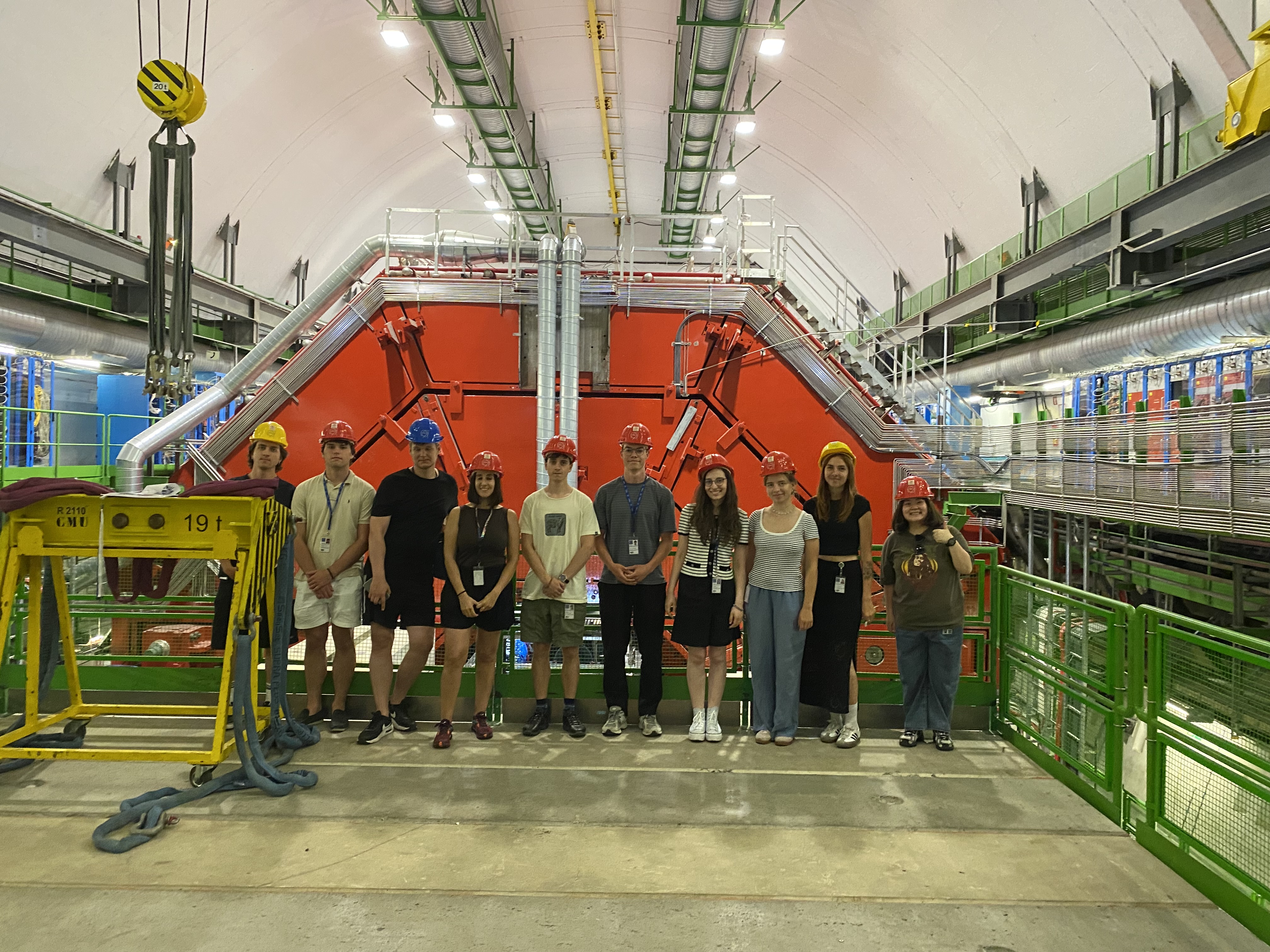
VU students at ALICE. Photo from the students' personal archive
The CERN Data Centre, the control rooms of the LHC’s major experiments, particle detectors, the Antimatter Factory, the Synchrocyclotron (CERN’s first particle accelerator, operational until 1990), and many other facilities left a lasting impression on the students. Among the highlights were CERN's cryogenic technologies, which keep the Large Hadron Collider's equipment at extremely low temperatures. Above all, however, the students valued the opportunity to learn how technologies have evolved over the decades and to gain a deeper understanding of the fundamental questions that CERN’s research seeks to answer.
Jokūbas Mačiulis, an undergraduate student in Light Engineering, emphasised that there is always an opportunity to learn something new at CERN that can prove valuable elsewhere in the future. “The fact that the World Wide Web was originally developed as an internal tool at CERN and later became something used by people around the globe perfectly illustrates the kind of ideas that emerge here. Equally important was the environment itself: people from all over the world, a shared culture of collaboration and the feeling of being part of something bigger than yourself. It is an experience I will never forget,” he said.
Balancing research and recreation
The students' days began with lectures organised as part of the summer programme, followed by lunch with colleagues and work on their individual projects. The lectures explored a broad range of topics, from the theoretical principles of particle physics to detector and accelerator technologies. Among the speakers were representatives of Nvidia, one of the world's leading technology companies.
Rūta Lomsargytė, a Physics student on her second internship at CERN, and J. Mačiulis were very impressed by the lectures given by Professor Bjarne Stroustrup, the creator of the C++ programming language. This programming language is one of the most popular in the world and is used, for example, in scientific research, operating systems, robotics and computer game development.
“It was a wonderful and rare opportunity to listen to people who have achieved so much in their respective fields, ask them questions and get to know them,” said Eliza Holvoet, an undergraduate in Light Engineering. According to E. Idzelytė, although most of the lectures were not directly related to the internship projects, they provided a wealth of new knowledge and inspired her to delve deeper into high-energy physics. D. Juknevičiūtė said she had learned more about particle physics, magnets, and superconductors. “The lectures drew large numbers of young people from all over the world. What makes CERN special is that everyone here is united by the same curiosity and love of physics,” she said.
The students appreciated that CERN fosters a sense of community and offers a range of initiatives and events that help people connect and unwind after work. One of the local restaurants hosted live music nights with pizzas baked outdoors. On 18 July, the annual “Hardronic” music festival brought CERN colleagues together, with community bands and musicians performing on specially built stages.
“Physics allows us to know the world from the inside – to grasp the laws and mathematical equations that govern it – while travel helps us experience that same world through human senses, emotions and adventures. Productive scientific work and meaningful leisure do not interfere with one another but complement each other,” said D. Juknevičiūtė.
Some VU students spent their free time organising weekend hikes in France and Switzerland with their colleagues. They visited the Alps, Lake Oeschinen, the Jura Mountains, and the summit of Salève, as well as Switzerland's major cities – Zurich, Geneva, Lausanne and Bern – and explored museums of science, art and history, among other sites.
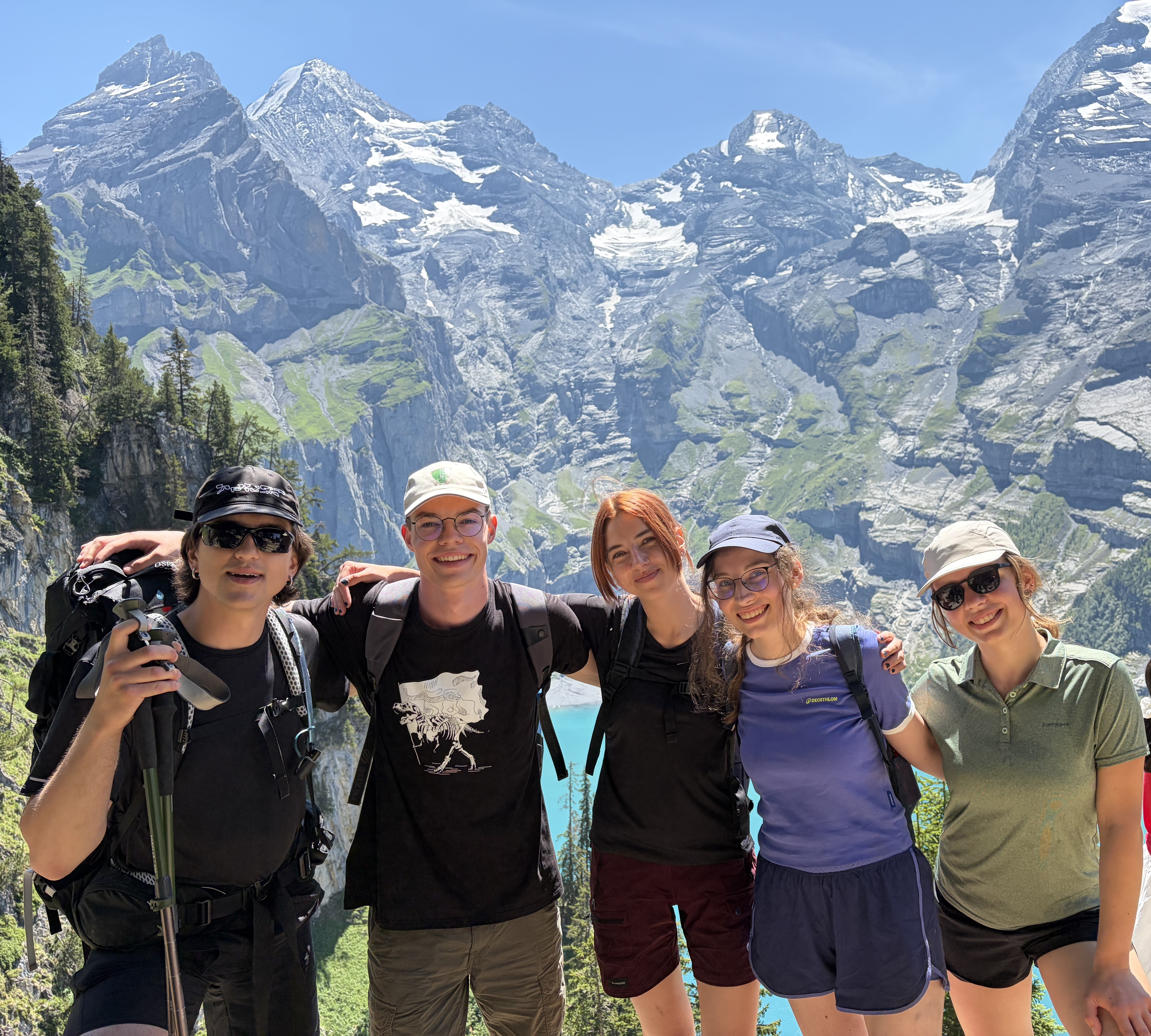
Photo from the students' personal archive
“The scenery here is simply stunning and staying active was a great way to recharge after the working week,” said J. Mačiulis. E. Idzelytė added that the mountain landscapes, azure lakes and rivers left a deep impression on her and became a real highlight of the internship. “An opportunity to travel and spend time in the mountains not only created the perfect balance between rest and work but also let us strengthen our bond with the other Lithuanians – a bond that, I have no doubt, we'll keep up even after returning to Lithuania,” she said.
The computer as the core working tool
E. Idzelytė developed a model of 3D sensor operation for a future muon particle accelerator and worked on integrating it into a computer simulation programme. “The goal of the project is to test the model's effectiveness and find the best sensor layout that allows us to distinguish useful signals from noise,” the student explained.
“This is a great opportunity to see what a scientist's life is really like and to figure out what career path to pursue. This experience helped me finally decide that I see myself in the field of particle physics, and it inspired me to actively pursue this goal,” she said.
D. Juknevičiūtė aimed to enhance data analysis for future particle physics experiments. The Future Circular Electron-Positron Collider (FCC-ee) will produce vast quantities of data, requiring highly efficient processing and analysis techniques. Using the Python programming language, the Physics student developed and tested a method that converts raw experimental data into a more compact format better suited to analysis. This would help scientists speed up data processing, enabling them to devote more time to physics analysis and the interpretation of results.
“For example, during one of its planned operational phases, the FCC-ee is expected to produce around five trillion Z bosons. To put this into perspective, the entire dataset collected by CERN's previous electron-positron collider, the Large Electron-Positron Collider (LEP), between 1989 and 2000 would be generated by the FCC-ee in approximately 30 seconds. Handling such vast amounts of data requires fast, efficient, and user-friendly analysis tools. That is precisely what my project is focused on,” she said.
J. Mačiulis's project involves developing software for physics data analysis. According to him, CERN's experiments collect vast amounts of data on particle collisions; these are stored in a special format called ROOT. The “uproot” library for the Python programming language allows this data to be read and written without CERN's more complex software. “Until now, this library could only be used to create new files. For example, if a dataset contained 10 million records and you wanted to add a single new column, the entire file would have to be rewritten. My objective was to introduce in-place file modification, enabling users to open an existing file, append new data, and leave the rest unchanged. The functionality was successfully implemented for both the legacy ROOT data format and its newer successor, which CERN is actively adopting. Both solutions are currently undergoing review and are expected to be incorporated into the official library used by physicists worldwide,” he said.
Developing technologies of the future
Eglė Lenkaitytė, a master's student in theoretical physics and astrophysics, analysed the Higgs boson's decay into charm quarks. “The strength of a particle's interaction with the Higgs field is related to its mass: the stronger the interaction, the heavier the particle. The interactions of third-generation fermions (particles) have already been well studied, and the current goal is to better measure the interactions of second-generation fermions, including the charm quark. Since the latter is significantly lighter, measuring its interaction with the Higgs boson is more complicated,” the student explained. In her project, she sought to improve the identification of this process using data analysis and machine learning methods.
Building on her previous internship, M. Biveinytė returned to the Vertex Locator (VELO) detector group of the Large Hadron Collider beauty (LHCb) experiment at CERN. She continued her research into silicon sensor technologies, gaining a deeper understanding of their practical applications. Together with E. Holvoet, she worked on a laboratory measurement system used to investigate and characterise signals from different silicon sensors exposed to various radioactive sources.
“The main objective was to develop a reliable and readily accessible method for characterising silicon sensors under laboratory conditions, without the need for particle beam tests. Although such tests are invaluable, they are only available at specific times, can be complex to organise, and are not always readily accessible. A laboratory-based system using radioactive sources could therefore provide a fast and practical way to verify sensor performance, measure the amount of charge collected, and investigate how sensor response varies with thickness. Such studies are also important for preparing sensors for future experiments, comparing different sensor technologies, and identifying potential technical issues before undertaking more complex and resource-intensive tests,” explained M. Biveinytė.
E. Holvoet enjoyed the dynamic working environment, the opportunity to contribute directly to experimental research, and the balance between hands-on work and data analysis. Following M. Biveinytė's departure, she stayed on to complete the project.
Photo from the students' personal archive
By working with mentors and professionals from a range of fields and carrying out different projects, the VU students contributed to the development of future technologies. On returning to Lithuania, they bring back not only new knowledge, experience and motivation, but also lasting memories and valuable new perspectives. They highly recommend the experience to others and hope to return themselves, continuing to deepen their understanding of the work carried out at one of the world's leading particle physics research organisations.
They took part in the CERN Summer Student Programme and in IRIS-HEP and Erasmus+ internships, deepening their knowledge of physics and programming. Ten of them are students at the Faculty of Physics and three at the Faculty of Mathematics and Informatics. Some are members of the “LHCb Vilnius” group.
From 14 to 18 September, VU will host LHCb Week, an international conference dedicated to CERN's LHCb experiment. For the first time, several hundred members of the LHCb collaboration from around the world will gather in Lithuania.
This shows that collaboration between VU and CERN is growing stronger.