

“Whilst travelling, I realised that sometimes we live in bubbles and the problems we face seem bigger than they really are,” says Mindaugas Gudaitis, a bachelor’s student at the Faculty of Physics, Vilnius University (VU). He spent the spring semester on an exchange programme at Chung-Ang University, where he gained not only academic knowledge but also a unique cultural experience.
M. Gudaitis. Photo from personal archive
Physics and engineering – an unusual choice
Chung-Ang University has around 10,000 more students than Vilnius University. The university is renowned for its strong arts programmes, but it also carries out research in the natural sciences, actively engaging in research into AI and pharmaceuticals.
“Although, as an exchange student, the physics programme, the choice of modules and the facilities did not seem to be on a par with those at Vilnius University, I had heard that high-level research into semiconductors was being carried out there. The modules I chose were mainly in the field of engineering. From what I could gather from the other exchange students – 500 in total – very few had chosen physics or engineering. Most were business and IT students,” said Gudaitis.
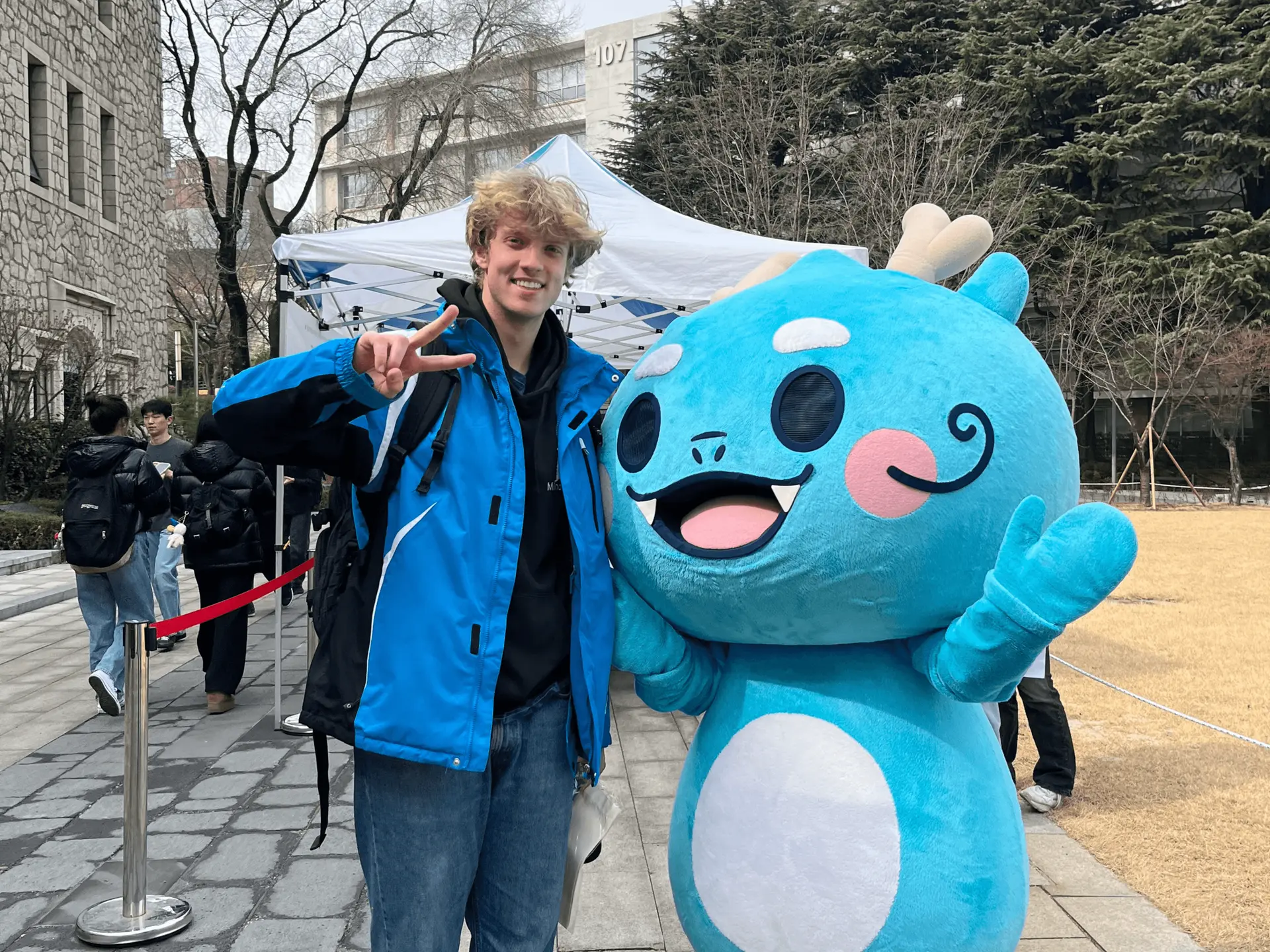
The student represented Lithuania and VU at the university fair. “They don’t know much about Lithuania – just where it is on the map. At the fair, each of us had the chance to present the country we’d come from. The Koreans themselves were fascinated to see images of the architecture of Vilnius’s Old Town – it’s quite exotic to them,” said the student.

M. Gudaitis. Photo from personal archive.
Intense academic culture
At Chung-Ang University, the semesters are slightly shorter than is usual in Lithuania – 4 months instead of 6 – and the culture surrounding examinations and the academic environment itself is also different. “The studies are very intense; during the exam period, I even had to take 6 exams in a single week. The exams are mainly multiple-choice, but there are a large number of questions and very little time. Sometimes it felt as though our ability to complete the test was being assessed rather than our actual knowledge – if you make even a single arithmetic error, you get zero marks. Lecturers at Vilnius University aren’t quite so strict about time limits; they place greater value on the thought process itself rather than the perfection of the solution – I find that more acceptable.
The academic culture there is also very intense, with compulsory attendance. I’m glad that, as an exchange student, my workload was lighter and I was able to choose all my modules myself. Although Koreans are very competitive with one another, nobody talks about their marks amongst themselves, so I didn’t really feel the pressure; overall, I felt comfortable studying there. Generally speaking, I liked the lecturers; they taught in an interesting and professional manner. I was just surprised that I was the only exchange student who was perhaps the most active in answering questions in class – a large proportion of the class were too shy to answer when the lecturer asked a question,” said Gudaitis.
Although the student missed nature and tranquillity in the Seoul metropolis, the city captivated him. “Seoul is very concrete-heavy. Of course, there are parks there, but I feel more at home in Lithuania, where there’s more nature within the city. You really feel the huge number of people in Seoul – there are almost 10 million residents there. But wherever you go, you’ll bump into people. Unlike, for example, at the Saulėtekis student campus. I really missed that tranquillity – in tourist spots and on the streets in the centre, it feels as though you’re walking through a crowd of people released from a stadium after a match. On the underground after work, everyone was packed in like sardines. It was very tiring. I’m glad I lived in the student village, which, although not in the city centre, wasn’t out in the suburbs either. However, the distances between places are very long, and a journey by public transport would take at least 40 minutes. Despite all that, this very modern and colourful city charmed me – there you can find all sorts of entertainment, interesting food from different cultures and activities,” the student told.

With the language teacher. Photo from personal archive
A unique food culture and an unexpected encounter
Gudaitis highlights Korean food culture as a unique experience, one that differs greatly from Lithuanian cuisine. “The food there is really interesting – they like it spicy, but sweet at the same time. I had kimchi with almost every meal; it was delicious. They have all sorts of sugary drinks and sweet snacks – they were too sweet for me; I missed salt and potatoes – even the potatoes there are sweet... Their bread is white and more like a cake, sweet as a treat. Once, whilst travelling, I saw some black bread, but then I realised it was actually a cake. I’d brought some bread chips with me, and the Koreans really liked them,” said Gudaitis.
Apart from the food, something else left a lasting impression – the free Korean language courses, to which he was invited by some elderly people he met by chance at the university. The student singles out this activity as one of the most enjoyable experiences of the exchange.
“It turns out that the university itself runs community-led courses where students are taught the language almost privately, in groups of two or three. All the teachers teach voluntarily and for free; the vast majority of them are already retired. But they all speak English. We had lessons once a week; it was fun to learn at least a little Korean. I also attended other, more intensive courses, during which I learnt to read the script. Admittedly, learning the language there isn’t very easy; practically everything in public spaces is written in English, so I didn’t have many opportunities to practise, apart from reading street signs. Our teacher was very friendly – I think he was an engineer, now retired. We became good friends; we even went to the cinema together, and he would tell us about his daily life, his travels and his family,” said the student.

M. Gudaitis. Photo from personal archive.
Discover Korea off the beaten track
According to Gudaitis, young Koreans tend to be rather reserved, whilst older people – although they often do not speak English – are very polite and helpful. He noticed these differences whilst travelling in his spare time.
“I visited practically all the main tourist attractions in South Korea. Of course, I had to plan my time carefully, because if you miss three or four lectures, you fail the whole course, and I had lectures five days a week. I usually travelled at the weekends, visiting different cities. South Korea has some very beautiful mountains; I’ve even heard that hiking is considered a national sport there. That was the first time I’d ever gone hiking in the mountains – nothing too extreme, but I really enjoyed it. The natural scenery there is stunning, with plenty of forests. There are also many Buddhist temples; I visited one in an older town myself, where there are lots of temples, monuments and burial sites. There are many coastal towns, as well as the volcanic island of Jeju with its tropical climate, which is a favourite with tourists.
I’m glad I managed to travel around so much. I visited small towns where I didn’t see a single foreigner, and travelled by ferry to tiny islands that are mostly visited by Koreans themselves. In places like that, I got a feel for the local, non-touristy side of Korea. The people there are very friendly – they come up to you themselves and treat you to bananas or soup. It’s a very beautiful country. After my exams, I took the opportunity to fly to Taiwan; my friends also travelled to neighbouring countries, such as Vietnam. To sum up, I’m really glad I had this opportunity to study abroad. I’ve also gained a fair bit of life experience. I’d recommend everyone give it a go,” said the student.