

Dr Kazimieras Černis, a researcher at the Institute of Theoretical Physics and Astronomy, Faculty of Physics, Vilnius University (VU), has named an asteroid in honour of the priest Juozas Tumas-Vaižgantas. This commemorates one of Lithuania’s most prominent writers and public figures, whose 157th birthday is celebrated on 20 September.
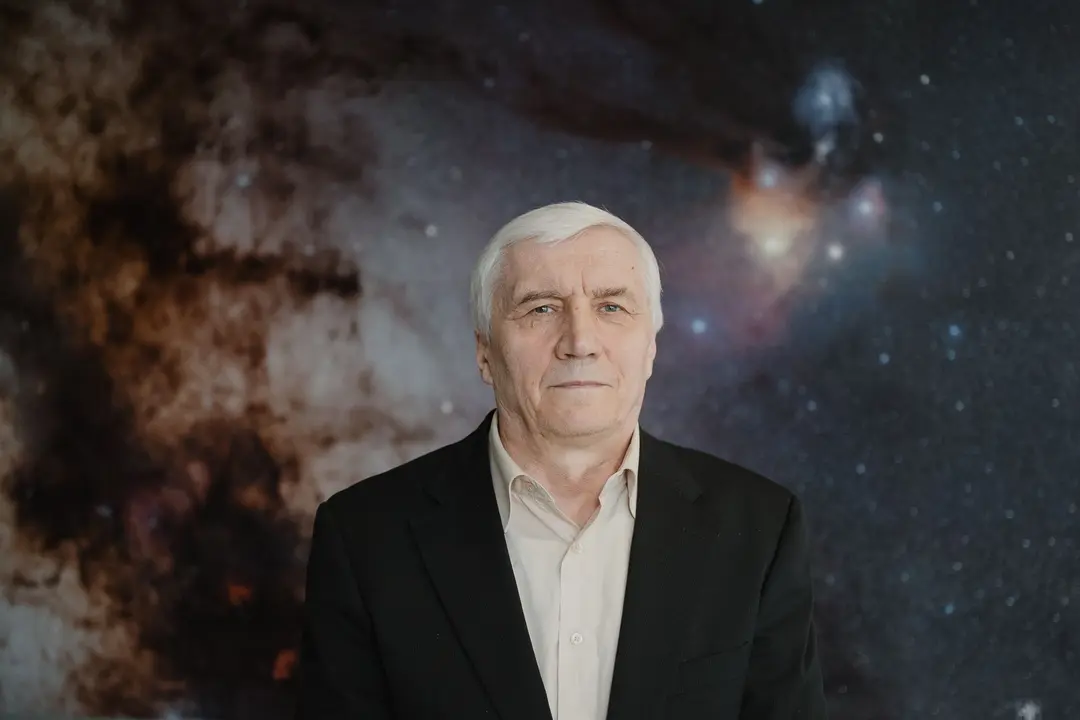
Dr Kazimieras Černis. Photo by VU.
From discovery to naming
Although the asteroid was named this summer, it was discovered just over a decade ago. Since then, other observatories have confirmed the discovery, it has been actively monitored, and its orbit has been determined, according to the scientist.
'We discovered this asteroid on 6 October 2015, together with Dr Ilgmārs Eglītis, at the Baldone Astronomical Observatory in Latvia. At the time, we were still using the observatory’s old camera, which had a rather narrow field of view and was not ideally suited to searching for asteroids. I remember that the weather conditions were poor at the time, so we were only able to carry out observations at dawn and managed to capture just three images of this asteroid. The asteroid was very faint, and when the weather forced us to stop observing, we thought we’d lost track of it.
However, eight days later, our discovery was confirmed by the Kitt Peak National Observatory in Arizona. If we hadn’t received that confirmation, it would have been very difficult to track this celestial body, so we were really lucky. This asteroid’s orbit is a highly elongated ellipse. Consequently, it can only be observed when it approaches Earth; until then, it is too far away and too faint for us to spot. It is also quite small – just 1 km in diameter,' explains the astronomer.
The asteroid will approach next summer
According to data from the International Astronomical Union’s Minor Planet Centre database, the asteroid (846464) 'Vaižgantas' is, on average, 2.6 times further from the Sun than Earth, and orbits the Sun in 4 years and 40 days. Orbital elements of the asteroid: a = 2.562 AU, e = 0.274, i = 12.670°, P = 4.11 years. 'Vaižgantas' will approach Earth again on 16 June 2027 – the closest distance will be approximately 151 million km. At that time, it will be approximately magnitude 20. The asteroid will appear on the border between the constellations Aquila and Delphinus, and observing conditions in Lithuania will be among the most favourable.
The International Astronomical Union has announced that the asteroid, previously designated 2019 RS14 (846464), has been named 'Vaižgantas' following a proposal by Dr K. Černis. The citation for the name was published in the WGSBN Bulletin in 2026.