

Physicist Dr Remigijus (Remis) Gaska has spent more than 30 years working in the semiconductor field in the United States. Having lived in as many as five states, worked at universities and founded and grown businesses there, he not only looks back fondly on Vilnius University (VU) but also maintains close ties with it.
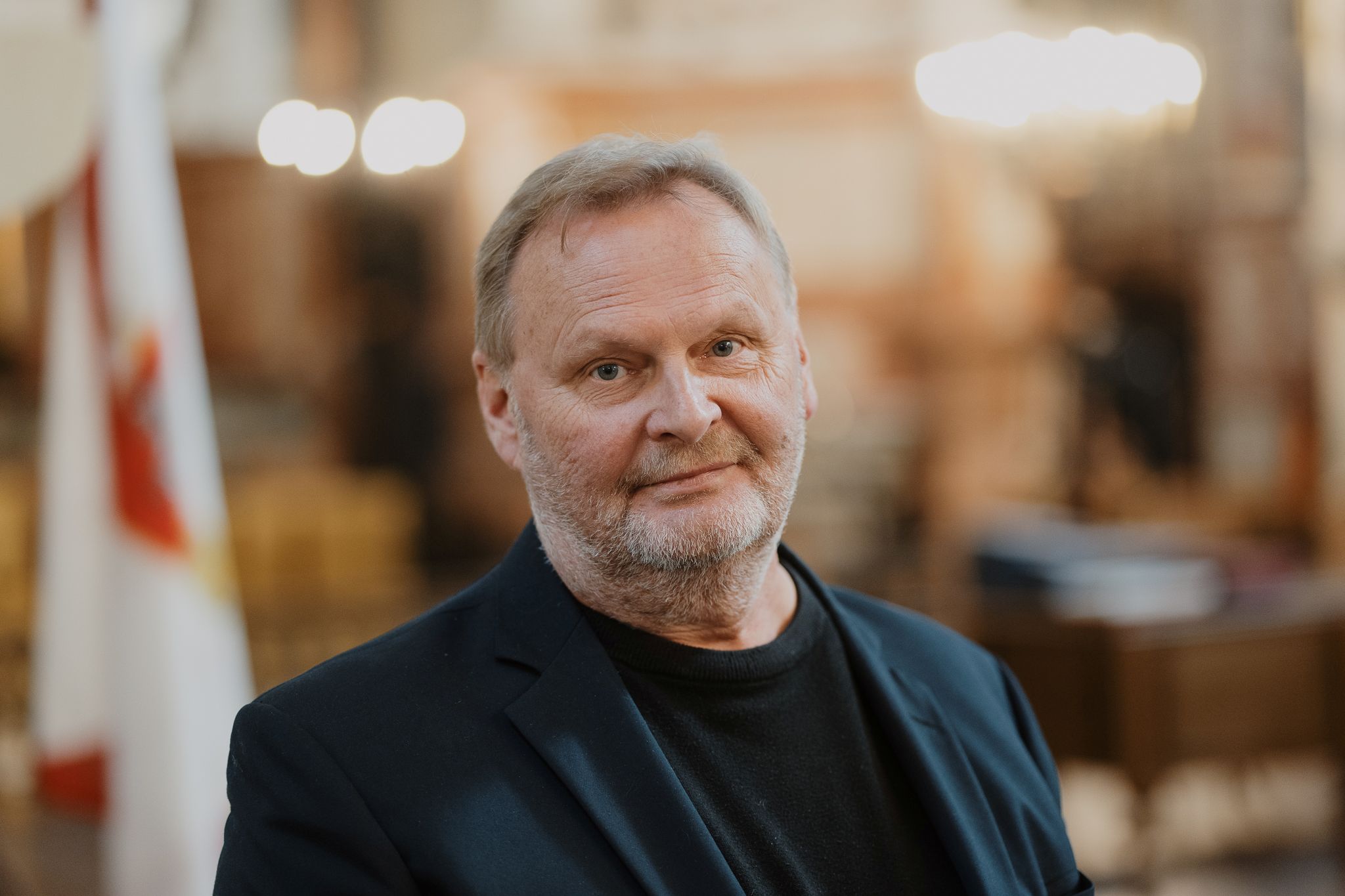
Dr Remigijus Gaska. Photo credit: VU
With more than 500 scientific papers and over 200 inventions to his name, Dr Gaska began his career at VU’s Semiconductor Physics Research Laboratory. In 1992, he moved to the United States, where he developed what was then the world’s most powerful transistor. He has lived in South Carolina for the past 20 years.
Enormous potential for semiconductors in many fields
“I spent a lot of time at Cornell University in New York State, where I had the opportunity to work in a unique, world-renowned laboratory. From there, I moved to Minnesota and joined a company that had launched the development of wide-bandgap gallium nitride (GaN)-based semiconductor materials and devices. We were pioneers, both in the US and internationally,” recalls Dr Gaska.
In Minnesota, he grew unique semiconductor materials. “My former diploma thesis supervisor, Prof. Artūras Žukauskas, who later became Rector of VU, got in touch with me. We agreed to send as much material as we could to the Faculty of Physics, where colleagues studied it and wrote papers. When I moved back to New York State, I received a couple of sizeable grants, which made it possible to invite colleagues from Lithuania for stays ranging from a few months to several years,” he says.
At Rensselaer Polytechnic Institute, the oldest technological university in the United States, Dr Gaska set up a new kind of optical research laboratory with funding from the US National Science Foundation. “At the time, we even sourced equipment from Lithuania. I had to justify buying it from Vilnius and I proved that it was genuinely unique: it was based on prototypes developed by Algis Petras Piskarskas and Kęstutis Jarašiūnas,” he explains.
Dr Gaska went on to found Sensor Electronic Technology, Inc., a company specialising in GaN-based semiconductor device technologies. He recalls that their development was funded by US defence industry.
“The original idea was to develop a light source that could help detect biological weapons and enable specialised optical communication systems. By the time I finished my work at the company, we had more than 3,000 customers. Our LEDs ended up in many places, NASA among them. As it happened, an optical disinfection system based on the company’s technology flew to the International Space Station” says Dr Gaska. He stresses that semiconductors hold enormous potential in many fields.
Lithuanian physicists: talented and hard-working
Dr Gaska recalls the days when he himself helped organise Physicist’s Day (FiDi). “Student life was wonderful back then and FiDi was a grand celebration. We would cause quite a stir in Vilnius. If I remember correctly, I chaired the 14th FiDi. We spent our first two years at Naugarduko Street, Afterwards we moved to Saulėtekis and there I came up with the idea of setting up an amusement park and calling it Fizland,” he says. The Fizland tradition is still part of the FiDi programme.
“The Faculty of Physics is home to talented, creative and hard-working people. Today the doors are wide open for them to strengthen international cooperation. It’s important that physicists in Lithuania are building up a technological base and creating more opportunities for collaboration on materials and devices. I’d love to live to see the Faculty of Physics celebrate its centenary,” he says with a smile.
As an inventor who has spent many years in business, Dr Gaska stresses the importance of intellectual property. “It matters not only to science and the university, but to business as well. The US is very active on this front and appreciates the value of patents. A single patent is like a stake in a field. You come across it, see it’s just a stake, and walk around it. But if you have more of them and put up a fence, the next person has to work out whether it’s worth going all the way around or whether it makes more sense to pay to have the gate opened,” Dr Gaska explains. He hopes his colleagues in Lithuania will file many more patents.
With his Lithuanian work ethic and strong character, he has finally learned not to overwork. Looking ahead, he hopes to spend more time travelling and to see different parts of the world for pleasure rather than work. “I’ve spent the last ten years living on planes. I’ve promised myself I won’t work 24/7 any more. As well as travelling, I want to spend more time in Lithuania. I still work, but I no longer overdo it,” he says. He does let slip, however, that he has another idea in the works: he has founded a new start-up, UVTON, Inc., and has already been granted its first patents.
Dr Gaska has collaborated with colleagues at the University for many years. In 2008, together with professors Saulius Juršėnas, Edmundas Kuokštis, and Gintautas Tamulaitis, he was awarded the Lithuanian Science Prize for their series of studies “Optical Spectroscopy of Semiconductors and Their Quantum Structures for Short-Wavelength Optoelectronics” (2001–2007) (Trumpabangės optoelektronikos puslaidininkių ir jų kvantinių darinių optinė spektroskopija (2001–2007 m.). In 2015, the Ministry of Education and Science honoured him for his internationally significant scientific achievements and collaboration with Lithuania. After moving to South Carolina to build factories and advance LED technologies, he established a scholarship for VU students, which is still awarded for the best Bachelor’s theses at the Faculty of Physics.