Sidebar

27-30 June the Vilnius University will host Workshop on Unconventional Optical Lattices (UOL2025), organised by VU Faculty of Physics.

The aim of the Workshop is to discuss how experiments with ultracold gases can address open problems of quantum dynamics and many-body quantum physics. Particular attention will be paid to unconventional optical lattices, including lattices with non-standard geometries, unusual atom-atom interactions, etc.

Find more on event's website.


ISOTDAQ 2025 is an international school organized for the 15th time with an aim of introducing those with an education in physics, engineering or computing (ranging from undergrads to postdocs) to the "arts and crafts" of triggering and acquiring data for physics experiments. The main aim of the school is to provide an overview of the basic instruments and methodologies used in high energy physics, spanning from small experiments in the lab to the very large LHC experiments, emphasizing the main building blocks as well as the different choices and architectures at different levels of complexity. The school is split 50%-50% between a series of lectures, which are open to public, and hands-on laboratory exercises, where the registered school participants will use the concepts and techniques they have learned throughout the course.

Lectures are open to public. 

WHEN? 17 - 26 June 2025

WHERE? National Center for Physical Sciences and Technology (NFTMC), Saulėtekio al. 3, Vilnius.

Find more information and programme here.

ISOTDAQ 2025 is an international school organized for the 15th time with an aim of introducing those with an education in physics, engineering or computing (ranging from undergrads to postdocs) to the "arts and crafts" of triggering and acquiring data for physics experiments. The main aim of the school is to provide an overview of the basic instruments and methodologies used in high energy physics, spanning from small experiments in the lab to the very large LHC experiments, emphasizing the main building blocks as well as the different choices and architectures at different levels of complexity. The school is split 50%-50% between a series of lectures, which are open to public, and hands-on laboratory exercises, where the registered school participants will use the concepts and techniques they have learned throughout the course.

Lectures are open to public. 

WHEN? 17 – 26 June 2025

WHERE? National Center for Physical Sciences and Technology (NFTMC), Saulėtekio al. 3, Vilnius.

Find more information and programme here.

ISOTDAQ 2025 is an international school organized for the 15th time with an aim of introducing those with an education in physics, engineering or computing (ranging from undergrads to postdocs) to the "arts and crafts" of triggering and acquiring data for physics experiments. The main aim of the school is to provide an overview of the basic instruments and methodologies used in high energy physics, spanning from small experiments in the lab to the very large LHC experiments, emphasizing the main building blocks as well as the different choices and architectures at different levels of complexity. The school is split 50%-50% between a series of lectures, which are open to public, and hands-on laboratory exercises, where the registered school participants will use the concepts and techniques they have learned throughout the course.

Lectures are open to public. 

WHEN? 17 – 26 June 2025

WHERE? National Center for Physical Sciences and Technology (NFTMC), Saulėtekio al. 3, Vilnius.

Find more information and programme here.

ISOTDAQ 2025 is an international school organized for the 15th time with an aim of introducing those with an education in physics, engineering or computing (ranging from undergrads to postdocs) to the "arts and crafts" of triggering and acquiring data for physics experiments. The main aim of the school is to provide an overview of the basic instruments and methodologies used in high energy physics, spanning from small experiments in the lab to the very large LHC experiments, emphasizing the main building blocks as well as the different choices and architectures at different levels of complexity. The school is split 50%-50% between a series of lectures, which are open to public, and hands-on laboratory exercises, where the registered school participants will use the concepts and techniques they have learned throughout the course.

Lectures are open to public. 

WHEN? 17 – 26 June 2025

WHERE? National Center for Physical Sciences and Technology (NFTMC), Saulėtekio al. 3, Vilnius.

Find more information and programme here.

ISOTDAQ 2025 is an international school organized for the 15th time with an aim of introducing those with an education in physics, engineering or computing (ranging from undergrads to postdocs) to the "arts and crafts" of triggering and acquiring data for physics experiments. The main aim of the school is to provide an overview of the basic instruments and methodologies used in high energy physics, spanning from small experiments in the lab to the very large LHC experiments, emphasizing the main building blocks as well as the different choices and architectures at different levels of complexity. The school is split 50%-50% between a series of lectures, which are open to public, and hands-on laboratory exercises, where the registered school participants will use the concepts and techniques they have learned throughout the course.

Lectures are open to public. 

WHEN? 17 – 26 June 2025

WHERE? National Center for Physical Sciences and Technology (NFTMC), Saulėtekio al. 3, Vilnius.

Find more information and programme here.

ISOTDAQ 2025 is an international school organized for the 15th time with an aim of introducing those with an education in physics, engineering or computing (ranging from undergrads to postdocs) to the "arts and crafts" of triggering and acquiring data for physics experiments. The main aim of the school is to provide an overview of the basic instruments and methodologies used in high energy physics, spanning from small experiments in the lab to the very large LHC experiments, emphasizing the main building blocks as well as the different choices and architectures at different levels of complexity. The school is split 50%-50% between a series of lectures, which are open to public, and hands-on laboratory exercises, where the registered school participants will use the concepts and techniques they have learned throughout the course.

Lectures are open to public. 

WHEN? 17 – 26 June 2025

WHERE? National Center for Physical Sciences and Technology (NFTMC), Saulėtekio al. 3, Vilnius.

Find more information and programme here.

ISOTDAQ 2025 is an international school organized for the 15th time with an aim of introducing those with an education in physics, engineering or computing (ranging from undergrads to postdocs) to the "arts and crafts" of triggering and acquiring data for physics experiments. The main aim of the school is to provide an overview of the basic instruments and methodologies used in high energy physics, spanning from small experiments in the lab to the very large LHC experiments, emphasizing the main building blocks as well as the different choices and architectures at different levels of complexity. The school is split 50%-50% between a series of lectures, which are open to public, and hands-on laboratory exercises, where the registered school participants will use the concepts and techniques they have learned throughout the course.

Lectures are open to public. 

WHEN? 17 – 26 June 2025

WHERE? National Center for Physical Sciences and Technology (NFTMC), Saulėtekio al. 3, Vilnius.

Find more information and programme here.

ISOTDAQ 2025 is an international school organized for the 15th time with an aim of introducing those with an education in physics, engineering or computing (ranging from undergrads to postdocs) to the "arts and crafts" of triggering and acquiring data for physics experiments. The main aim of the school is to provide an overview of the basic instruments and methodologies used in high energy physics, spanning from small experiments in the lab to the very large LHC experiments, emphasizing the main building blocks as well as the different choices and architectures at different levels of complexity. The school is split 50%-50% between a series of lectures, which are open to public, and hands-on laboratory exercises, where the registered school participants will use the concepts and techniques they have learned throughout the course.

Lectures are open to public. 

WHEN? 17 – 26 June 2025

WHERE? National Center for Physical Sciences and Technology (NFTMC), Saulėtekio al. 3, Vilnius.

Find more information and programme here.

Dominyka Stonytė, PhD student at Vilnius University will defend her PhD thesis "Ultrashort UV pulse-material interaction for laser microfabrication applications" in the field of Physics N 002. The defence will take place at 30 June 2025, 14:00, at VU Faculty's of Physics Laser Research Centre (Saulėtekio al. 10, LT-10223, Vilnius). Research Supervisor - prof. dr. Domas Paipulas.

Hong-Ou-Mandel effect (HOM), also known as two-photon interference, is a key tool in quantum optics laboratories, and has powerful applications for metrology and sensing even in the classical regime. We recently demonstrated that HOM interferometry can be used to for fluorescence lifetime imaging – a key tool in biomedical research that can detect changes in cell microenvironment such as temperature, pH, viscosity and protein-protein interactions. 

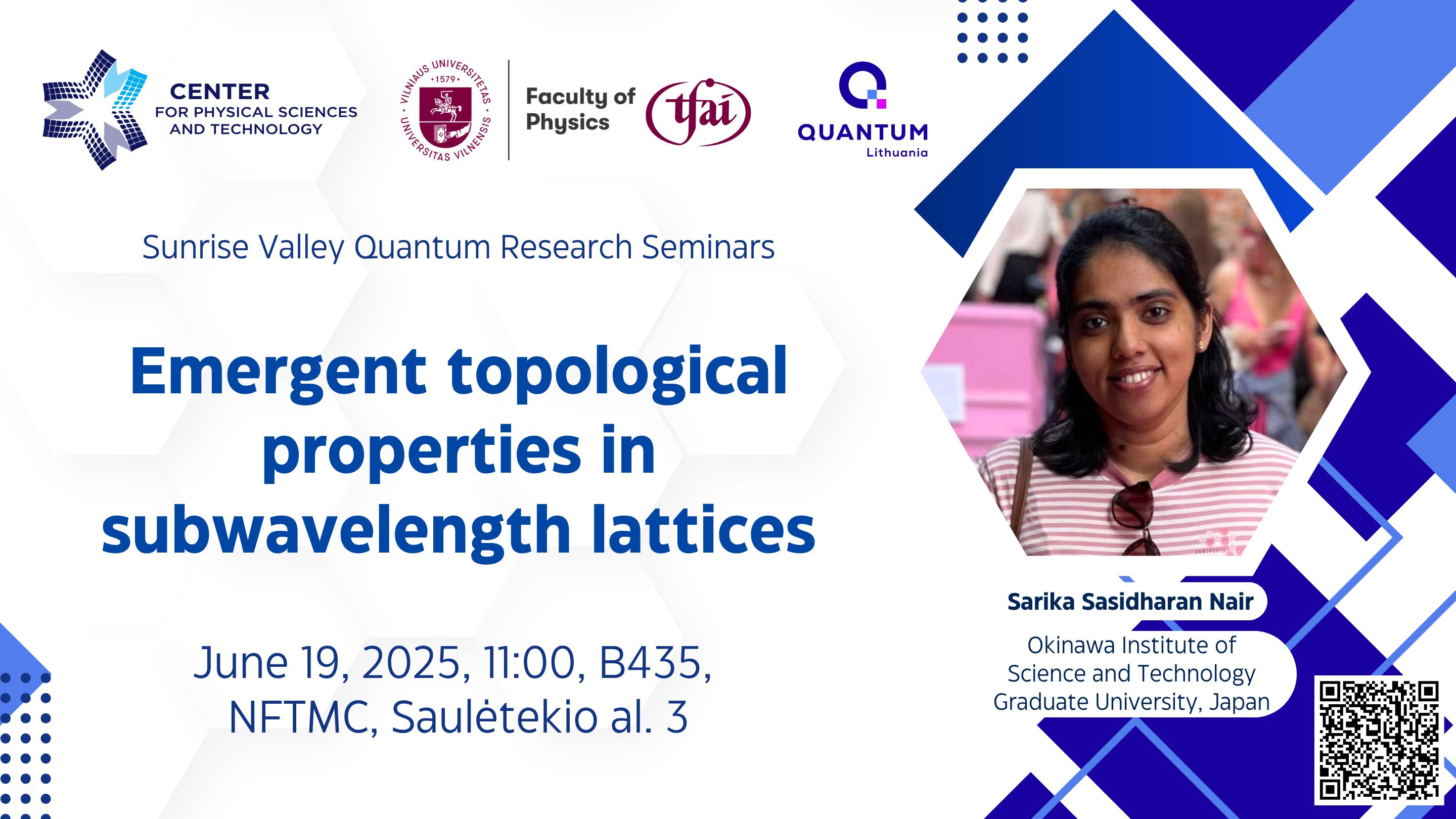
This seminar will present how cold atoms and topological phenomena are merging into one of the most exciting research areas in modern physics. Using cold atoms in optical lattices, scientists can simulate topological phases in materials - from topological insulators and superconductors to the Quantum Hall effect. Such models allow the study of edge states, quantum responses and new quantum phases of matter that do not exist in ordinary materials.

Start time: 2025-09-10 11:00
End time: 2025-09-10 13:00

Žygimantas Vosylius, PhD student at Vilnius University, 10 September 2025, 11:00, at A101 auditorium, the Center for Physical Sciences and Technology (Saulėtekio ave. 3, Vilnius), will be defending his PhD thesis „Characterization and Mitigation of Mismatch Effects in Solar Cell Testing Using Advanced LED-based Solar Simulators“. Supervisor - dprof. dr. Vincas Tamošiūnas.

The defence will be held in English.

Start time: 2025-09-12 11:00
End time: 2025-09-12 14:00

Romualdas Jonas Čepas, PhD student at Vilnius University, 12 September 2025, 11:00, at B336 auditorium, the National Center for Physical Sceinces and Technology (Saulėtekio ave. 3), Vilnius), will be defending his PhD thesis „Studies of charge carrier recombination and transport in disordered materials and their application in optoelectronic devices“. Supervisor - dr. Kristijonas Genevičius.

The defence will be held in Lithuanian.

Start time: 2025-09-29 10:00
End time: 2025-09-29 13:00

Erikas Atkočaitis, PhD student at Vilnius University, 29 September 2025, 10:00, at 306 auditorium, the VU FF Laser Research Centre (Saulėtekio ave. 10, LT-10223, Vilnius), will be defending his PhD thesis „Fatigue effect in optical coatings: parametric study of laser irradiation conditions, temporal scaling, and lifetime analysis“. Supervisor - doc. dr. Andrius Melninkaitis.

The defence will be held in English.

Start time: 2025-09-30 15:00
End time: 2025-09-30 18:00

Vaida Marčiulionytė, PhD student at Vilnius University, 30 September 2025, 15:00, at 306 auditorium, the VU FF Laser Research Center (Saulėtekio ave. 10, Vilnius), will be defending her PhD thesis „Supercontinuum Generation in Transparent Dielectrics at High Laser Repetition Rates“. Supervisor - prof. habil. dr. Audrius Dubietis.

The defence will be held in Lithuanian.

Subcategories

Page 3 of 4