Sidebar

Start time: 2026-06-01 14:00
End time: 2026-06-01 15:00

The seminar will present experimental studies of wavepacket propagation in a dissipative engineered quantum chain. The work implements a non-Hermitian synthetic lattice with an abrupt interface between dissipative and non-dissipative sub-chains, using the hyperfine manifold states of an Rb-87 Bose–Einstein condensate. By tuning the dissipation strength, the researchers observed the crossover between ballistic propagation, near-perfect absorption, and quantum Zeno reflection. Numerical simulations revealed that optimal absorption occurs when tunnelling and dissipation are properly matched.

Start time: 2026-07-22 14:00
End time: 2026-07-22 15:00

The lecture will be delivered by Prof. Oleg Chalykh (University of Leeds, UK).

Abstract
For a linear ODE in the complex domain, its singular point x=x0 is called an apparent singularity if all solutions to the ODE are meromorphic near this point. Equivalently, x=x0 is a regular singular point and the monodromy around x0 is trivial. What can one say about ODEs whose finite singular points are all apparent? I will give an answer for the case when x=∞ is an irregular singularity of the mildest kind (of Poincaré rank one). I will then discuss an analogous problem for difference equations. Finally, I'll indicate how these results can be applied to give a geometric interpretation of the algebraic Bethe ansatz for the quantum Gaudin and XXZ models. This is based on ongoing projects with N. Belousov, A. Liashyk, and Y. Xie.
 
Moderator: Dr Vidas Regelskis

Seminar will take place on 22 July at 14:00 val. at NFTMC B435 "Aquarium". 

This seminar is part of the "Sunrise Valley Quantum Research Seminars" series.

Organisers: Faculty of Physics, Vilnius University, Center for Physical Sciences and Technology, Lithuanian Quantum Technologies Association, Lithuanian Physical Society.

Start time: 2026-04-20 15:00
End time: 2026-04-20 16:00

We invite you to attend a lecture by Nobel Prize winner Professor Brian Schmidt "State of the Universe."

The professor will offer a comprehensive and accessible overview of current cosmological knowledge, tracing the Universe’s development from the Big Bang through its subsequent evolution. This event is free of charge and open for anyone interested.

The lecture will take place on April 20 at Saulėtekio av. 3, in English. Registration and more information: https://openreadings.eu/special-event-2026/

Start time: 2025-12-11 14:00
End time: 2025-12-11 15:00

The emerging field of Quantum Machine Learning (QML) lies at the intersection of quantum computing and advanced data analysis, offering the potential to fundamentally transform the way complex computational problems are addressed. During the presentation, attendees will be introduced to the core principles of quantum computing, including qubits and the structure of quantum circuits.

Start time: 2026-03-26 13:00
End time: 2026-03-26 14:00

In recent years, Rydberg atoms have emerged as a promising platform for quantum sensing, enabling the detection of electromagnetic fields across a wide frequency range from MHz to THz. Atomic media offer broad tunability, high quality factors, and intrinsic calibration based on the Autler–Townes effect. However, most existing protocols still do not surpass conventional electronics in terms of sensitivity. Nevertheless, atom-based measurements hold the potential to approach the fundamental limits of electromagnetic field detection. The talk will present our efforts to develop novel Rydberg sensing protocols in both hot and cold atomic ensembles, including interaction-assisted measurements and multi-wave mixing techniques.

Start time: 2025-11-27 14:00
End time: 2025-11-27 16:00

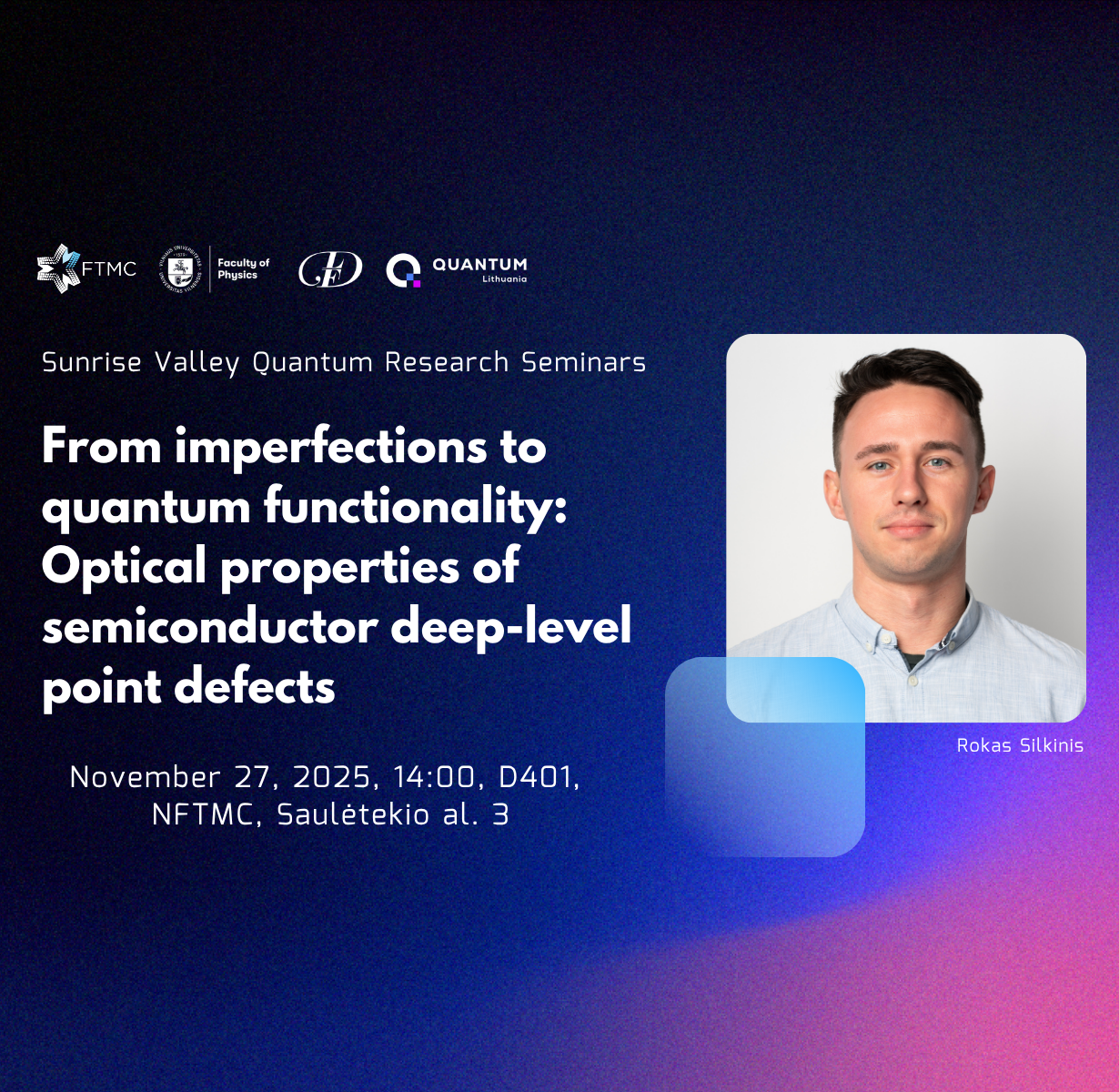
Point defects are atomic-scale imperfections in otherwise periodic crystals that strongly influence the electrical and optical properties of semiconductors. Once regarded as undesirable, these defects have become key building blocks of emerging quantum technologies, enabling applications in sensing, communication, and information processing.

Start time: 2025-11-04 14:00
End time: 2025-11-04 16:00

On November 4 at 2:00 PM in room LRC 306

Speaker: Prof. Yuri Gordienko (National Technical University of Ukraine “Igor Sikorsky Kyiv Polytechnic Institute” Ukraine)

Title: 3D Structure Manufacturing of Functionalized Optical Micro-Systems for AI-based Machine Vision Systems

Abstract:

The research aims to develop and validate 3D-manufacturing techniques for the integration of functionalized optical micro-systems directly on top of low-cost CMOS camera sensors, thus bridging the gap between high-performance optical microsystems and mass-market imaging technologies. The research embraces the following core aspects: design and fabrication of 3D micro-optical components (filters, lenses, metasurfaces, etc) using additive and hybrid lithographic processes; functionalization of these micro-structures by specialized processing, materials and their combinations (enabling illumination control, wavelength selectivity, etc.); integration with low-cost CMOS sensors (e.g., from smartphone cameras or industrial vision modules) using scalable alignment and bonding methods compatible with semiconductor packaging; and targeting for the functional prototypes for key use-cases (micro-robotic vision, bio-sensing, environmental monitoring, hyperspectral imaging, etc.). 

Start time: 2025-11-26 16:00
End time: 2025-11-26 17:00

On 26 November at 16:00 in room A101 at NFTMC

Speaker: Dr Adam Benjamin Morris (CERN, LHCb Experiment)

Abstract:

Computing is an integral part of modern high-energy physics experiments, and the required 
computing power grows rapidly with the volume and complexity of the data. This talk will give a pedagogical overview of the concepts and current state-of-the-art of computing at the LHC. It will also cover recent innovations, the challenges posed by the upcoming high-luminosity upgrade, and what the future may look like for the field.

Start time: 2026-08-25 14:00
End time: 2026-08-25 15:00

On August 25 at 14:00 in room D401, Saulėtekio ave. 3.

Speaker: Prof. Wei-Hung Chiang (National Taiwan University of Science and Technology, Taipei)

Seminar is organised by VU FPh Institute of Chemical Physics

Abstract:

Zero-dimensional (0D) nanostructures with tunable properties are at the forefront of materials research due to their critical roles in biomedical, optoelectronic, clean energy, and sustainable engineering applications. However, synthesizing such catalysts in a rapid, controlled, low-energy-consumption, and environmentally friendly manner remains a significant challenge. Here, we employ non-equilibrium, atmospheric-pressure microplasmas with tuned electron energies and densities to synthesize structure- and composition-controlled 0D nanostructures under ambient conditions—without the use of toxic chemicals, expensive processes, or complex vacuum technologies [1-4]. The reactive species generated by the plasma not only rapidly break down precursors into small molecular fragments but also simultaneously drive the formation of crystalline domains and catalyst nucleation. In this presentation, I will discuss plasma engineering strategies for tailoring catalyst synthesis. This work offers new insights into 0D nanostructures growth mechanisms through a renewable electricity-driven, scalable, and sustainable approach.

[1] Y.-J. Yeh et al., J. Am. Chem. Soc. 2025, 147, 8227. 

[2] M. H. Akmal et al., Small 2025, 21, e06831. 

[3] C.-H. Lin et al., ACS Appl. Mater. Interfaces. 2025, 17, 8147. 

[4] Y.-J. Yeh et al., ACS Appl. Nano Mater. 2021, 4, 6364.

About the speaker 

Prof. Chiang’s group is a partner in the joint Lithuania-Taiwan project conducted with spectroscopists from VU Institute of Chemical Physics and Center for Physical Sciences and Technology. His research focuses on non-equilibrium plasma chemistry and the synthesis of functional semiconductor nanomaterials, particularly through plasma–liquid interfaces that enable energy-efficient and low-temperature materials processing. His group develops plasma-enabled approaches for synthesizing quantum-sized nanostructures, including graphene quantum dots, nanographene materials, carbon nanotubes, and plasmonic–semiconductor hybrid nanostructures with tunable electronic and optical properties. A key direction of his research is the development of sustainable synthesis strategies, including plasma-enabled conversion of carbon-rich feedstocks, such as plastic waste and biomass, into functional nanocarbon semiconductors. His work aims to advance plasma-enabled approaches for bandgap engineering and electronic structure control in emerging semiconductor nanomaterials.

Start time: 2026-04-17 15:00
End time: 2026-04-17 17:00

Matas Plūkys, 

PhD student at Vilnius University, 17 April 2026, 15:00, at 306 auditorium, at the Laser Research Center (Saulėtekio ave. 10), Vilnius), will be defending his PhD thesis “Microchip Lasers with Spatial- and Polarization-Filtering Metamirrors“. Supervisor – Prof. Dr Kęstutis Staliūnas, consultant – Dr Darius Gailevičius.

The defence will be held in English.

Start time: 2026-05-04 11:00
End time: 2026-05-04 14:00

Ashutosh Sharma, PhD student at Vilnius University, 4 May 2026, 11:00, at A101 auditorium, the National Center for Physical Sciences and Technology (Saulėtekio ave. 3), Vilnius), will be defending his PhD thesis “Spectroscopic study of the planet-host stars“. Supervisor – Assoc. Prof. Dr Edita Stonkutė.

The defence will be held in English.

Start time: 2026-05-05 14:00
End time: 2026-05-05 17:00

Barkha Yakub Bale, PhD student at Vilnius University, 5 May 2026, 14:00, at A101 auditorium, the National Center for Physical Sciences and Technology (Saulėtekio ave. 3), Vilnius), will be defending her PhD thesis “Abundances of chemical elements in magnetically active stars“. Supervisor - Prof. (HP) Gražina Tautvaišienė.

The defence will be held in English.

Start time: 2025-12-05 15:00
End time: 2025-12-05 17:00

Jonas Banys, PhD student at Vilnius University, 5 December 2025, 15:00, at 306 auditorium, the VU FF Laser Reasearch Center (Saulėtekio ave. 10), Vilnius), will be defending his PhD thesis „Investigation of Optical Parametric Light Sources Pumped by the Subnanosecond Microlaser Pulses“. Supervisor - Assoc. Prof. Dr Vygandas Jarutis.

The defence will be held in Lithuanian.

Start time: 2025-12-12 14:00
End time: 2025-12-12 16:00

Vytautas Bubilaitis, PhD student at Vilnius University, 12 December 2025, 14:00, at A101 auditorium, the National Center for Physical Sceinces and Technology (Saulėtekio ave. 3), Vilnius), will be defending his PhD thesis “Spectral Characteristic of Molecular Aggregates at Various Intensities of Optical Fields“. Supervisor - Prof. Dr Darius Abramavičius.

The defence will be held in English.

Start time: 2025-12-15 14:00
End time: 2025-12-15 16:00

Jakov Braver, PhD student at Vilnius University, 15 December 2025, 14:00, at A101 auditorium, the National Center for Physical Sceinces and Technology (Saulėtekio ave. 3), Vilnius), will be defending his PhD thesis “Topological Phenomena In Driven Quantum Gases“. Supervisor - Prof. Dr Egidijus Anisimovas.

The defence will be held in English.

Start time: 2025-10-29 10:00
End time: 2025-10-29 12:00

On October 29 at 10:00 AM in A101 aud. (National Center for Physical and Technological Sciences, Saulėtekio ave. 3), Professor Jian-Jang Huang will give a public lecture "Nitride-based transistors – from lateral to vertical structure". He is a Distinguished Professor and Associate Dean of the College of Electrical Engineering and Computer Science, Graduate Institute of Photonics and Optoelectronics (GIPO), Department of Electrical Engineering National Taiwan University.

Subcategories

Page 2 of 5