

„Next-generation semiconductors are essential to meet the demands of advanced computing, AI data centres, modern communications, and quantum technologies“, says Vice-dean for Science and Strategic Development prof. Dr Pranciškus Vitta.
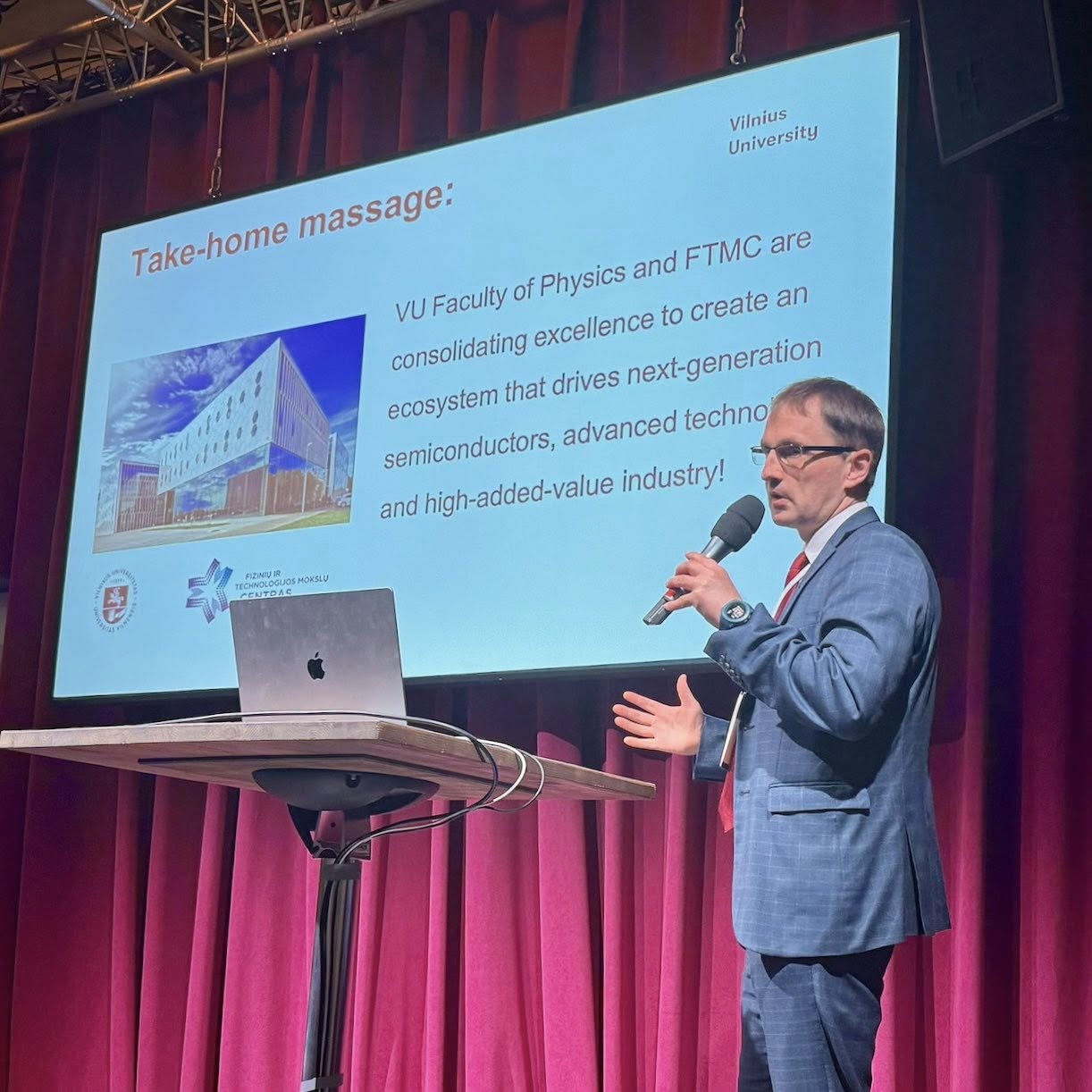
He has returned from Dresden, Germany, where at the international conference, Building Bridges 2025: Latest Findings in Artificial Intelligence, he emphasised that Lithuania aims to become an important player in shaping the future of semiconductors in Europe.
“Technological solutions for terahertz chips, hybrid photonic-electronic platforms, and advanced quantum-enabled devices are being investigated an developed right here in Vilnius, using cutting-edge materials. For years, the Faculty of Physics at Vilnius University has specialised in III–V compound semiconductors, particularly in photonics. We’re also developing modern structures like gallium (indium, aluminium) nitride (Ga(In,Al)N), scandium oxide (ScO) interlayer integration, and remote epitaxy via graphene, enabling flexible membranes,” he explains.
Vilnius University, together with FTMC and international partners, is launching the Competence Centre of Competence for Terahertz and Hybrid Semiconductor Chips. Furthermore the ChipsC² LT project with FTMC, VGTU and KTU is already started. These initiatives mark a significant step in strengthening Lithuania’s role in the European semiconductor ecosystem.