

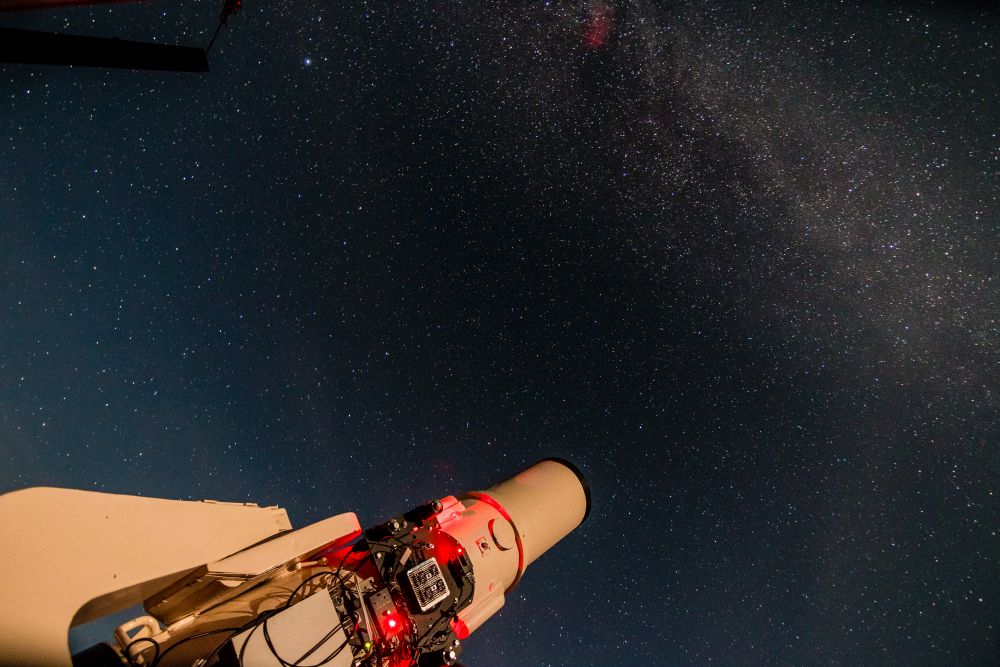
Photometry specialist Dr Erika Pakštienė from the Faculty of Physics at Vilnius University is participating in an international team aiming to reveal the physical properties of one of the reddest objects in the main asteroid belt, (269) Justitia. These studies included photometric observations carried out at the VU Molėtai Astronomical Observatory using the 35/51 cm Maksutov telescope.
(269) Justitia is a dark and unusually red asteroid orbiting between Mars and Jupiter. Its spectrum is so red that it resembles distant Solar System bodies (such as Centaurs or trans-Neptunian objects) than typical main-belt asteroids. It is thought that these colors are caused by complex organic compounds formed in cold regions of the early Solar System. It is therefore possible that Justitia formed far from the Sun and only later migrated into the main asteroid belt.
In one of the studies published in 2025, led by Prof. Dr Anna Marciniak (Poland), a very interesting method “thermophysical modeling” was applied. This required the use of light curves (including observations from Molėtai) together with infrared data from space missions. Thermophysical modelling is a method used in planetary science in which models are compared with observations to describe how a celestial body’s surface absorbs, conducts, and re-emits heat as it rotates and orbits the Sun. This approach allowed the researchers to determine the asteroid’s shape, rotation parameters, size, and surface properties with high precision, and to better constrain its diameter to approximately 55–60 km.
The second paper, published in "Astronomy & Astrophysics" and titled “Asteroid sizes determined with thermophysical model and stellar occultations,” was led by Dr Antoine Choukroun and combined thermophysical modelling with stellar occultation results. The study also relied on international photometric observations, including contributions from Molėtai, and provided robust, independent constraints on asteroid sizes and shapes, strengthening the physical characterization of objects such as (269) Justitia.
Key publications (2025):
Information by Vilnius University, Faculty of Physics, Institute of Theoretical Physics and Astronomy, Molėtai Astronomical observatory