

On 18 September, Ignas Lukošiūnas successfully defended his PhD thesis titled “Investigation of Laser Radiation Control via 2D Thin Film Guided Mode Resonance Filters”. Supervisor – Prof. Dr (full HP) Kęstutis Staliūnas.
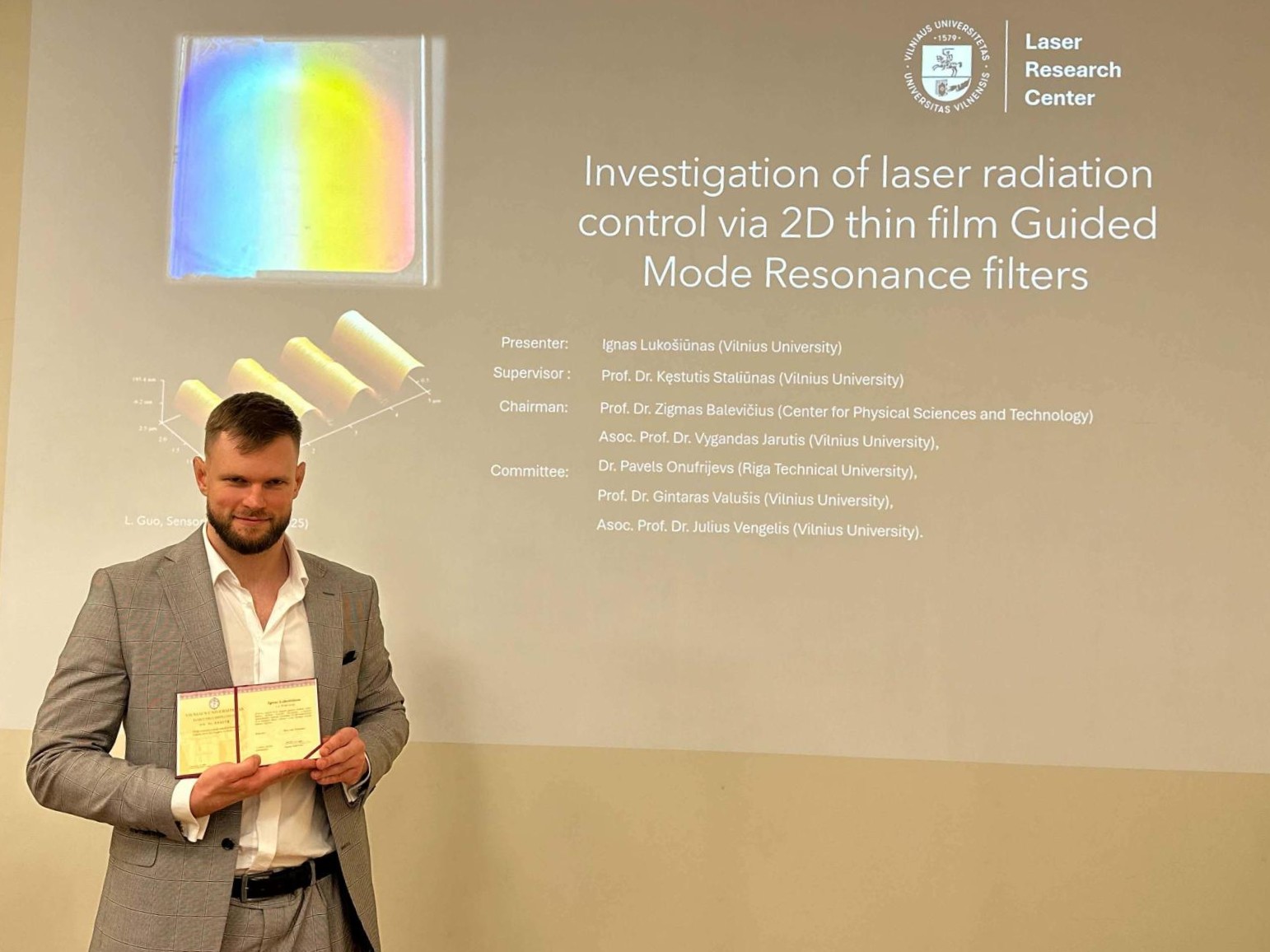 Light-to-matter interaction enhancement as well as light propagation control can be realised via guided mode resonance filters, which are thin films deposited on transparent Fused Silica gratings via Ion Beam Sputtering method. Guided mode resonance phenomenon is explored during the preparation of this thesis via analytical, numerical and experimental means. The thesis heavily incorporates numerical simulation of physical phenomena related to guided modes in the corrugated structures, whose resonant properties vary from low to high qualities.
“I explore how the interaction between light and matter can be enhanced through guided mode resonance, an effect in which light of a particular wavelength and angle couples into a periodically modulated thin layer of material and is directionally guided. Then the captured light remains in the waveguide long enough until it is slowly irradiated into the environment. The interaction with the material is enhanced far more strongly compared with bulky materials,” says Dr Lukošiūnas.
For the first time, broadband spectral filter in the narrow angular regime has been demonstrated, as well as its physical mechanism. Enhanced light-to-matter interaction is also achieved via implementing guided mode resonance in light-amplifying or light-absorbing materials that possess non-Hermitian and asymmetrical topological properties.
All these physical phenomena and devices were simulated using the open-source "ZenScat" interface, developed as part of the doctoral research. The software delivers computational speeds approximately twice those of comparable commercial packages, such as "MC Grating".
The findings could contribute to the development of more advanced optical filters, microlasers, sensors, and more efficient solar cells. Thesis abstract.