Arnoldas Solovjovas
Excitation-relaxation processes in cerium activated garnet scintillators
Cerium-activated garnet scintillators offer high light yield and compositional flexibility, yet the performance of real materials often remains below their intrinsic potential. Thesis aims to identify processes limiting emission efficiency and scintillation response of Ce-doped garnets through investigation of excitation-relaxation processes in materials obtained by different material-engineering strategies, including compositional modification, heavy aliovalent codoping, and two-step sol-gel composite fabrication. Materials were studied by photoluminescence, time-resolved photoluminescence, quantum yield and cathodoluminescence measurements under varied excitation and temperatures. It was shown that Ga incorporation in Y3(Al1−xGax)5O12 accelerates luminescence by lowering the barrier for thermal depopulation of the Ce3+ emitting state; x≈0.7 gives the best balance between emission efficiency and timing performance. In LuGAGG,Mg, heavy Mg codoping forms modified Ce3+-Mg2+ centres with a temperature-independent nonradiative channel and a lower thermal-quenching barrier, accelerating decay at the expense of quantum efficiency. Comparison of resonant and electron-beam excitation indicates that the efficiency loss originates mainly at Ce-related emitting centres rather than during excitation transfer. YAG, LuYAG, and LuAG grains embedded in silica retain Ce3+ emission and decay properties, supporting scalable, low-cost scintillator fabrication by a two-step sol-gel route.
Abdul Mannan Majeed
Multication CsZnPbI3 Perovskites for Solar Cells and Lasers
Metal halide perovskites are promising for next-generation solar cells and coherent light sources because of their strong absorption, tunable band gap, long carrier diffusion length, and low-temperature processing. This dissertation investigates Zn-alloyed cesium lead iodide perovskites (CsZnxPb1-xI3) as lead-reduced inorganic materials for solar cells and distributed feedback (DFB) lasers. CsZnxPb1-xI3 thin films were prepared by one-step spin coating, with and without polyvinylpyrrolidone (PVP), and characterized using optical spectroscopy, photoluminescence, time-resolved photoluminescence, laser-induced transient grating measurements, and structural analysis. Zn incorporation, especially x = 0.3 to 0.5, improved film quality, reduced defect-related recombination, and enhanced carrier transport. The optimized film showed a diffusion coefficient of 22 cm2 s-1 and a diffusion length of 0.43 µm. CsZn0.5Pb0.5I3 solar cells reached 10.3% efficiency, with JSC = 18.7 mA cm-2 and VOC = 1.01 V. Light-intensity analysis showed bimolecular recombination at high intensity, Shockley-Read-Hall recombination at moderate intensity, and dominant trapping losses at low light intensity. Adding 3% PVP in CsZn0.4Pb0.6I3 improved the morphology and stability of grating structure produced by Nd: YAG laser. The fabricated DFB lasers emitted at 709 nm with a 0.35 nm linewidth, a threshold of 55 µJ cm-2, and stability beyond 4 × 10⁸ pulses.
Marijus Ambrozas
Precision of the Drell-Yan process measurement with the CMS Phase-2 upgrade
The Drell-Yan (DY) process – annihilation of a quark and antiquark into a virtual photon or Z boson decaying into a pair of oppositely charged leptons – is one of the most important benchmark processes at hadron colliders. It allows precision tests of Standard Model (SM) predictions, refinement of proton parton distribution functions, and improved background modelling for new-physics searches. The High-Luminosity LHC (HL-LHC) upgrade will greatly increase the collected data volume, so the CMS detector – especially its Inner Tracker – must undergo a major Phase-2 upgrade to maintain performance under much higher radiation levels and pileup.
This dissertation presents a high-precision measurement of the DY differential cross section dσ/dm using the full CMS Run 2 (2016–2018) dataset, focusing on background estimation methods for misidentified leptons and top-quark production. It also describes preparatory work for the CMS Phase-2 Inner Tracker upgrade: calibration and performance studies of the RD53B-CMS (CROCv1) pixel readout chip prototype, and contributions to developing the Ph2-ACF software. Finally, Monte Carlo simulation is used to assess how the upgraded detector will affect future DY measurement precision under HL-LHC conditions, showing that muon reconstruction efficiency stays high while the resolution of key kinematic quantities improves significantly.

Ignas Lukošiūnas
Investigation of laser radiation control via 2D thin film Guided Mode Resonance filters
Light-to-matter interaction enhancement as well as light propagation control can be realised via guided mode resonance filters, which are thin films deposited on transparent Fused Silica gratings via Ion Beam Sputtering method. Guided mode resonance phenomenon is explored during the preparation of this thesis via analytical, numerical and experimental means. The thesis heavily incorporates numerical simulation of physical phenomena related to guided modes in the corrugated structures, whose resonant properties vary from low to high qualities. The former low quality resonances can be used to achieve broadband spectral reflection for a single, transverse electric, polarization, but has its angular response limited due to Rayleigh anomaly - critical wavelengths that provide additional diffraction orders. Such an effect is achieved via a single-layer waveguide, which can replace multilayer Bragg gratings in laser resonator systems. Furthermore, single-layer periodically modulated thin films near the Rayleigh anomaly exhibit asymmetrical-like spectral responses due to the photonic states being localised near the cut-off region where the electromagnetic field is freely propagating. Such resonances are expected to have a narrow-band spectral response, which is particularly useful for spectral filtering and also as polarisers. Furthermore, asymmetrical placement of absorbing materials on such structures enforces unidirectional guided mode propagation, which is enabled via non-Hermitian coupling between incident light and propagating guided modes. The main consequence is increased absorption of the structure, which is the most intense near Rayleigh anomaly. Such phenomenon can be applied for novel light absorbing elements, such as solar cells. Furthermore, if the thin film has optical amplification, high quality resonance can be tuned to enhance the fluorescent signal, which follows the resonant pattern in angular and wavelength range, given the fact that the resonance is able to modify peak fluorescence of the active material by a factor of nanometers. In turn, the angular response of the GMR is narrow in this case, and such devices can be applied in micro-lasing systems, amplifiers and active polarising spatial filters.
Evaldas Kažukauskas
Femtosecond laser ablation and surface roughness control
Femtosecond laser ablation is a precise and versatile method for shaping and modifying a wide range of materials. However, the process also alters surface texture, which can strongly affect the optical, mechanical, chemical, and functional properties of the fabricated components. Despite the growing use of femtosecond laser micromachining, surface roughness is still commonly treated as an unavoidable consequence of the process rather than as a property that can be deliberately controlled. A deeper understanding of surface texture formation is therefore essential for improving processing quality and expanding the industrial application of laser micromachining. The main aim of this dissertation is to investigate the physical mechanisms governing the formation and evolution of surface roughness during femtosecond laser ablation and to develop strategies for its precise control. Surface evolution is examined under different laser-processing conditions, scanning strategies, and initial surface states using spatial and spectral analysis methods. The results provide new insights into the factors governing surface roughness and demonstrate strategies for controlling it throughout multilayer laser processing, while the literature review offers a comprehensive overview of surface roughness and its accurate characterisation
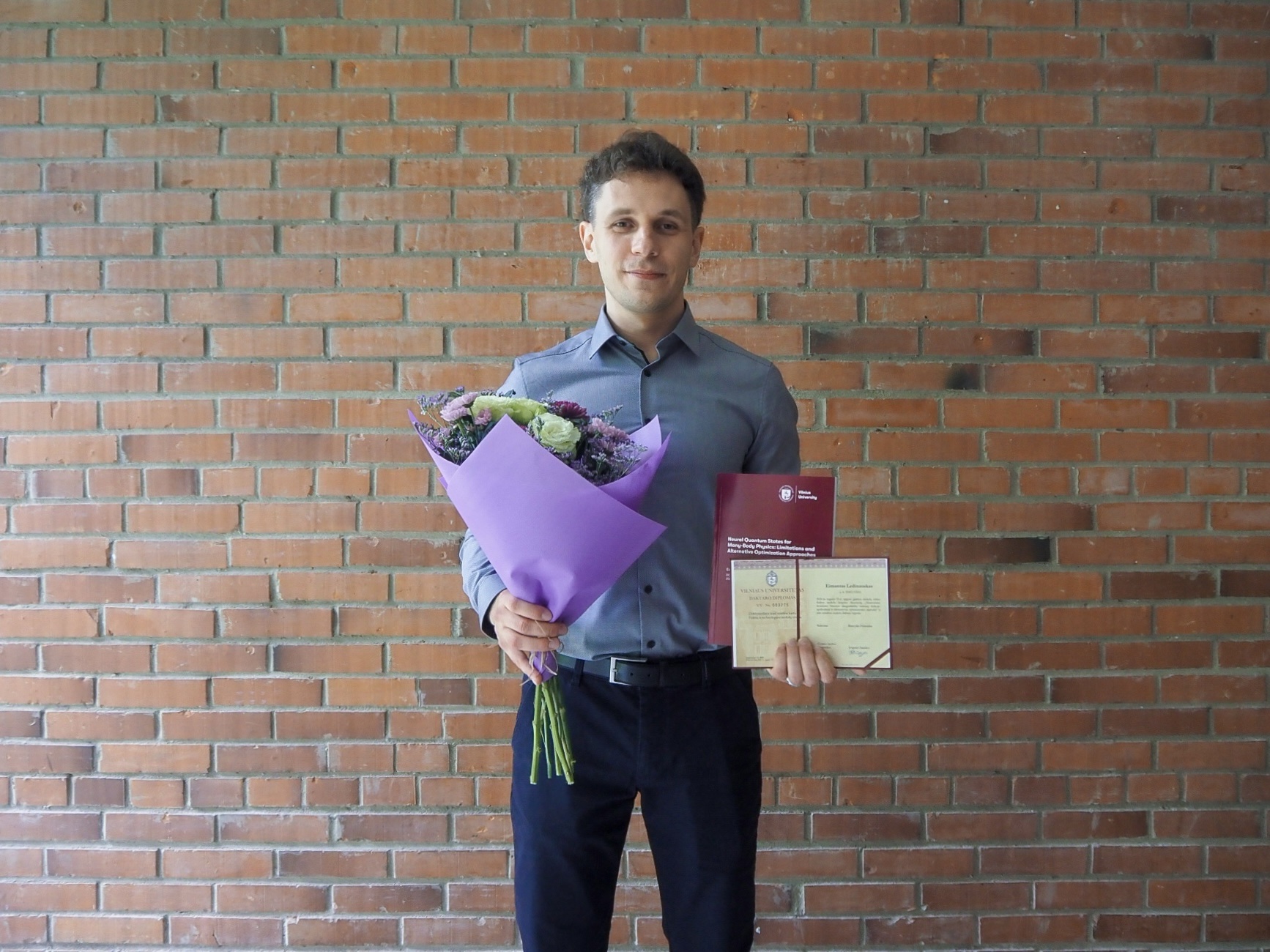
Eimantas Ledinauskas
Neural Quantum States for Many-Body Physics: Limitations and Alternative Optimization Approaches
Understanding interacting quantum particles is essential for explaining quantum materials, but an exact description quickly becomes computationally impractical as systems grow. Neural quantum states use neural networks to represent these systems compactly. This dissertation stress-tests this approach to diagnose limitations in representation, training and sampling. It also develops methods to improve the robustness and reliability of neural quantum states.
Two new methods are developed in this work. Supervised imaginary time evolution turns the search for the lowest-energy state into a sequence of learning tasks. It stabilises training in frustrated magnets and enables calculations with networks containing an order of magnitude more parameters. Neural importance resampling trains a separate network to propose configurations for estimating physical quantities. It enables simultaneous calculations of several low-energy states and accurately reproduces their energies in cases where conventional Monte Carlo sampling stalls.
The studies also expose significant limitations. For bosons in strong magnetic fields, the tested generic networks lose accuracy by orders of magnitude even when fitted directly to exact ground states. These comparisons remove sampling uncertainty and reduce dependence on the optimisation method, pointing to difficulties in representing the states compactly. In the toric code, a topologically ordered spin system, incorporating known physical structure and improving sampling, recovers the low-energy states on small systems, although training remains difficult at larger sizes. These findings guide the design of more dependable neural network methods for quantum many-body physics.
Barkha Yakub Bale
Abundances of chemical elements in magnetically active stars
This study investigates the influence of magnetic activity on the chemical composition and internal mixing processes in stars. Through a homogeneous high-resolution spectroscopic analysis of a sample comprising more than 50 magnetically active RS Canum Venaticorum (RS CVn) stars observed at Moletai Astronomical Observatory, Lithuania, complemented by a sample of eruptive stars observed at the Nordic Optical Telescope, we identify systematic deviations from the predictions of standard stellar evolution models.
The results show that in magnetically active stars, internal mixing processes can occur earlier than expected, as indicated by low carbon isotope ratios and unusual lithium abundances. These findings suggest that magnetic activity plays a key role in modifying the internal structure and evolution of stars. In contrast, the chemical abundances of eruptive stars remain consistent with predictions from standard stellar evolution, implying that their surface activity does not lead to significant modification of their chemical composition.
These findings demonstrate that magnetic activity plays a key role in altering the timing and efficiency of internal mixing in evolved stars, providing new insights into stellar evolution and chemical enrichment in the Galaxy.

Ashutosh Sharma
Spectroscopic study of the planet-host stars
This doctoral dissertation presents a comprehensive high-resolution spectroscopic study of planet-hosting stars aimed at investigating the connection between stellar chemical composition and planetary system properties. The analysis is based on a homogeneous sample of 160 F-, G-, and K-type stars with confirmed exoplanets, observed using the 1.65 m telescope at the Molėtai Astronomical Observatory and the Vilnius University Echelle Spectrograph.
Stellar atmospheric parameters were determined using a classical equivalent width method, followed by a detailed abundance analysis employing spectral synthesis technique. Stellar kinematics and ages were also determined to account for Galactic population and evolution effects. The study focuses on both light/α-elements (C, N, O, Mg, Si) and neutron- capture elements (Sr, Y, Zr, Ba, La, Ce, Pr, Nd, Eu).
The results show that elemental abundance patterns in planet-hosting stars largely follow Galactic chemical evolution trends; however, subtle but statistically significant differences are identified. Enhanced Mg and Si abundances, variations in C/O and Mg/Si ratios, and systematic trends in neutron-capture elements provide insights into planetary composition and formation environments. Statistical analyses reveal correlations between stellar elemental abundances and planetary mass, particularly in giant stars with planets. Trends between condensation temperature and abundance differences further suggest that refractory-element enrichment may act as a chemical signature of planet formation.
Overall, this dissertation strengthens our understanding of the chemical link between stars and their planets by combining detailed chemical abundances with stellar metallicity, ages, kinematics, and planetary properties, thereby providing observational constraints that are crucial for refining models of exoplanet formation and internal composition.

Matas Plūkys
Microchip Lasers with Spatial- and Polarization-Filtering Metamirrors
This dissertation investigates microchip lasers incorporating meta-mirror structures for spatial and polarization filtering. The main objective is to improve key output parameters, including brightness, beam quality factor (M²), and polarization contrast. Experimental results demonstrate enhancement of brightness and beam quality using angularly selective meta-mirrors, as well as improved polarization control and increased polarization contrast ratio at high pump powers. A practical theoretical model based on two-dimensional linear field equation is developed to describe the evolution of the beam quality factor M² in multi-mode operation. Numerical simulations support the experimental findings and confirm the general applicability of the proposed approach. The results indicate that meta-mirror-based microchip lasers are a promising solution for compact, high-brightness laser sources in applications such as industry, medicine, sensing and others.