

Congratulations to Abdul Mannan Majeed on the successful defence of his PhD thesis in Physics, titled “Multication CsZnPbI3 Perovskites for Solar Cells and Lasers”. Supervisor – Dr Patrik Ščajev.
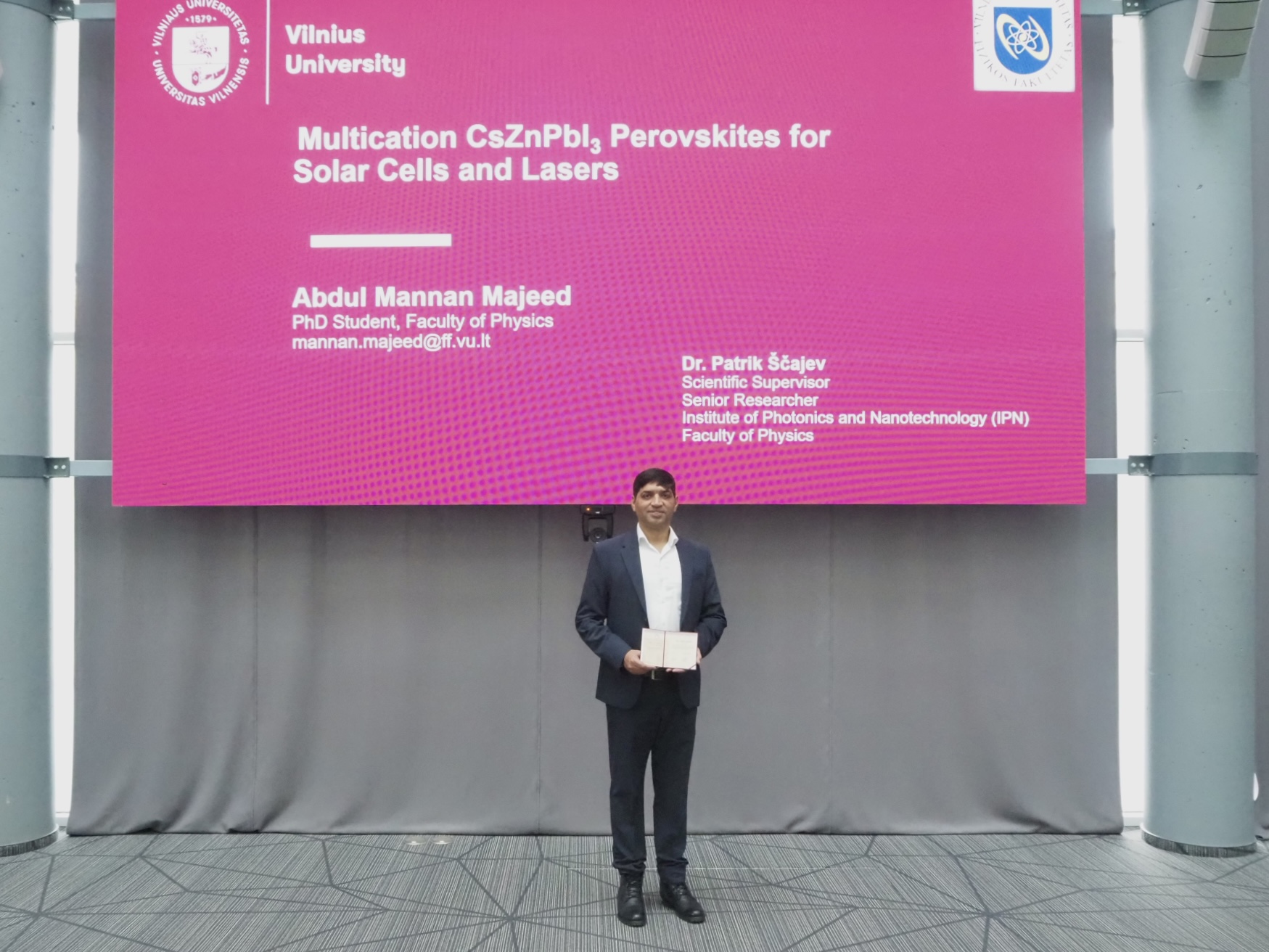
"Metal halide perovskites are attracting growing attention because they absorb light strongly, are relatively easy to synthesize, and can be deposited by spin coating. These advantages make them highly promising for optoelectronic devices. In my thesis, I studied how replacing part of the lead with zinc affects their performance in solar cells and lasers”, says Dr Majeed
The band gap of these materials can also be tuned, and charge carriers diffuse over long distances. The inorganic cesium lead iodide perovskite thin films studied in the thesis were prepared by one-step spin coating and characterized using optical spectroscopy, time-resolved photoluminescence, laser-induced transient gratings, and structural analysis.
Zinc incorporation improved thin-film quality and charge carrier transport and reduced defect-related recombination. Solar cells made from these films reached an efficiency of 10.3%. Light-intensity analysis showed that bimolecular recombination dominates under strong illumination and Shockley–Read–Hall recombination at moderate intensity, while weak light losses are mainly caused by charge carriers becoming trapped at defects.
The grating required for distributed feedback (DFB) lasers was formed in the film with an Nd:YAG laser, and adding 3% of the polymer polyvinylpyrrolidone (PVP) improved its morphology and stability. The resulting lasers emitted light at 709 nm with a linewidth of 0.35 nm and maintained their performance for more than 400 million pulses.
The findings could be useful for developing solar cells and lasers that contain less lead.