

'European universities don’t hand out honorary doctorates left and right. If you’ve been given one, it means you’ve really accomplished something,' smiles Prof. Saulius Juodkazis, the newest honorary doctor of Vilnius University (VU).
On October 6, at a ceremonial session of the VU Senate held in St. John’s Church, the university awarded honorary doctorates to several distinguished scholars, including Prof. Juodkazis. His impressive career spans multiple countries and even continents. After a decade in Japan, the physicist has spent the past 17 years leading a nanotechnology center in Australia. He says that, despite the distance, he has never lost touch with Lithuania and its scientific community. The scientist continues to collaborate actively with the Laser Research Center at the VU Faculty of Physics.
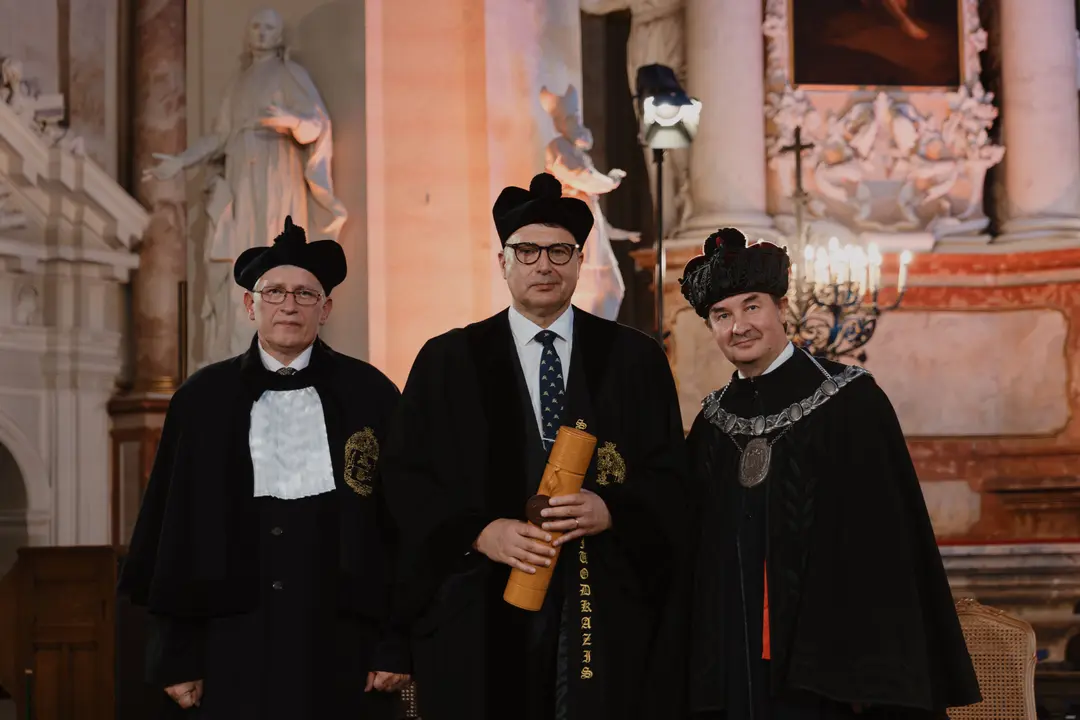
Photo credit: Tomas Laurinavičius / VU
Beginnings in a time of upheaval
Asked how and why he chose a life in science, Prof. Juodkazis simply shrugs and says that he followed his passions. In school, the future scientist excelled at math and even attended a specialized math class. He calls mathematics the language of science, one that lets you work on a huge range of problems once you can speak it. This universal language eventually led him to physics.
'My parents were scientists themselves, but they never tried to steer me in any particular direction. They let me decide for myself, so I went where I found it most interesting. My student years coincided with a time of great change. I spent a few years in the Soviet army, and in the end, I got to see an independent Lithuania,' he recalls.
Those years were sometimes chaotic, but the honorary doctor is glad that he met several teachers who inspired him, set him on the right path, or simply offered human support.
'I was lucky to meet many remarkable people. The formulas that someone like Professors Julijonas Jonas Kaladė and Viktoras Šugurovas could derive straight from memory were astonishing. Professor Juozas Vidmantis Vaitkus and Mindaugas Petrauskas also helped me enormously with their support. I remember that in the early years of independent Lithuania, when an opportunity came up to do joint doctoral studies at the University of Lyon, they urged me not to hesitate and to take it,' says Prof. Juodkazis.
A turn towards Japan
Prof. Juodkazis’ dissertation, 'Optical Properties of Thin Films,' remains special to this very day. Not only for its content, but because it was the first in the country to be defended at two universities at once, Vilnius and Lyon. It’s hardly surprising that world-class universities took an interest in a young scientist. One of them was the University of Tokushima in Japan.
Having grown up in the Soviet Union, Prof. Juodkazis says, his grandparents’ stories of traveling freely around Europe as students sounded like science fiction. The wish to experience something similar was one of the key reasons why he was so eager to test himself in an international setting. The decision to move, of course, wasn’t easy.
'I was given a chance to work in a truly modern country, and opportunities like that don’t come often. My wife and I talked for a long time about what to do. Our older son was just about to start first grade, and it was a little scary to think how it would all work out. But in the end, we decided to go. There was an adjustment period, of course, but since everything was so fascinating and exciting, we settled in fairly quickly,' recalls Prof. Juodkazis.
All in all, he spent more than ten years in Japan, first at Tokushima and then at Hokkaido University. Conditions for research there were nothing short of perfect. The professor says that, when he first arrived, he found more lasers in a single laboratory than in all the Baltic states combined. Eventually, Prof. Juodkazis rose to associate professor, but at the end of his tenure, he felt ready for a new adventure.
'Around that time, headhunters contacted me and told me about an opportunity to set up a nanotechnology center in Australia. If I’d come across that job description myself, I probably would have thought, ‘This isn’t for me, it’s too daunting.’ Luckily, they came to me, so they knew what I did, what I was capable of, and how to talk to me. That put me at ease. I realized there was nothing to be afraid of. You just have to try,' says the VU honorary doctor.
The bond with Lithuania never went away
So, seventeen years ago, Prof. Juodkazis joined the Optical Sciences Center at Swinburne University of Technology (originally the Center for Micro-Photonics), where he still conducts cutting-edge research that may one day help treat cancer patients and solve energy problems.
'Before taking this job, I used to travel to all sorts of trade shows and think a lot about what could be done with the instruments on display. The picture gradually came together. My vision was to create technologies with 3D capabilities. That’s how we ended up with a femtosecond laser in our lab that is also a 3D printer. Our goal has always been to create next-generation, nanoscale devices,' the professor says of the start of his career in Australia, highlighting advanced 3D lithography technologies.
Today, he feels firmly rooted in Australia. Yet his connection to Lithuania has endured all these years. He has written and published many joint papers with VU scientists, runs international projects with them, and helps to get funding from prestigious research foundations. Students and researchers also regularly travel between Lithuania and Australia. The Faculty of Physics especially values Prof. Juodkazis’s mentorship and his contribution to training young scientists. This long and successful collaboration has helped spread scientific knowledge worldwide and established VU as a leader in laser technologies and micro- and nanostructure fabrication.
'Lithuania is truly strong in these fields. We have many talented specialists who use the most modern equipment to do truly cutting-edge research. As for myself, I feel useful to Lithuania even from afar because I can contribute through my contacts and my help. And when I come back, I always feel as if I’d hardly been away. The surroundings are so familiar. I walk down a street in Vilnius and remember everything. A lot has changed, but it all still feels known. Whenever I’m back, I call my friend Arūnas and say, ‘Let’s meet at the spot that we were guarding in 1991.’ And we both know exactly where that is,' says Prof. Juodkazis.