

Congratulations to Arnoldas Solovjovason the successful defence of his PhD thesis in Physics, titled “Excitation-relaxation processes in cerium activated garnet scintillators”. Supervisor – Dr Saulius Nargelas.
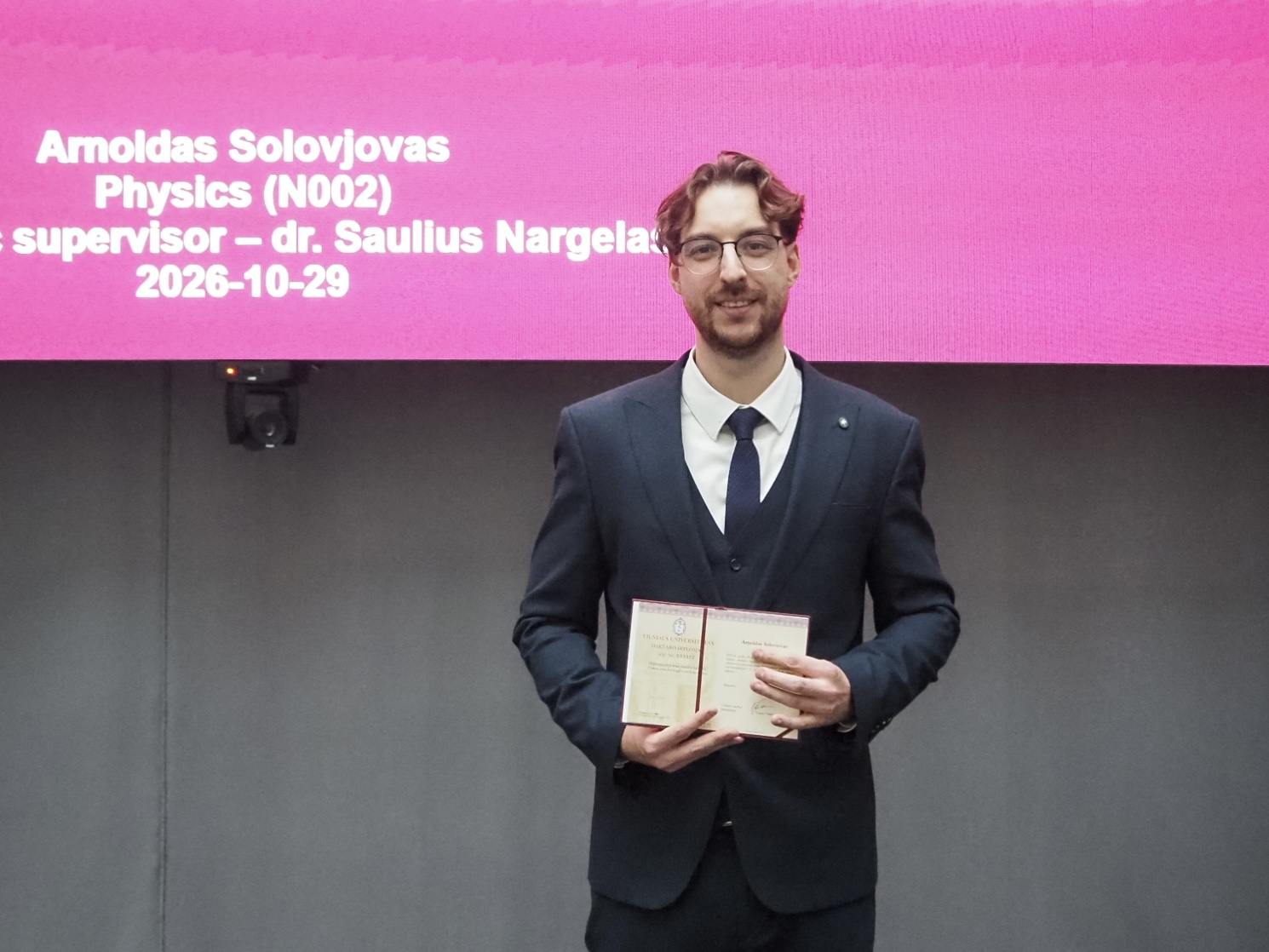 “Scintillators are materials that convert high-energy radiation into visible light. They are used in medicine and in particle physics experiments. In my thesis, I studied garnet-structure scintillators – synthetic crystals with a garnet-type crystal structure, in which added cerium ions emit the light. They have a high light yield, but they do not always achieve their full potential,” says Dr Solovjovas.
The chemical composition of such crystals can be varied widely. The thesis examined how the properties of these scintillators change when the material’s composition and structure are modified. It focused on two properties that affect how well radiation detectors work: how much light a scintillator emits and how quickly that light fades. These were measured by exciting the materials with light and with an electron beam at different temperatures.
The results reveal processes that determine the speed and efficiency of light emission. For example, adding gallium to yttrium aluminium garnet made the light flashes faster, but part of the energy turned into heat instead of light. The best balance was achieved when about 70% of the aluminium was replaced with gallium.
In another, more complex garnet, a large amount of magnesium had a similar effect: the flashes became shorter, but less light was produced. The energy was found to be lost mainly at the Ce-related emission centers rather than on its way to them.
The research also showed that lower-cost composite scintillators produced by a sol-gel method – garnet grains embedded in silica – can preserve key optical properties. This opens the way to producing scintillators more cheaply.
The findings contribute to a better understanding of the processes that limit scintillator performance and may support the development of faster and more efficient radiation detectors.