

2025- 2028 Parahydrogen-induced polarization for enhanced target sensing, LMT S-MIP-25-24
Principle investigator: dr. Laurynas Dagys
Nuclear Magnetic Resonance (NMR) spectroscopy is one of the most versatile tools in the physical sciences, capable of providing rich, multidimensional information across all phases of matter. However, its widespread utility is constrained by inherently low sensitivity, which is typically addressed through costly superconducting magnets and advanced detection electronics — significantly raising both acquisition and maintenance expenses. This present the questions whether more cost-effective technique can be developed. This project, PARASENSE, presents a low-cost methodology for enhancing NMR sensitivity through indirect target sensing. This approach utilizes often neglected magnetic interactions between sensing and target compounds, enabling detection with standard NMR instrumentation. While earlier implementations of such techniques achieved limited practical gains, PARASENSE will integrate cutting-edge parahydrogen-based hyperpolarization protocols to overcome previous barriers. The methodology will be validated in a fully automated setup, offering a potentially viable solution for more accessible and efficient NMR analysis. Project PARASENSE idea.
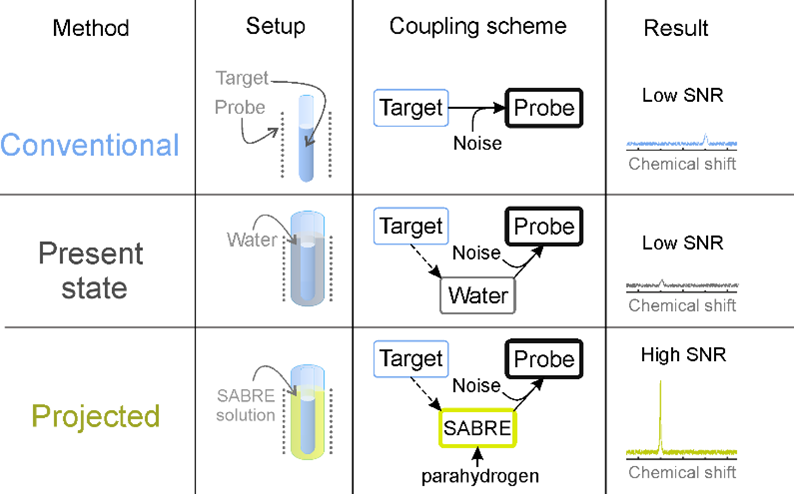
Project PARASENSE idea.
2023 – 2026 Elucidation of the aqueous ELEctrochemical deGRAdation and aging processes in NASICON-Type materials: towards in situ NMR (ELEGRANT), funded by Research Council of Lithuania, S-MIP-23-47.
Principle investigator: dr. Vytautas Klimavičius
The current shift towards more sustainable energy and materials systems requires significant development in energy conversion and storage technologies based on non-critical materials. Alternative technologies, such as aqueous Na-ion batteries could solve many of the mentioned issues due to their safety, cost and sustainability at the expense of reduced energy density which is less important for stationary power grid stabilisation applications. Project ELEGRANT aims to contribute to the field of sustainable energy conversion. This will be achieved by developing NASICON-structured (Na Super Ionic CONductor) materials for the electrochemical applications. For the successful application of NASICON based materials in technologies such as battery electrode materials, separators for redox flow and seawater batteries, or as insertion hosts for capacitive deionization cells, the understanding of the relation between molecular structure and macroscopic properties is an essential factor. In order to elucidate structure - properties relations, experimental investigations using various techniques are required. Solid-state NMR among other methods has a handful of experimental techniques allowing to reveal fine details on studied materials. It provides information on the molecular level and allows to detect all crystalline and amorphous species in the studied systems which is often an issue for other techniques. Among development of NASICON-based materials for electrochemical applications, project ELEGRANT aims to perform extensive solid state NMR based investigation on these materials which include ex-situ and in-situ approaches employing MAS, MQMAS, REDOR-type, wideline methods. The obtained data will contribute for the application of NASICON-based materials in battery technology as well as the development of solid state NMR methodology for studying such type of functional materials.
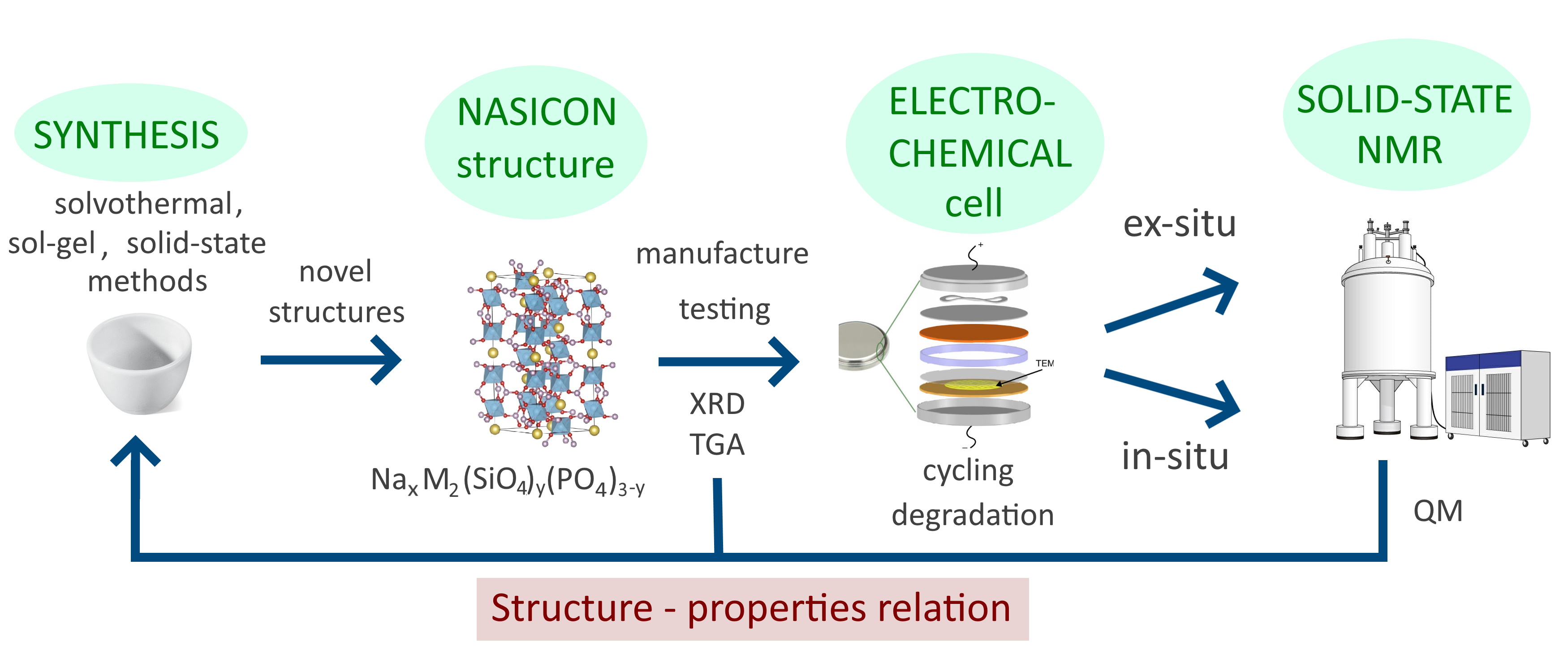
Project ELEGRANT idea.
Publicationss:
-
Multinuclear Solid-State NMR Study of the Aqueous Solid-Electrolyte Interphase Formation in NaTi2(PO4)3, ACS Applied Energy Materials, 2024, 7, 24, 11665–11669
-
Minimal liquid-assisted method for synthesis of ammonium, sodium, and potassium intercalated zirconium hydrogen phosphate: the effect of the cation used on the formation of an α- or γ-structure, Dalton Transactions, 2026, 55, 885-893
-
Probing the Aqueous Electrochemical Degradation in NASICON-structured Na2.5V1.5Ti0.5(PO4)3 by Multinuclear NMR through the Interplay Between Paramagnetic and Diamagnetic Vanadium Ions, Chemistry of Materials, 2026, submitted https://chemrxiv.org/doi/full/10.26434/chemrxiv.15001740/v1
2023 – 2026 Phase transitions in calcium phospates, funded by Research Council of Lithuania, P-MIP-23-134.
2022 – 2023 Garnets as self-enhancing systems for Dynamic Nuclear Polarization (DNP), funded by the internal Vilnius University funds for the promotion of science.PI- dr. vytautas Klimavičius
2022 – 2025 Modeling of structural and NMR parameters of bioactive ionic liquids, funded by Research Council of Lithuania, P-MIP-22-359.
2021 – 2022 Synthesis of novel whitlockite type calcium phosphates and their characterization using solid state NMR and EPR methods, funded by the internal Vilnius University funds for the promotion of science.
2020 – 2022 Synthesis and NMR crystallography of novel supramolecular aggregates, funded by Research Council of Lithuania, 09.3.3-LMT-K-712-19-0022.
2019 – 2022 New Generation Materials for Light Technologies: Frontier Research on the Correlation of Optical Properties and Structure for the Purposive Synthesis (NEGEMAT), funded by Research Council of Lithuania, S-MIP-19-59.
2018 Modern trends in solid-state NMR and spin dynamics: towards non-destructive polarizing agents for DNP, funded byBaltic States - German Liaison Office.
2016 – 2017 NMR and vibrational spectroscopy of molecular and ionic nano-clusters in aqueous solutions of lyotropic liquid crystals, funded by the Research Council of Lithuania, TAP-LU-15-017.
2013 – 2015 Synthesis and Characterization of New Materials for Semiconductor- and Nano-Technologies by Means of Continuous and Ultrafast Spectroscopic Methods, funded by the European structural funds, VP1-3.1-ŠMM-08-K-01-004/KS-120000-1756.