Congratulations to Dominyka Stonytė, the New Doctor of Physics
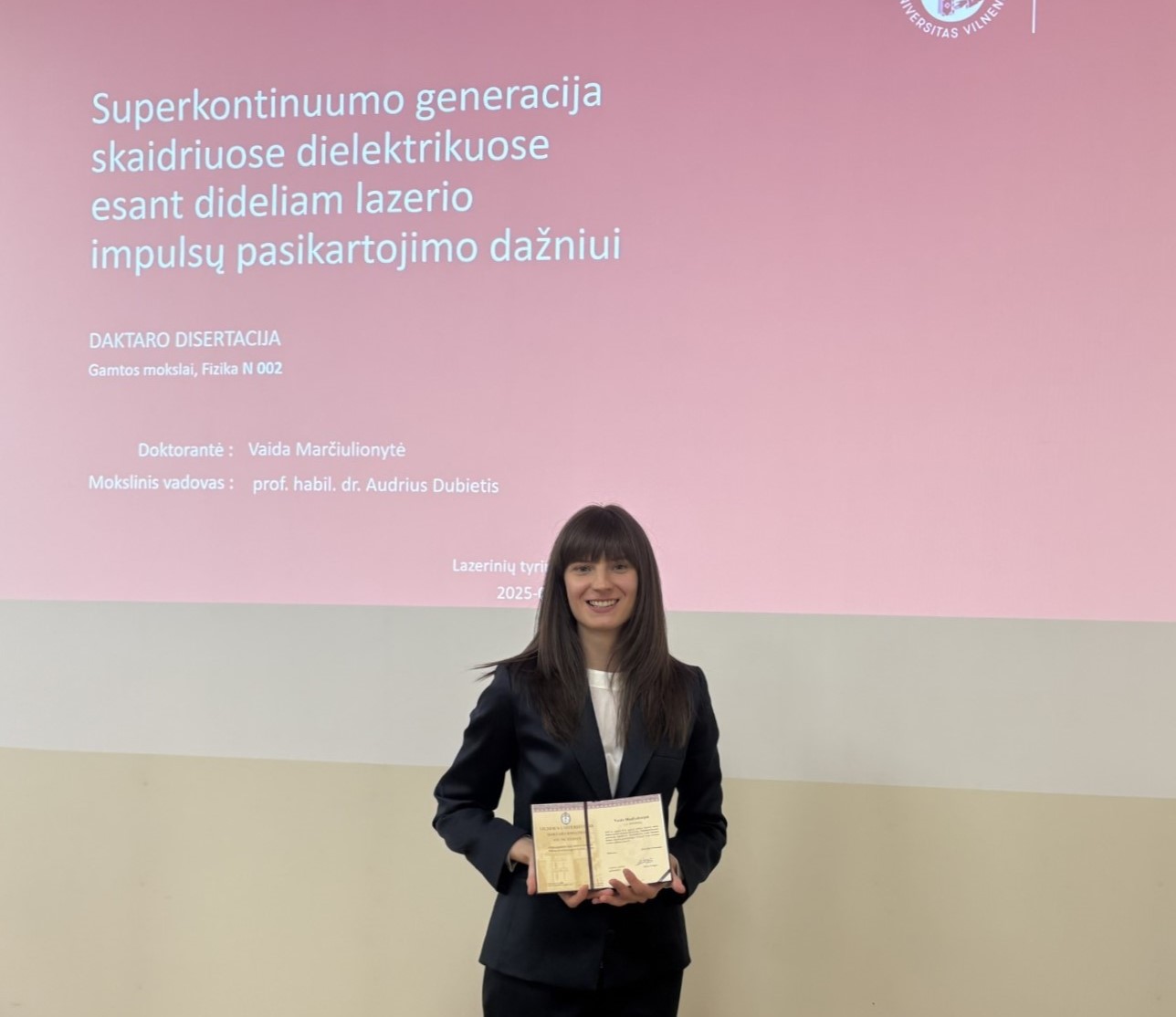
Dominyka Stonytė successfully defended her PhD thesis "Ultrashort UV pulse-material interaction for laser microfabrication applications."
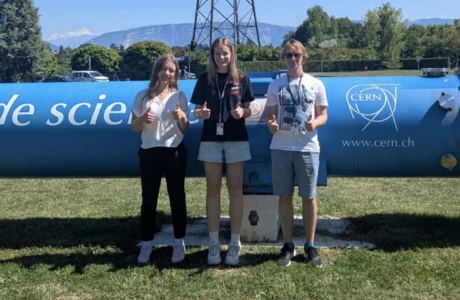
Last week, Vilnius University (VU) hosted the International School on Trigger and Data Acquisition ISOTDAQ2025. The event, based on the expertise of the European Organisation for Nuclear Research (CERN), brought together nearly one hundred participants.
On 26–27 June, during a visit to Vilnius University (VU) by a delegation from France’s Sorbonne University, its President, Prof. Nathalie Drach-Temam, was presented with a printed replica of the Sorbonne University Chapel, which appears as a mere dust particle to the naked eye. The special gift was created by Dr Gordon Zyla, a senior researcher at the Laser Research Center of the VU Faculty of Physics and a former Marie Skłodowska-Curie Postdoctoral Fellow.
Vilnius University (VU) has been ranked 446th in the newly released QS World University Rankings – its position among the top global institutions assessed from nearly 7,000 universities across 106 countries, marking the most comprehensive edition in the ranking’s history. VU retains its status as the top university in Lithuania.
From 23 to 27 June, the Vilnius Town Hall will host the Central European Workshop on Quantum Optics (CEWQO), organised by Vilnius University (VU) and the Lithuanian Physical Society. This significant international conference will bring together over 200 scientists, researchers, and experts in quantum technologies.
On 17 June, the graduation ceremony of the VU Faculty of Physics took place at the Church of St. John's.
This seminar will present how cold atoms and topological phenomena are merging into one of the most exciting research areas in modern physics. Using cold atoms in optical lattices, scientists can simulate topological phases in materials - from topological insulators and superconductors to the Quantum Hall effect. Such models allow the study of edge states, quantum responses and new quantum phases of matter that do not exist in ordinary materials.
Scientists from Vilnius University (VU) Faculty of Physics, together with colleagues from Poland and other countries, have identified an exoplanet – a gas giant located far from the Galactic Centre. This is only the third such discovery in the entire history of observations. The discovery is even more exceptional due to the method used – the phenomenon known as microlensing. The results of the observations have been published in one of the most prestigious astronomy journals “Astronomy & Astrophysics”.
Vilnius University (VU) hosts an international school on trigger and data acquisition ISOTDAQ2025 on June 17-26, 2025. Around one hundred participants from different countries will attend the event that shares experience from the European organization for nuclear research (CERN).
The graduation season is just around the corner, when St Johns’ Church and other venues chosen for the official diploma-awarding ceremonies will be filled with the joyful bustle of graduates. As we approach this celebration, please be reminded that you are welcome to wear a VU cap during the ceremony.
Dr Mindaugas Šarpis, a researcher at the Institute of Photonics and Nanotechnology, Faculty of Physics, Vilnius University (VU), and leader of the LHCb Vilnius group, has been awarded a prestigious ERA Fellowship grant under Horizon Europe funding programme for his postdoctoral research. The funding, amounting to almost 200,000 Eur will strengthen Lithuania’s competences in particle physics and lay the foundations for further research at VU.
We are pleased to invite the graduates of the Faculty of Physics, their relatives and members of our faculty community to the graduation ceremony.
Arqus is glad to launch a joint call for Blended Intensive Programmes (BIP) and a call for Arqus Twinning 2.0 projects. These two calls are aimed at academic staff to reinforce the collaboration between the members of the Alliance and to propose short-term mobility opportunities for students and staff.
Lithuania stands out globally for its rapidly developing light technology industry, with lasers playing a key role in this important ecosystem. The laser infrastructure at Vilnius University’s (VU) Faculty of Physics is equally renowned for its international outlook and open science practices. Long-standing collaboration between the academic community and industry here drives innovative solutions.
For her contributions to astrophysical science and the development of astrospectroscopy, initiation of exoplanet research in Lithuania, dissemination of knowledge on the understanding of the Universe, and for promoting the name of Lithuania in the world, she was awarded with the Ignotas Domeika Medal and became an honorary member of the Lithuanian Ignotas Domeika Society.
Would you like to expand your knowledge on bioelectronics, biophotonics and biomechanics? Do you love a diverse environment of international scientists?
Quantum physics, with its mysterious phenomena, raises more and more questions about the nature of reality – from Schrödinger’s cat, which is both alive and dead at the same time, to quantum teleportation that transmits quantum states without transferring any physical matter.
On May 30 Vadzim Horonin successfully defended his thesis “Pulsed Laser Deposition and Broadband Dielectric Spectroscopy of Complex Perovskite Materials”.
From June 27 to 29, a team of six astronomers from our Faculty of Physics, led by Dr Šarūnas Mikolaitis, travelled to Warsaw to meet with Polish colleagues as part of the first in person scientific meeting of the project “The History of C, N, and O in the Galaxy”.
Researchers at the Institute of Photonics and Nanotechnology of Vilnius University (VU) Faculty of Physics, including Dr Irina Buchovec and PhD student Gabrielė Vasiliauskaitė in collaboration with Master student Nojus Radzevičius from the Faculty of Chemistry and Geosciences, are exploring how light-based technologies can help combat harmful microorganisms.