Sidebar

“Open Readings” conference organisers announce award opportunity to celebrate the outstanding achievements of physics and science students – the “Open Readings Research Excellence Award”.

The award will be presented in two categories: undergraduate/graduate and doctoral students.

Applications must be submitted by February 9, 2026.

Arqus and the IDea_Lab, from the University of Graz, invite the Arqus community to an online event on the topic of AI in research university education. The event will bring together experts from across Europe to discuss practical AI applications in higher education, as well as key challenges related to ethics, governance and academic integrity.

On February 19 at 15:00 at VU Library’s Scholarly Communication and Information Centre (MKIC), Saulėtekio ave. 5, Orlando Naranjo, a distinguished astronomer, will give a public lecture "Frontiers of Deep Space: From Near-Earth Asteroids to Interstellar Voyagers".

In December, students from the Faculty of Physics at Vilnius University (VU) participated in a two‑week Taiwan–Europe Semiconductor Short‑Term Training Programme. Senior undergraduates Adomas Puluikis, Kasparas Stanaitis, Master’s student Karolina German, PhD students Kęstutis Žilinskas and Domantas Vizbaras gained experience in the field of semiconductors together with colleagues from Lithuania, Romania, Slovakia, Italy, the Czech Republic, and Kosovo.

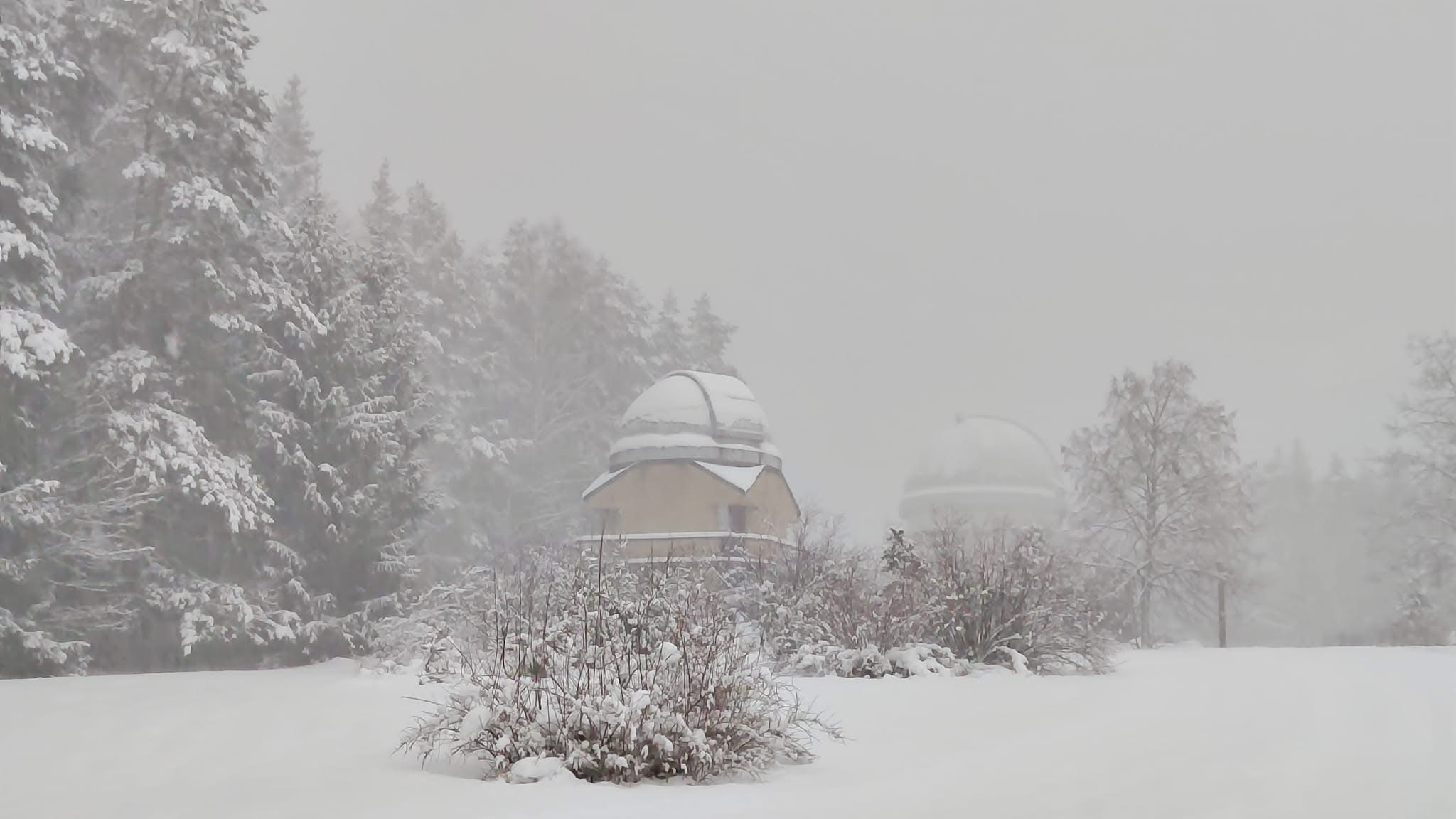
In 2026, we will mark the 150th anniversary of Jeronimas Ralys (1876–1921), a doctor, translator, and prose writer. Dr Kazimieras Černis, a researcher at the Institute of Theoretical Physics and Astronomy at the Vilnius University (VU) Faculty of Physics, named an asteroid discovered together with Dr Justas Zdanavičius at the VU Molėtai Astronomical Observatory after him.

On December 17, the Faculty of Physics held a pre-Christmas celebration to mark its 60th anniversary. The evening began with a shared expression of gratitude – more than sixty members of the Vilnius University (VU) community, including colleagues, alumni, and students, actively contributed to the organisation of the anniversary events. Together, they revived stories from recent memory and created new ones.

On December 18, Vilnius University hosted a ceremonial festive evening - “Farewell to 2025.” During the event, distinguished members of the VU academic community were awarded, including representatives of the Faculty of Physics. Guests of the evening were welcomed by the Rector of Vilnius University, Prof. Dr Rimvydas Petrauskas, Chair of the Senate Prof. Dr Eglė Lastauskienė, and Chair of the Council Dr Marius Jurgilas.

This online courses are designed to help participants lay the foundation of a language, helping them every step of the way. The sessions consist of two-hour interactive online lessons once a week with an experienced tutor.

The Research Council of Lithuania (RCL) is launching its annual call for student summer research internships and announces the first stage of the process. Research and higher education institutions, together with internship supervisors, are invited to propose internship topics for prospective interns. Topics selected by RCL from various fields will then be available for students wishing to undertake a research internship in the summer of 2026. Proposals for topics should be submitted by January 9, 2026, at 15:00..

“Astronomers and cosmologists are fortunate to work in a field that inspires great fascination. People want to learn about the universe – it’s their universe,” says Prof. Vicent J. Martínez, a leading Spanish astronomer and cosmologist known for his research on galaxy clustering and the large-scale structure of the universe.

Prof. V. J. Martínez is also a gifted science communicator, recognised for making complex cosmic ideas accessible to the public – a mission he continues during his first visit to Lithuania and to Vilnius University (VU).

Although astronomers have long been able to observe other galaxies, the structure of our own – the Milky Way – remains not entirely clear. This is largely because we live within the Galaxy itself, making it particularly difficult to observe its central regions, which are obscured by dense clouds of dust.

On 1 December, an event of the Doctoral Integration Day took place in the spaces of the Vilnius University Life Sciences Centre (VU LSC). Several dozen VU doctoral students from various fields of science participated in it, most of them were first-year students. The event was organised in English, also including the international VU doctoral community.